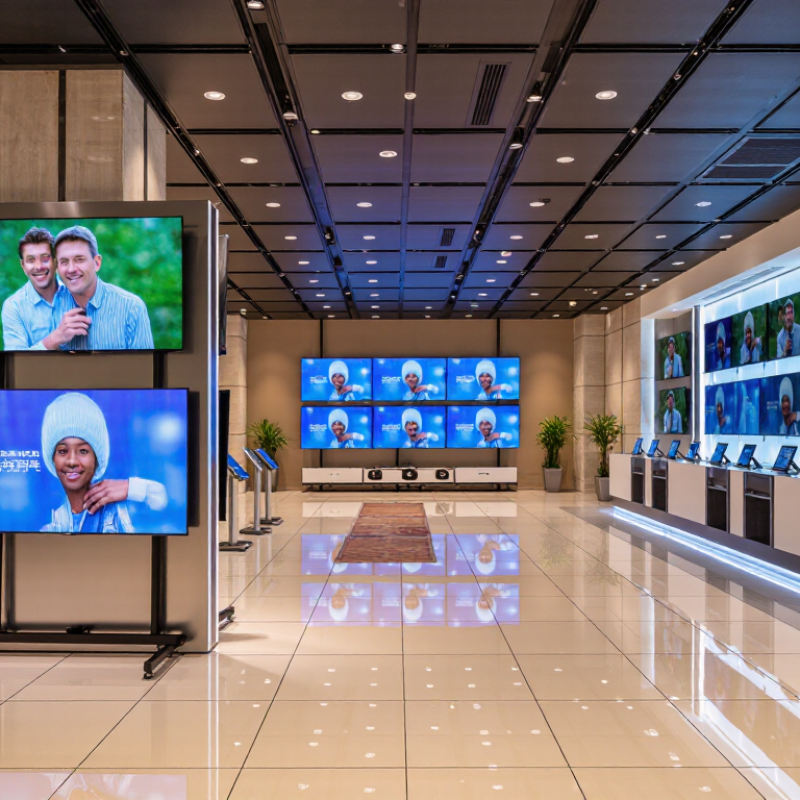
| Product definition | A professional large-format display designed for business, public, hospitality, retail, education, and institutional environments. | Commercial models are generally built for longer operating schedules, centralized management, and more demanding installation conditions than household televisions. | Retail stores, hotels, restaurants, offices, schools, healthcare facilities, transportation hubs, and public venues. |
| Display technology | Most products use LCD panels with LED backlighting. Professional LED, direct-view LED, and fine-pitch LED systems are used for larger or more specialized installations. | The technology affects image quality, viewing distance, installation flexibility, energy consumption, and total project cost. | LCD for general signage and indoor viewing; direct-view LED for large-format, high-impact, or seamless display walls. |
| Screen size range | Common commercial LCD sizes range from approximately 32 to 98 inches, while modular LED displays can be configured at much larger dimensions. | Size selection depends on room dimensions, audience distance, mounting method, content type, and required visibility. | Small information screens, meeting rooms, retail signage, hotel displays, lecture halls, and large public advertising surfaces. |
| Resolution | Full HD remains suitable for many basic signage applications. 4K UHD is widely selected for detailed promotional content, presentations, dashboards, and close-viewing areas. | Higher resolution improves text clarity and image detail, particularly when viewers are close to the screen. | Corporate presentations, product demonstrations, digital menus, control rooms, design reviews, and high-detail advertising. |
| Brightness | Indoor commercial displays commonly offer approximately 350–700 cd/m². Higher-brightness models are available for brightly lit areas and semi-outdoor applications. | Brightness should be matched to ambient light. Excessive brightness may increase power use, while insufficient brightness can reduce readability. | Indoor signage, shop windows, transit areas, atriums, event spaces, and covered outdoor locations. |
| Operating schedule | Professional displays are commonly specified for extended daily operation, such as 16/7 or 24/7, depending on the model and installation requirements. | The rated duty cycle helps buyers select equipment that can support continuous business operations and reduce unplanned downtime. | Airports, shopping centers, control rooms, security monitoring, hospitality, broadcast support, and public information systems. |
| Orientation and installation | Depending on the model, displays may support landscape or portrait orientation, wall mounting, ceiling mounting, floor stands, kiosks, or video-wall configurations. | Installation compatibility affects project design, viewing angle, ventilation, structural loading, and maintenance access. | Digital signage, wayfinding, menu boards, meeting rooms, reception areas, retail columns, and video walls. |
| Connectivity | Typical interfaces include HDMI, DisplayPort, USB, Ethernet, RS-232, Wi-Fi, and sometimes SDI or professional control interfaces. | Connectivity determines compatibility with media players, computers, cameras, control systems, room systems, and content networks. | Video conferencing, signage networks, classrooms, command centers, retail content systems, and event production. |
| Content management | Many commercial displays support USB playback, embedded media players, network-based content management, scheduling, remote monitoring, and device control. | Centralized control simplifies updates across multiple locations and helps reduce manual maintenance costs. | Multi-site retail, hotel chains, franchise networks, campuses, hospitals, transport facilities, and corporate offices. |
| Durability and protection | Relevant specifications may include reinforced housing, thermal management, dust protection, anti-glare treatment, commercial-grade components, and optional impact or weather protection. | Protection requirements vary by location and influence service life, maintenance frequency, and installation cost. | Busy public areas, retail environments, industrial sites, covered outdoor spaces, and high-traffic facilities. |
| Energy and environmental factors | Power consumption varies with screen size, brightness, operating hours, display technology, and power-management settings. Buyers may also review applicable energy and environmental compliance requirements. | Energy performance influences operating expenditure and may support sustainability targets or procurement policies. | Large signage networks, public-sector procurement, offices, educational institutions, and environmentally focused projects. |
| Regional compliance | Global projects may require conformity with local electrical safety, electromagnetic compatibility, wireless, energy, recycling, and product-labeling regulations. | Compliance documentation helps prevent customs delays, installation issues, procurement rejection, and regulatory penalties. | International distribution, public tenders, cross-border projects, commercial real estate, and multi-country deployments. |
| Market scope | The commercial display TV market covers professional signage, corporate collaboration, hospitality, retail, education, healthcare, transportation, public information, entertainment, and control-room applications. | Market demand is shaped by digital transformation, content personalization, remote device management, replacement cycles, venue modernization, and large-scale infrastructure projects. | Indoor and semi-outdoor commercial environments across regional, national, and international buyer markets. |