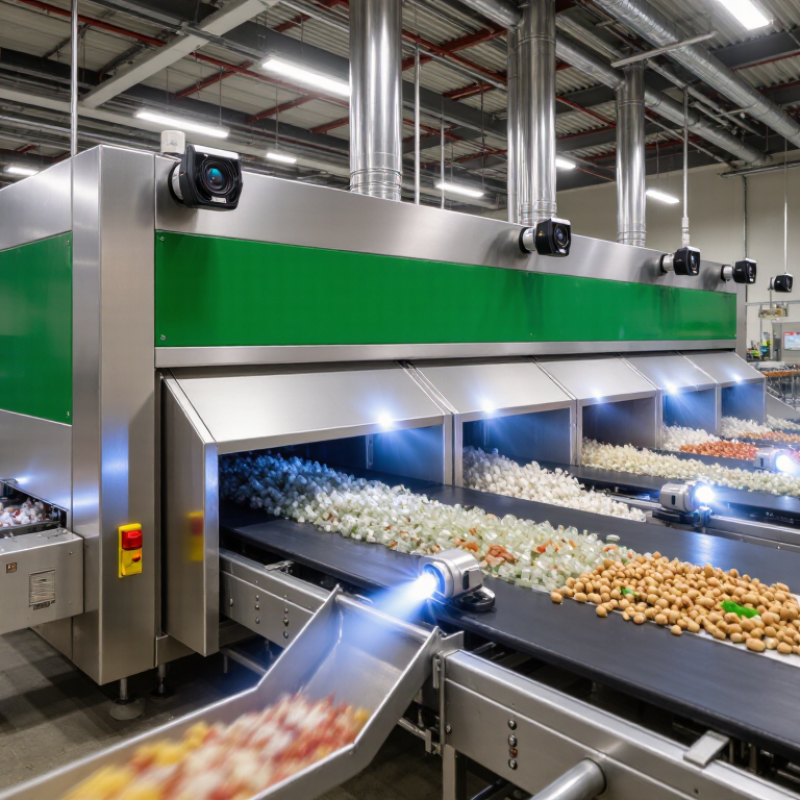
| Color and Visible-Spectrum Sorter | Separates objects according to differences in reflected visible light, color, brightness, and shape. | Recyclable plastics, glass, paper, food products, and agricultural commodities. | High-speed RGB line-scan cameras with image-processing software. | Usually a controlled conveyor or free-fall feed, depending on the machine design. | Compressed-air ejectors activated after image classification. | Color contamination, dark particles, labels, foreign objects, and visibly different items. | Effective for clear visual differences; suitable for many dry, well-presented materials. | Lighting stability, belt speed, object spacing, particle size, and surface cleanliness. | Basic color separation and removal of visible contaminants. |
| Near-Infrared (NIR) Material Sorter | Identifies materials through their characteristic near-infrared spectral response. | Mixed plastic packaging, paper, cardboard, textiles, and other dry recyclables. | NIR sensors, often combined with visible-light cameras. | Most commonly a conveyor-based system with a consistent material layer. | Targeted compressed-air jets remove selected materials from the product stream. | Polymer families, paper versus non-paper, and other material classes with different spectra. | Can distinguish materials that appear similar in visible color. | Moisture, black or heavily pigmented plastics, multilayer items, film orientation, and calibration. | Material recovery facilities and plastic or paper fraction purification. |
| Dual-Sensor Color and NIR Sorter | Combines visible imaging with spectral material recognition in one sorting stage. | Mixed packaging, plastics, paper, glass, and complex dry recycling streams. | Visible-light cameras plus NIR sensors and integrated classification software. | Conveyor presentation with controlled spacing and even distribution. | High-speed air-ejection system with programmable sorting logic. | Simultaneous removal of color defects, foreign objects, and incorrect material types. | Provides broader identification capability than a single-sensor configuration. | Sensor combination, software settings, throughput objectives, compressed-air quality, and maintenance access. | Multi-stage recycling lines requiring both appearance and material-based separation. |
| Free-Fall or Chute-Fed Sorter | Analyzes particles while they pass through a controlled free-fall trajectory. | Granular food products, seeds, grains, nuts, minerals, and small dry particles. | Visible cameras, NIR sensors, or combined optical sensor packages. | Material travels through a chute or falls through a sensor zone in a narrow stream. | Precisely timed air jets divert rejected particles during free fall. | Discoloration, foreign particles, mold-related visual defects, and size or shape anomalies. | Compact material path and accurate particle-level ejection when feed presentation is consistent. | Feed rate, particle size distribution, dust control, chute cleanliness, and air-jet timing. | Food processing and agricultural sorting of relatively uniform granular products. |
| Belt-Fed Whole-Item Sorter | Inspects items on a moving belt and classifies them using image and spectral data. | Whole plastic containers, packaging, glass containers, electronic components, and bulky recyclables. | Visible cameras, NIR sensors, shape-analysis software, and optional metal detection. | Items are conveyed on a belt with an emphasis on spacing and exposure of the target surface. | Air jets or mechanical diversion, depending on item size and line configuration. | Incorrect material, color mismatch, labels, attached items, and unwanted objects. | Handles larger objects and enables inspection of item geometry and surface appearance. | Belt width, object overlap, orientation, line speed, dust, and the portion of each item visible to sensors. | Container recovery, packaging inspection, and whole-item recycling lines. |
| Fine-Particle Optical Sorter | Uses high-resolution optical inspection and rapid ejection for small, closely spaced particles. | Small plastic flakes, glass cullet, minerals, rice, seeds, and processed food particles. | High-resolution cameras, NIR sensors, or laser-assisted optical detection. | Specialized chute or narrow-belt presentation designed for small particles. | Fast, individually timed compressed-air jets. | Small color defects, fine foreign particles, and material contamination. | Designed for precise separation where particle size and defect visibility are critical. | Minimum particle size, feed uniformity, dust accumulation, air consumption, and sensor resolution. | Flake purification, fine glass sorting, seed cleaning, and high-value product upgrading. |
| Multi-Ejector Sorting Line | Uses multiple sorting zones or machines in sequence to create several product fractions. | Mixed municipal recyclables, plastics, paper, glass, and complex industrial feed streams. | Combination of visible cameras, NIR sensors, metal detectors, and control software. | Conveyor-based arrangement with transfer points between sorting stages. | Multiple air-ejection stages, with each stage assigned to a defined target fraction. | Sequential recovery of valuable materials and removal of different contaminant groups. | Supports higher overall purity and recovery by dividing the process into specialized steps. | System layout, material flow balance, cross-contamination control, controls integration, and maintenance planning. | Large recycling plants and installations requiring multiple recovered output streams. |
| Technical note: Actual throughput, detection limits, recovery, purity, power use, air consumption, and conveyor dimensions depend on the material, moisture, particle-size distribution, feed presentation, sensor package, machine width, and line configuration. The configurations above describe common optical-sorter categories rather than manufacturer-specific specifications. |