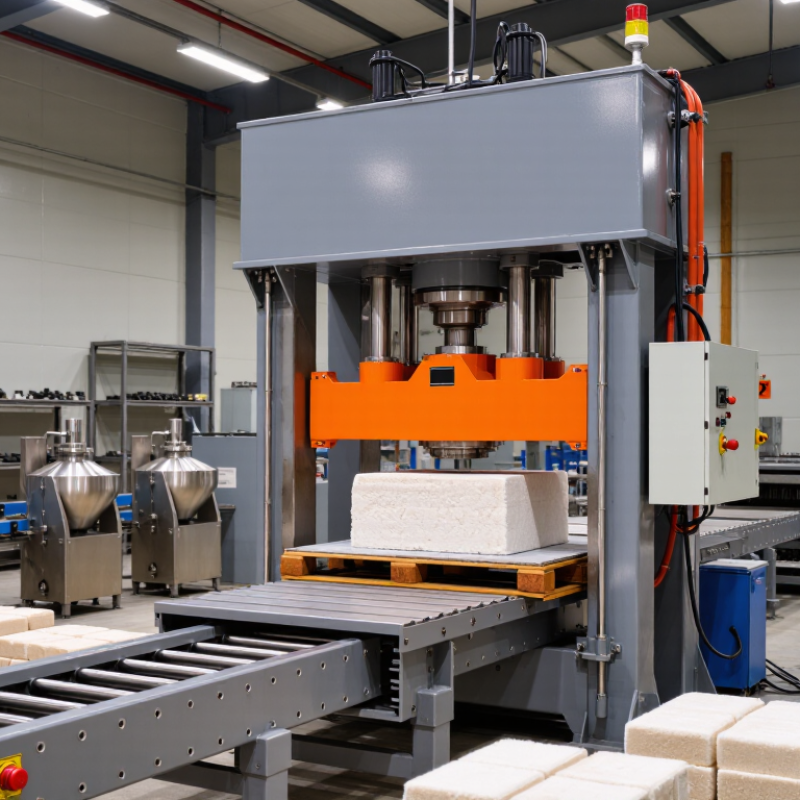
| 1 | Rated press capacity | Confirm the rated force in metric tonne-force (tf) and its equivalent in kilonewtons. The 100–500 tf range is approximately 981–4,903 kN. | Required force depends on the material, mold area, block dimensions, and target density. Rated tonnage alone does not establish production capacity. |
| 2 | Feed material and preparation | Ask about acceptable salt particle size, feed consistency, moisture considerations, and whether pre-processing is needed. | Consistent feed helps support repeatable filling and compaction. Suitability should be confirmed using the buyer’s actual salt material. |
| 3 | Pressing sequence | Check how the machine handles mold filling, compression, any programmed dwell, pressure release, and ejection. | These are common stages in a hydraulic compaction cycle; the exact sequence and cycle settings depend on the machine and product. |
| 4 | Hydraulic system and force control | Review pressure adjustment, gauges or sensors, cylinder specifications, and overload protection. | Hydraulic pressure acting on the cylinder area generates pressing force. Ask how force and cycle settings are monitored and adjusted. |
| 5 | Frame and platen design | Compare the frame layout, working opening, platen dimensions, and stated operating limits. | The frame and platen must suit the mold and withstand the specified working load; design details are model-specific. |
| 6 | Mold and block dimensions | Specify the required block shape, dimensions, mass, and any surface or edge requirements; confirm mold material and replacement arrangements. | Tooling determines the product geometry. A press’s maximum force does not by itself confirm that a particular mold or block size is suitable. |
| 7 | Ejection and handling | Check the ejection method, access for mold changes, and options for manual or automated block removal. | Ejection and handling arrangements affect operator workflow and integration with downstream collection or packaging equipment. |
| 8 | Controls and operator safety | Review the control interface, operating modes, emergency stop, guarding, and safety documentation supplied with the machine. | Controls and safeguards should match the installation, operating procedure, and applicable workplace safety requirements. |
| 9 | Potential product applications | Discuss the intended product and its end-use requirements before selecting the press and mold. | Salt compaction equipment may be configured for products such as water-softener salt tablets or livestock salt/mineral blocks; suitability depends on the material and product specification. |
| 10 | Testing, documentation, and service | Request a material trial where practical, a written specification, operating and maintenance manuals, spare-parts information, and service terms. | Testing with the intended feed and mold can help assess whether the proposed configuration meets the buyer’s product and production requirements. |