| Screen Mesh | Fiberglass-coated PVC, aluminum, stainless steel, or polyester | Common insect-screen configurations include 18 × 16 mesh and 20 × 20 mesh; mesh count means openings per linear inch | Uniform openings, consistent wire or yarn diameter, tear resistance, UV stability, and clean coating | ASTM D882 may be used for tensile properties of plastic-film materials; ASTM G154 may be used for accelerated UV exposure testing where applicable | Specify mesh count, finished roll width, color, openness factor, and intended insect or ventilation requirement. Do not compare mesh count alone without checking wire or yarn diameter |
| Door Frame or Sash Profile | Aluminum alloy, galvanized steel, reinforced PVC, or wood | Common aluminum profile wall thicknesses are approximately 0.8–1.5 mm, depending on the door size and design | Straightness, accurate corner geometry, adequate wall thickness, smooth finish, and resistance to twisting | ASTM B117 or ISO 9227 can be used for comparative neutral salt-spray testing of metallic finishes; acceptance limits should be agreed in advance | Confirm alloy, temper, profile dimensions, corner-joining method, coating type, and tolerances. Larger doors generally require stronger profiles or intermediate reinforcement |
| Screen Spline | EPDM rubber, flexible PVC, or thermoplastic elastomer | Common nominal diameters include approximately 0.120 in, 0.125 in, and 0.140 in; the correct size depends on the frame groove and mesh thickness | Stable diameter, flexibility across the expected temperature range, resistance to cracking, and secure retention in the groove | Material testing may include tensile, elongation, hardness, and low-temperature flexibility tests specified by the purchasing agreement | Request the groove width and depth, spline diameter tolerance, cross-section sample, and compatibility with the selected mesh. Oversized spline can distort the frame |
| Roller Assembly | Nylon, acetal, steel, stainless steel, zinc alloy, or aluminum | Common sliding-door roller diameters are approximately 19–32 mm; axle, housing, and adjustment dimensions vary by system | Smooth rotation, low noise, adequate load capacity, corrosion resistance, and reliable height adjustment | Cycle testing, load testing, and corrosion testing should be defined according to the door weight and operating environment | Provide door weight, track profile, wheel diameter, wheel material, bearing type, housing dimensions, and adjustment range. A dimensional sample is strongly recommended |
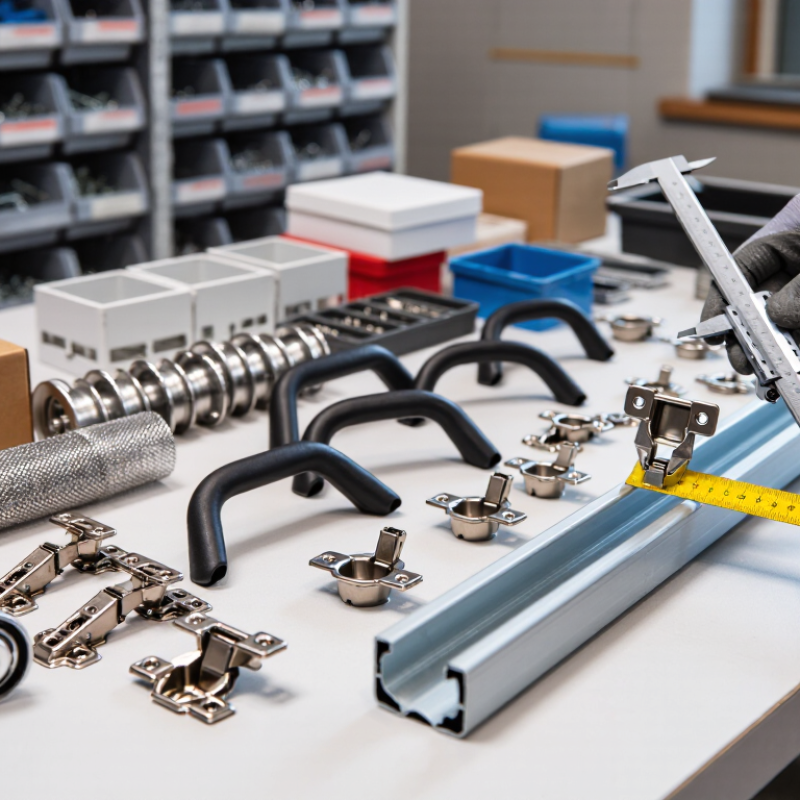
| Hinges | Stainless steel, steel with protective coating, aluminum, or reinforced polymer | Typical butt-hinge leaves range from approximately 50–100 mm in height; thickness and screw pattern depend on door mass | Accurate knuckle alignment, secure pin retention, consistent opening torque, and resistance to sagging | ASTM B117 or ISO 9227 may be used to compare corrosion resistance of metallic finishes; hinge-cycle requirements should be project-specific | Match the hinge count and load rating to the door size and weight. Verify screw-hole spacing, pin diameter, handedness, and compatibility with the frame |
| Handle and Latch | Zinc alloy, aluminum, stainless steel, steel, nylon, or acetal components | Common lever or pull-handle center-to-center dimensions range from approximately 64–96 mm, but installation patterns vary widely | Positive latching, smooth operation, secure fastening, wear resistance, and resistance to outdoor corrosion | ASTM D3359 can be used to evaluate coating adhesion on coated metal surfaces; operational cycle and pull-force limits should be specified by the buyer | Confirm backset, mounting-hole spacing, spindle or latch dimensions, handing, key or non-key operation, and compatibility with the strike plate |
| Door Closer or Spring | Steel, stainless steel, aluminum, or reinforced polymer | Spring force and closer size should be selected according to door width, door weight, wind exposure, and closing speed requirements | Controlled closing, consistent spring force, smooth adjustment, secure mounting, and resistance to leakage or fatigue | Cycle testing and temperature-condition testing should be completed using the intended door size and operating load | Specify opening angle, closing time, hold-open requirement, adjustable force, temperature range, and whether the product is intended for exterior exposure |
| Weatherstripping or Brush Seal | EPDM, silicone, PVC, polypropylene, nylon, or thermoplastic elastomer | Common brush pile heights range from approximately 5–15 mm; compression seals are selected by gap size and compression ratio | Continuous coverage, uniform pile or profile, strong backing, low compression set, and resistance to sunlight and moisture | ASTM D395 may be used for compression-set testing of elastomers; ASTM G154 may be used for comparative UV exposure testing where applicable | Measure the actual clearance around the door. Specify backing width, pile height, adhesive or fixing method, temperature range, and replacement availability |
| Corner Keys and Joining Components | Nylon, glass-fiber-reinforced polymer, zinc alloy, or aluminum | Dimensions must match the internal profile cavity; common designs use insert-fit or screw-fixed corner joints | Accurate fit, adequate impact strength, minimal joint movement, and consistent geometry across production batches | Dimensional inspection, impact testing, and assembly pull-out testing can be specified for quality control | Request profile drawings, insertion depth, corner angle, screw specification, and assembled-frame samples. Poor corner fit can cause mesh loosening and door sag |
| Track, Threshold, or Bottom Guide | Aluminum, stainless steel, galvanized steel, nylon, or acetal | Track width and guide height depend on the roller or door system; low-profile thresholds are commonly selected for easier access | Straight running surface, accurate alignment, drainage capability, wear resistance, and compatibility with the rollers | Dimensional inspection, load testing, cycle testing, and corrosion testing may be applied according to the installation environment | Confirm track width, guide height, drainage design, surface finish, replacement method, and compatibility with local installation conditions |
| Fasteners | Stainless steel, zinc-plated steel, coated steel, or aluminum | Common screw sizes are selected by frame thickness and substrate; exterior applications generally require corrosion-resistant fasteners | Correct thread form, consistent head dimensions, adequate torque performance, and resistance to galvanic corrosion | ISO 3506 applies to certain stainless-steel fastener mechanical properties; coating and corrosion requirements should be stated separately | Identify metric or inch threads, head style, drive type, material grade, coating, packaging quantity, and compatibility with the frame material |