| Material identity | Food-contact-grade silicone elastomer; obtain the exact formulation and supplier material specification. | Confirm the formulation is suitable for repeated food contact and falls within the applicable requirements for rubber articles. | The finished article must not transfer substances to food in quantities that endanger health or cause unacceptable changes in food composition or organoleptic properties. | Material specification, composition statement, supplier compliance declaration, and traceability records. |
| FDA extraction testing | Testing should reflect the intended food type, contact time, temperature, and repeated-use conditions. | Request test results for the applicable extractive limits using the specified simulants and conditions for the finished lid. | FDA results alone do not establish EU compliance; EU assessment and supporting documentation are also required. | Accredited laboratory report, test method, simulant, time/temperature condition, sample description, and result units. |
| EU framework compliance | Assess the finished lid under Regulation (EC) No 1935/2004 and manufacturing controls under Regulation (EC) No 2023/2006. | EU documentation does not replace the FDA assessment when the product is sold into the United States. | Verify safety, inertness, traceability, good manufacturing practice, and intended-use conditions. Silicone may also require assessment under applicable national or member-state guidance where relevant. | EU Declaration of Compliance or equivalent supplier declaration, migration assessment, GMP statement, and traceability information. |
| Temperature range | Specify the validated operating range. A common silicone product target is approximately −40°C to 200°C, but the actual limit depends on formulation, design, and use. | Temperature is not a blanket FDA approval claim; extraction and safety data must cover the proposed use conditions. | The intended temperature and contact duration must be included in the risk and migration assessment. | Technical data sheet, oven/freezer validation, thermal cycling results, and use-condition statement. |
| Intended food contact | State whether the lid is intended for aqueous, acidic, alcoholic, fatty, dry, hot, frozen, or mixed foods. | The applicable extraction conditions depend on the food-contact scenario and repeated-use profile. | Migration and sensory assessment should represent the foods and conditions reasonably expected during use. | Intended-use matrix, food simulant selection rationale, migration report, and sensory/odour evaluation where applicable. |
| Odour and taste neutrality | Choose low-odour, post-cured silicone and verify that the lid does not impart taste or odour under normal use. | Chemical compliance does not automatically prove acceptable sensory performance; practical testing is recommended. | Food-contact materials must not cause unacceptable changes in food characteristics, including taste or smell. | Organoleptic test report, post-curing specification, production batch information, and cleaning-condition results. |
| Lid diameter and tolerance | List the supported vessel diameter range, for example 70–230 mm, plus dimensional tolerances and fit limitations. | Dimensional fit is not a regulatory compliance criterion, but poor fit can increase leakage and misuse risk. | Provide clear instructions so the article is used as intended and remains traceable through the supply chain. | Engineering drawing, tolerance table, fit-test records using representative containers, and user instructions. |
| Seal performance | Define leak-resistance criteria for liquids, powders, and tilted or inverted storage; universal lids generally seal best on smooth, rigid rims. | Functional performance is separate from 21 CFR material compliance and must be validated through product testing. | Use instructions and foreseeable-use assessment should address leakage, detachment, and contamination risks. | Leak test protocol, vacuum or pressure test where relevant, tilt test, repeated-use test, and container compatibility results. |
| Mechanical durability | Assess tear strength, compression set, flexibility, puncture resistance, and repeated stretching of the sealing edge. | Mechanical properties are not a substitute for chemical extraction compliance. | The product should remain safe and suitable throughout its reasonably foreseeable service life. | Tensile/tear data, compression-set results, accelerated ageing, cyclic opening tests, and visual inspection criteria. |
| Cleaning and dishwasher use | Only claim dishwasher suitability after validating detergent, heat, drying, and repeated-cycle exposure. | Cleaning exposure should be considered when it can affect extractives, odour, surface condition, or product life. | Provide cleaning instructions and ensure continued compliance after the stated cleaning process. | Dishwasher-cycle test, detergent compatibility data, post-cycle migration or sensory assessment, and care instructions. |
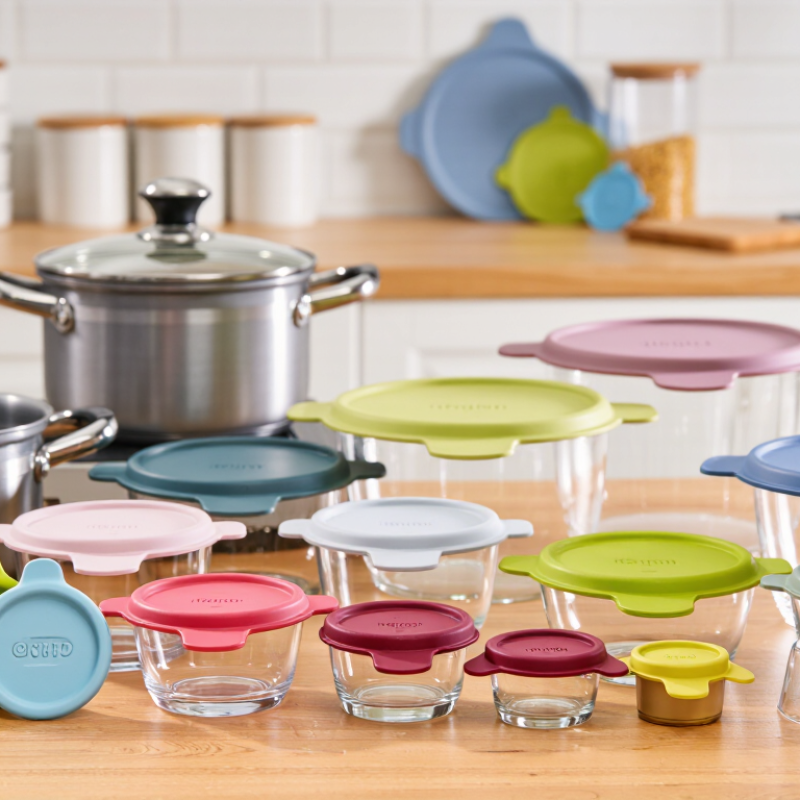
| Colourants and additives | Use documented food-contact colorants and additives; black, red, and highly pigmented parts need the same finished-article verification as translucent parts. | The full colored formulation, not only the base silicone, must be included in the compliance assessment. | All constituents and foreseeable migrants must be assessed for the intended application. | Colorant/additive declarations, formulation change-control procedure, and finished-color migration or extractive results. |
| Traceability and labeling | Use batch or lot identification and retain production records for the finished product. | Maintain records linking the tested material and production lot to the supplied lid. | Regulation (EC) No 1935/2004 requires traceability through relevant stages of manufacture and distribution. | Lot code, production date, packaging label, supplier audit records, and recall/complaint procedure. |
| Key purchasing decision | Approve only when material, finished-product performance, intended-use conditions, and documentation are consistent. | Do not rely on the phrase “FDA approved”; request evidence for the specific formulation and article. | Do not rely on an “EU compliant” label without a documented assessment covering 1935/2004, GMP, and the actual use. | Signed compliance statement, current laboratory reports, technical file, production controls, and change-notification commitment. |