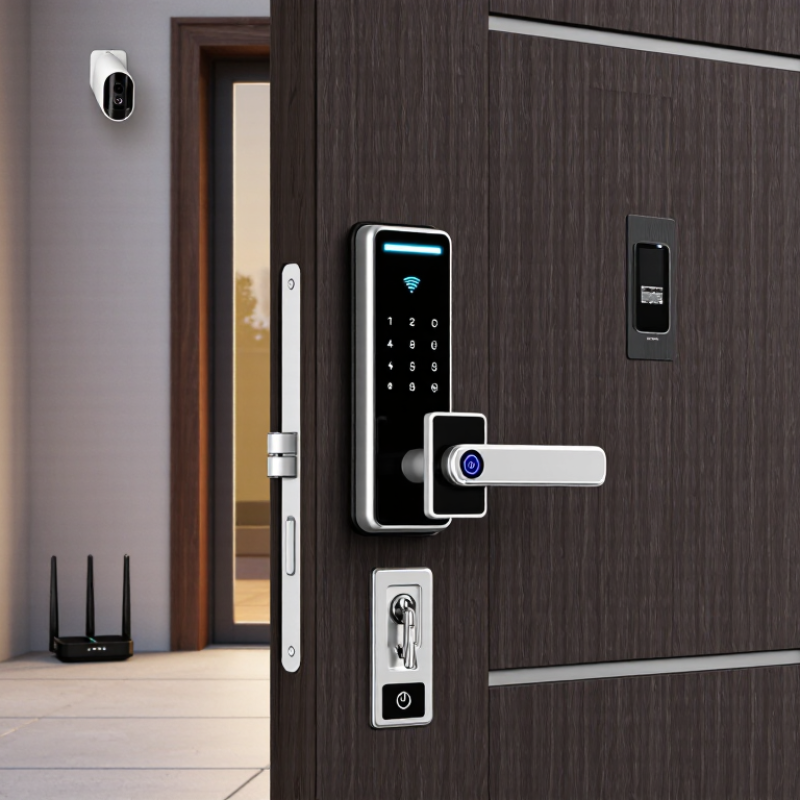
| PIN Authentication | Numeric code | Users enter a predefined or time-limited code on a keypad. The lock validates the code locally or through a connected access-management system. | Homes, rental properties, offices, utility rooms, and shared facilities. | Unique codes should be assigned to individuals or groups. Repeated failed attempts can trigger temporary lockout or alerts. Codes should not be reused across sites. |
| Mobile Credential | Bluetooth or app | A smartphone communicates with the lock through Bluetooth Low Energy or an application. The user is granted, denied, or scheduled access according to stored permissions. | Residential access, workplace entry, property management, and service personnel access. | Access depends on phone security, credential protection, battery status, and the lock’s offline behavior. Permissions can usually be revoked without changing the physical lock. |
| Near-Field Credential | NFC or contactless card | A card, key fob, or compatible mobile device is presented near the reader. The lock checks the credential against an authorized list. | Hotels, offices, campuses, multi-tenant buildings, and controlled internal areas. | Lost credentials should be disabled promptly. Secure credential technology and protected key management help reduce cloning and unauthorized duplication risks. |
| Biometric Authentication | Fingerprint or facial recognition | The reader compares a captured biometric characteristic with an enrolled template and unlocks the door when the match meets the configured threshold. | Private residences, restricted rooms, laboratories, and areas requiring hands-free access. | Biometric systems must address false acceptance and false rejection. Biometric templates should be protected, and an alternative credential should be available for failed reads or accessibility needs. |
| Mechanical Key | Physical key override | A conventional key cylinder provides a non-electronic method of operating the locking mechanism when electronic authentication is unavailable. | Emergency entry, battery depletion, maintenance access, and backup operation. | Key control remains important. Restricted key systems, secure storage, and documented issuance procedures help reduce unauthorized physical access. |
| Remote Access Management | Cloud or gateway control | An administrator uses a web portal or application to create, modify, schedule, or revoke credentials and review access events remotely. | Distributed properties, rental units, commercial facilities, and multi-site operations. | Internet availability, administrator account security, encryption, role-based permissions, and service availability affect remote-control reliability. |
| Offline Authorization | Local decision-making | The lock stores authorized credentials, schedules, and rules locally, allowing it to make access decisions without a continuous internet connection. | Homes and facilities with unreliable internet or strict local-processing requirements. | Remote changes may not take effect until the lock synchronizes. Local storage capacity, clock accuracy, and update procedures should be considered. |
| Connectivity | Bluetooth, Wi-Fi, Zigbee, or Z-Wave | Wireless communication links the lock to a phone, hub, gateway, building system, or internet service, depending on the selected architecture. | Smart homes, access-control systems, property portfolios, and integrated building management. | Each protocol has different requirements for range, power consumption, network dependence, interoperability, and security configuration. Wireless communication should use current supported security settings. |
| Access Scheduling | Time-based permissions | Credentials are configured for permanent, recurring, or one-time access within defined dates and times. | Housekeeping, contractors, caregivers, deliveries, offices, and short-term occupancy. | Schedules should account for time zones, daylight-saving changes, clock drift, and the difference between an issued credential and an actually used credential. |
| Audit Trail | Event logging | The system records events such as successful unlocks, denied attempts, credential changes, battery warnings, and forced-entry alerts when supported. | Security monitoring, compliance reviews, incident investigation, and occupancy management. | Logs should include reliable timestamps and user or credential identifiers. Retention, access permissions, and privacy requirements should be defined before deployment. |
| Power Management | Battery or wired power | Battery-powered locks use low-power electronics and provide status notifications or local warnings as energy decreases. Wired systems may use building power with backup support. | Residential doors, offices, hospitality spaces, and controlled internal doors. | Battery life varies with lock design, communication frequency, temperature, traffic, and battery quality. A low-battery alert and a documented replacement process are essential. |
| Door-State Monitoring | Position and lock sensors | Magnetic or integrated sensors report whether the door is open, closed, locked, or unlocked, depending on the hardware configuration. | Security-sensitive rooms, offices, storage areas, and automated building workflows. | Sensor alignment and installation quality affect accuracy. Door-state information should be treated as a security signal, not as a substitute for physical inspection in emergencies. |
| Tamper Detection | Alerts and alarms | The lock or connected system can detect selected events such as repeated failed credentials, enclosure tampering, forced rotation, or unusual access behavior. | Commercial facilities, restricted areas, and properties requiring security notifications. | Alerts should be prioritized to avoid alarm fatigue. Detection capability depends on the hardware, installation, configuration, and integration with monitoring systems. |
| Emergency Operation | Override and fail mode | An emergency procedure may use a mechanical key, external power contact, administrative credential, or designated life-safety integration. | Residential buildings, workplaces, healthcare environments, and emergency-response scenarios. | Fail-safe and fail-secure behavior have different safety implications. The selected mode must comply with applicable fire, building, accessibility, and emergency-egress requirements. |
| System Integration | API or building platform | The lock exchanges credentials, events, schedules, or status data with property-management, identity, visitor-management, or building-automation systems. | Enterprise facilities, residential portfolios, hospitality, and multi-system access environments. | Integration should use authenticated interfaces, least-privilege permissions, documented data flows, and a defined process for software updates and access revocation. |