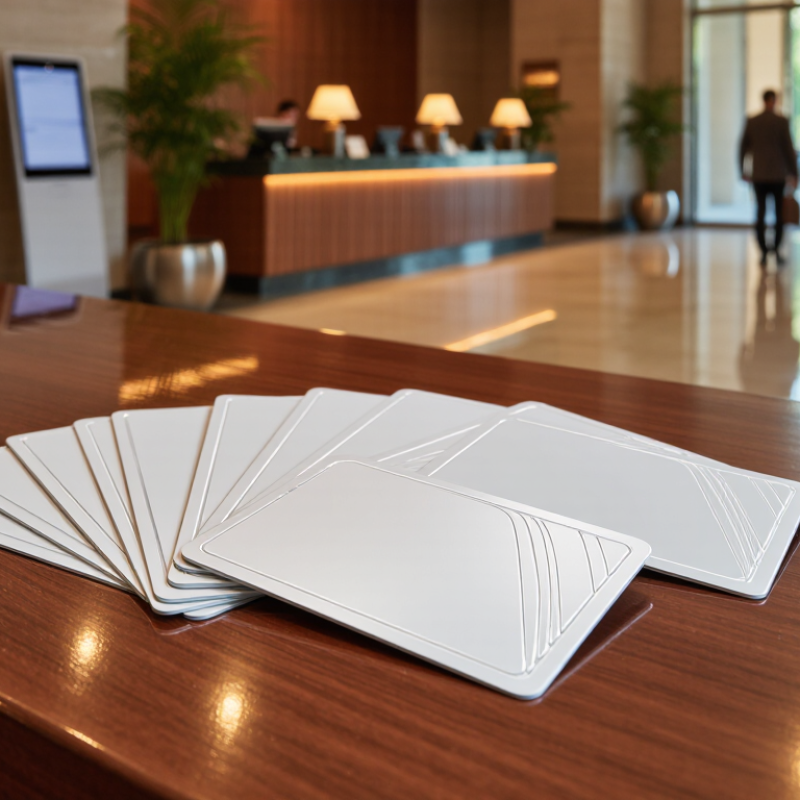
| Card Technology | SALTO hotel cards generally use contactless smart-card technology with data stored on the card for authorized access management. | The card can carry access-related information and support offline locks without requiring every door to be continuously connected to a central server. | Confirm the exact card family, memory configuration, encryption method, and system compatibility before purchasing. |
| Operating Frequency | 13.56 MHz high-frequency RFID. | This frequency is widely used for contactless access cards and is supported by established international smart-card standards. | Do not substitute a low-frequency 125 kHz proximity card unless the installed readers explicitly support it. |
| Contactless Interface | ISO/IEC 14443 proximity-card interface, normally using short-range inductive coupling. | The guest can present the card by tapping or holding it near the reader; physical insertion is not required. | Request confirmation of ISO/IEC 14443 support and the applicable card type used by the hotel access system. |
| Data-on-Card Model | The SVN model uses authorized card data to distribute or update access permissions through the hotel’s operational network. | Cards may be updated at designated points such as reception or other equipped access points, reducing the need for wired connections at every lock. | Verify where card updates occur, how often permissions are refreshed, and what happens when a card is lost or expired. |
| Access Permission Content | Typical records include room or zone permissions, validity dates, validity times, issue information, and security-related control data. | Time-limited permissions support check-in, checkout, staff access, housekeeping schedules, and restricted-area control. | Ask for the supported permission structure and confirm that the card does not expose sensitive personal data in readable form. |
| Security Architecture | Secure authentication and encrypted card communication should be used; the exact cryptographic implementation depends on the approved card and system configuration. | Strong authentication helps reduce unauthorized cloning, replay, and manipulation of access credentials. | Require written confirmation of supported encryption, key-management responsibility, card revocation, and replacement procedures. |
| Read Range | Usually a short range of a few centimetres, depending on the reader, antenna design, card orientation, and installation conditions. | Short-range operation reduces accidental reads and provides a predictable guest experience at the door. | Test the card with the actual lock and reader model rather than relying only on laboratory read-range claims. |
| Card Construction | Common formats include ISO/IEC 7810 ID-1 cards measuring approximately 85.60 × 53.98 mm, with a typical thickness close to 0.76 mm. | Standard dimensions fit common card holders, printers, wallets, and hotel key-card packaging. | Confirm dimensions, material, surface finish, antenna placement, and compatibility with the hotel’s card printer. |
| Printing and Personalization | Cards may support one- or two-sided visual printing, while electronic encoding is performed using compatible card-encoding equipment. | Visual branding, room instructions, emergency information, and event details can be printed without replacing the electronic credential function. | Separate visual-printing requirements from electronic encoding requirements and request a production sample. |
| Memory Capacity | Available memory varies by integrated circuit; common contactless smart-card products provide memory from a few hundred bytes to several kilobytes. | The required capacity depends on the number of access zones, permission records, audit data, and system-specific security fields. | Never approve a card based on memory size alone; confirm the exact chip model and encoding profile. |
| Environmental Durability | PVC, composite, or similar card bodies are commonly used; resistance to bending, abrasion, moisture, and temperature depends on the construction. | Durability is important for repeated handling, humid locations, outdoor facilities, and long staff-use cycles. | Request material specifications, test reports, and operating-temperature information for the intended region. |
| Global Compliance Considerations | Relevant references may include ISO/IEC 14443 for contactless cards, ISO/IEC 7810 for card dimensions, and applicable regional radio-equipment requirements. | Compliance documentation supports customs clearance, procurement approval, and deployment across multiple countries. | Request declarations of conformity, test reports, safety information, and country-specific import documentation where applicable. |
| Supplier Qualification | A qualified supplier should provide traceable chip information, encoding support, quality-control records, samples, and consistent batch production. | Traceability helps international buyers manage counterfeit risk, inconsistent read performance, and cross-border warranty issues. | Check sample approval, minimum order quantity, lead time, packaging, quality tolerance, replacement policy, and pre-shipment testing. |
| Recommended Sourcing Workflow | Identify the installed access platform, confirm the approved card profile, test samples, validate encoding, approve artwork, and release the production order. | A controlled workflow minimizes incompatibility, rejected batches, guest lockouts, and delays during hotel opening or renovation projects. | Obtain written technical approval before mass production and retain approved samples for future batch comparison. |