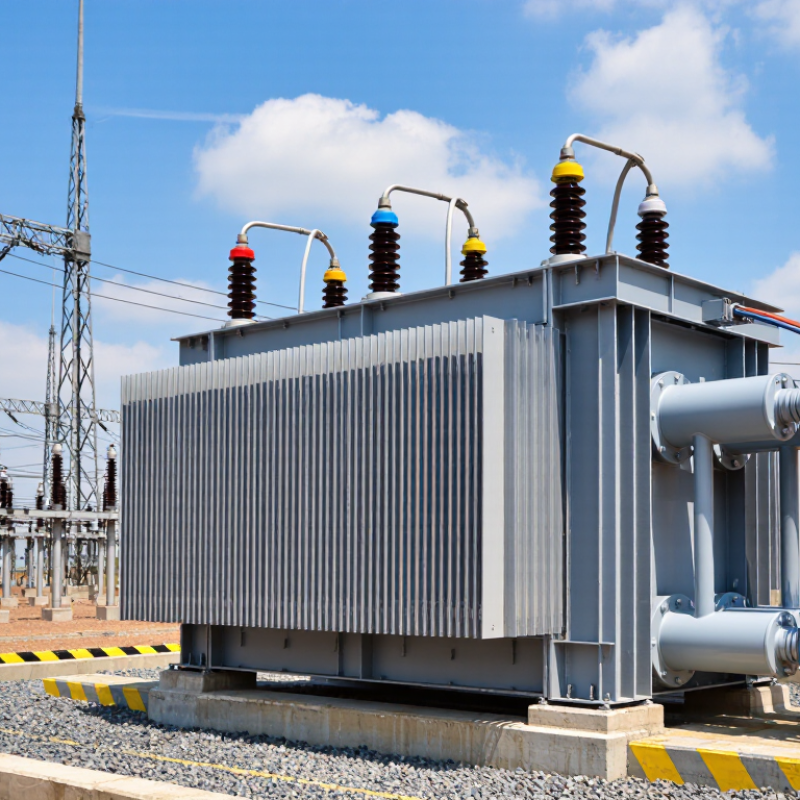
| 1. Match the transformer design to the installation | Liquid-immersed versus dry-type construction; indoor or outdoor location; fire and environmental requirements. | Liquid-immersed units commonly use mineral oil or an alternative insulating liquid and may use ONAN cooling. Dry-type units commonly use air cooling, such as AN, and are often selected for indoor installations. | Confirm the installation environment, fire-protection rules, ventilation, spill containment requirements, and applicable local codes. Neither design is universally best. |
| 2. Select the correct kVA rating | Present demand, motor starting, non-linear loads, load growth, and operating duty. | Common three-phase distribution ratings include 100, 250, 500, 1,000, and 2,500 kVA. These are examples, not a substitute for a load calculation. | Size from the expected maximum demand and load profile. Check starting currents, harmonic content, ambient temperature, altitude, and any required future capacity. |
| 3. Confirm voltage, frequency, and vector group | Primary and secondary voltage, system frequency, tap range, and winding connection. | Example systems include 11 kV to 400 V at 50 Hz and 13.8 kV to 480 V at 60 Hz. Dyn11 is a commonly used vector group, but it is not appropriate for every network. | Specify the actual network voltages and frequency. Confirm the required vector group, neutral arrangement, phase rotation, and tap-changing method with the utility or system designer. |
| 4. Compare efficiency using losses, not a percentage alone | No-load loss, load loss, expected loading, power factor, and the method used to state efficiency. | Illustrative example: a 1,000 kVA unit with 1.6 kW no-load loss and 10 kW load loss has approximately 98.86% efficiency at rated load and unity power factor, before auxiliary losses. | Request guaranteed losses at the specified reference temperature and test method. Compare total energy cost over the expected load cycle; efficiency varies with load and power factor. |
| 5. Check insulation, temperature rise, and site conditions | Insulation level, temperature-rise limits, ambient temperature, altitude, humidity, and corrosion exposure. | IEC 60076 and IEEE C57 are widely used transformer standards families. Applicable requirements and specific test levels depend on the project and market. | State the governing standard and any local deviations in the purchase specification. Confirm derating or design requirements for high altitude, hot climates, coastal air, or dusty locations. |
| 6. Review protection, accessories, and maintainability | Temperature monitoring, pressure or liquid-level devices where applicable, surge protection, enclosure rating, and access for inspection. | Accessory requirements differ by design and rating. Outdoor installations may require a suitable weather-protected enclosure; liquid-immersed designs may require specified liquid containment and monitoring. | List required alarms, trips, sensors, terminals, cable entry, grounding points, and enclosure protection in the specification. Confirm maintenance clearances and replacement access. |
| 7. Compare test documentation, delivery, and lifetime cost | Routine and type-test documentation, manufacturing lead time, transport limits, warranty terms, and spare-parts support. | IEC 60076 and IEEE C57 include requirements and test guidance for different transformer categories. The exact tests required depend on the design and contract. | Request a dimensional drawing, nameplate data, loss guarantees, test plan, packing details, and commissioning requirements. Evaluate purchase price together with losses, maintenance, and expected service life. |