| 1 | Measure the Available Floor Space | Overall width, depth, height, door clearance, and drawer-opening space | Width: 24–72 in (61–183 cm)
Depth: 18–30 in (46–76 cm) | A cabinet that fits the room may still block walkways or prevent drawers from opening fully. | Measure the installation area, add the planned drawer-extension space, and allow room to move the cabinet. |
| 2 | Match Cabinet Size to Tool Volume | Number of drawers, drawer width, internal depth, and total storage volume | Compact: 5–7 drawers
Medium: 8–10 drawers
Large: 11–14 drawers | Extra empty space increases cost and footprint, while an undersized cabinet encourages unsafe overloading. | Group tools by type and estimate the space needed for hand tools, power tools, cases, and accessories. |
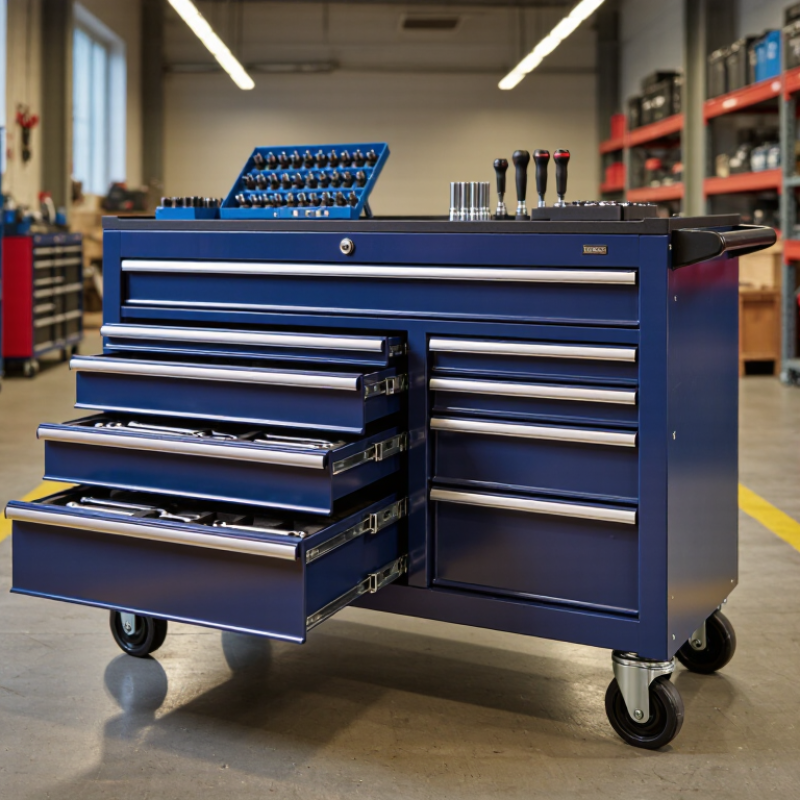
| 3 | Compare Drawer Layouts | Drawer count, drawer height, full-width drawers, and small-part compartments | Common layouts include 5 shallow drawers, 8 mixed drawers, or 10–14 mixed-height drawers | Shallow drawers suit sockets and screwdrivers; deeper drawers are better for drills, impact tools, and bulky equipment. | Choose at least one or two deep drawers for large tools and enough shallow drawers for frequently used hand tools. |
| 4 | Check the Rated Drawer Capacity | Capacity per drawer, not only the cabinet’s total capacity | Light-duty drawers: 50–75 lb (23–34 kg)
Heavy-duty drawers: 100–200 lb (45–91 kg) | Drawer slides and fasteners may be damaged when one drawer is heavily loaded even if the cabinet total appears adequate. | Use the manufacturer’s rating for the specific drawer size and confirm whether the rating applies to evenly distributed weight. |
| 5 | Evaluate Total Weight Capacity | Static cabinet capacity, loaded cabinet weight, and caster capacity | Typical rolling cabinets support approximately 600–2,000 lb (272–907 kg), depending on construction and casters | The total rating must include tools, drawer liners, accessories, and any items stored on the top surface. | Keep the expected loaded weight below the stated limit and account for the combined rating of all casters. |
| 6 | Inspect the Drawer Slide Design | Ball-bearing or other slide type, extension length, smoothness, and anti-tilt function | Full-extension slides commonly allow approximately 90–100% access to drawer depth | Full-extension slides make tools easier to see and reduce the need to reach into the back of a loaded drawer. | Open every drawer fully, check for binding, and verify that the cabinet prevents multiple drawers from opening simultaneously. |
| 7 | Choose Suitable Caster Dimensions | Caster diameter, swivel and locking arrangement, tread material, and load rating | Common caster diameters are 4–6 in (10–15 cm); two locking swivel casters are a common arrangement | Larger casters generally roll more easily over small thresholds and uneven workshop floors. | Confirm that the casters are rated for the fully loaded cabinet and that the locks secure both rolling and swiveling. |
| 8 | Consider Handle and Mobility Clearance | Handle position, turning radius, cabinet weight, and floor conditions | Cabinet depth commonly ranges from 18–30 in (46–76 cm), excluding some external handles | A deep cabinet can hold more tools but may be difficult to turn in narrow work areas. | Measure doorways, aisles, ramps, and elevator openings before selecting a deep or wide cabinet. |
| 9 | Review Security and Safety Features | Central locking system, key or coded lock, drawer retention, and corner protection | Many cabinets include a lockable front panel and an internal drawer-retention mechanism | Locks help deter casual access, while retention features reduce drawer movement during relocation. | Confirm that the lock secures all drawers and that the cabinet includes a way to prevent tipping during use. |
| 10 | Compare Construction and Surface Protection | Steel thickness, welded or bolted joints, powder-coated finish, top material, and drawer liners | Common steel construction is approximately 18–24 gauge; thicker steel is generally more rigid | Stronger construction can reduce flexing, noise, and damage when drawers are loaded or the cabinet is moved. | Inspect corners, drawer fronts, welds, seams, finish quality, and the included or compatible drawer-liner material. |