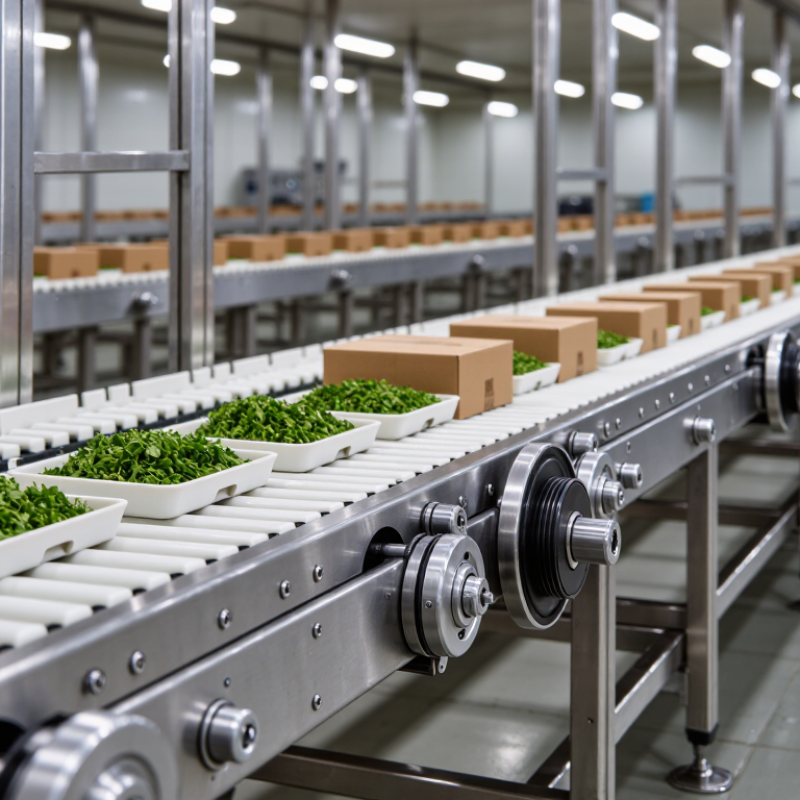
| Conveying purpose | What product or material will the conveyor move, and what process will it support? | The application determines the belt layout, surface style, and required handling characteristics. | Move packaged food containers between filling and inspection stations. |
| Product dimensions | What are the smallest and largest product dimensions and weights? | The belt width and module design must support the product without tipping, snagging, or falling between openings. | Products range from 80 to 300 mm wide and weigh up to 2 kg. |
| Throughput | How many items must the conveyor move per minute or hour? | Throughput helps establish belt speed and the capacity of the overall line. | Target rate: 60 items per minute at a controlled, consistent flow. |
| Operating speed | Will the belt run continuously, intermittently, or at variable speeds? | Speed and start-stop frequency affect drive selection, control requirements, and product stability. | Variable speed from 5 to 20 m/min with frequent production-line stops. |
| Conveyor path | Does the route include straight sections, turns, inclines, or declines? | The path influences belt configuration, transfer points, and the need for suitable side guides or turning modules. | One straight section followed by a 90-degree horizontal turn. |
| Operating environment | What temperatures, moisture levels, dust, chemicals, or washdown conditions will the belt encounter? | Environmental exposure can affect belt material, service life, cleaning methods, and operating reliability. | Indoor area with routine water washdown and ambient temperatures of 5–35°C. |
| Hygiene and cleaning | What cleaning frequency and sanitation procedures are required? | Open belt designs and accessible components can make inspection and cleaning easier where hygiene is important. | Daily cleaning with approved detergent and visual inspection before production. |
| Product contact and belt surface | Does the product need a flat, textured, low-friction, or high-grip surface? | The surface affects product movement, accumulation, release, and the risk of slipping or marking. | Flat-top surface for stable transport of rigid containers. |
| Installation and maintenance | What space is available, and how quickly must belt sections be inspected or replaced? | Modular belts can simplify repairs by allowing individual sections to be replaced, but access and spare parts still need planning. | Provide side access for routine inspection and keep compatible replacement modules on site. |
| Safety and integration | What guarding, emergency stops, sensors, and upstream or downstream connections are needed? | Clear interface and safety requirements help the conveyor operate reliably within the complete production line. | Guard accessible pinch points and coordinate photoelectric sensors with adjacent equipment. |