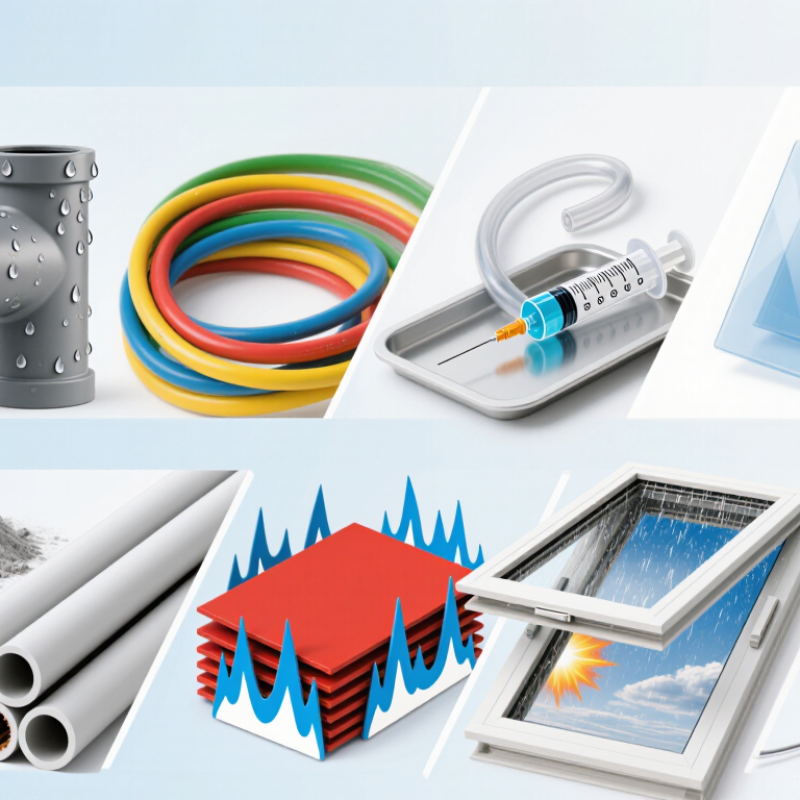
| 1 | General-Purpose Rigid Extrusion Compound | Profiles, trims, channels, rigid tubes and construction sections | Balanced PVC resin, thermal stabilizer, lubricant system, processing aid and a moderate level of mineral filler. | Good dimensional stability, surface finish and stiffness; suitable for routine indoor and general construction applications. | Single- or twin-screw extrusion. Common melt-processing range is approximately 170–205°C, depending on formulation and equipment. | Choose this grade when balanced cost, stiffness, appearance and general processability are more important than extreme impact or weathering performance. |
| 2 | Pressure-Pipe UPVC Compound | Potable-water pipes, irrigation pipes and industrial fluid-pressure pipes | High-molecular-weight PVC resin with controlled filler content, stabilizers suitable for the intended service, and formulation control for long-term pressure performance. | High hoop strength, chemical resistance, low water absorption and strong resistance to corrosion; normally designed around recognized pipe standards. | Dedicated pipe extrusion with careful control of melt temperature, vacuum sizing, cooling and wall-thickness uniformity. | Select according to pressure class, service temperature, fluid compatibility, regulatory requirements and the applicable pipe standard. Do not substitute a general profile compound. |
| 3 | Drainage and Sewer Pipe Compound | Non-pressure drainage, sewer, soil and waste pipes | Rigid PVC base with stabilizers, lubricants and impact modifiers or mineral reinforcement selected for underground and building-drainage conditions. | Good ring stiffness, chemical resistance, low friction and resistance to moisture; impact performance is important during handling and installation. | High-output pipe extrusion followed by vacuum calibration, water cooling and socket or end-forming operations. | Prioritize ring stiffness, low-temperature impact, wall-thickness control, installation temperature and compliance with the relevant drainage standard. |
| 4 | Weatherable Window and Door Profile Compound | Window frames, door profiles, façade sections and exterior architectural profiles | UV-resistant stabilizer package, impact modifier, titanium dioxide or other light-scattering pigment, processing aid and controlled lubricant balance. | Improved color retention, weathering resistance, surface quality, weldability and dimensional stability for long-term outdoor exposure. | Profile extrusion, often with co-extrusion or lamination for decorative or protective surfaces; precise fusion and cooling control are required. | Select based on climate, solar exposure, required color, expected service life, impact requirements, surface finish and regional building standards. |
| 5 | Impact-Modified Rigid UPVC Compound | Protective profiles, technical sections, fittings and products exposed to handling or low temperatures | Rigid PVC matrix containing an elastomeric or acrylic impact modifier, with stabilizers and lubricants adjusted to preserve fusion and surface quality. | Higher notched-impact strength and improved resistance to cracking during transport, installation and cold-weather use; stiffness may be slightly lower than unmodified grades. | Extrusion or injection molding. Processing conditions must provide adequate fusion without degrading the impact modifier. | Choose when drop impact, installation abuse or low-temperature toughness is more critical than maximum modulus or lowest material cost. |
| 6 | Injection-Molding UPVC Compound | Pipe fittings, valves, electrical boxes, housings, connectors and molded construction components | Formulation optimized for flow, fusion, mold filling, release and dimensional control, commonly with impact modification for fittings. | Good chemical resistance, dimensional accuracy and repeatability; performance depends strongly on gate design, mold temperature and residence time. | Injection molding using controlled barrel temperature, screw speed, back pressure and residence time. Avoid overheating and prolonged holding. | Select by required flow length, wall thickness, weld-line strength, impact level, shrinkage, cycle time and the applicable fitting or product standard. |
| 7 | Electrical Conduit and Cable-Protection Compound | Electrical conduits, trunking, junction boxes and rigid protective covers | Flame-retardant rigid PVC formulation with stabilizers, lubricants and electrical-insulation performance maintained after processing. | Good electrical insulation, flame resistance, stiffness and resistance to moisture and many common chemicals; exact fire performance depends on the formulation and test method. | Conduit extrusion, profile extrusion or injection molding with strict control of contamination, moisture and thermal history. | Verify voltage application, dielectric strength, flame classification, installation temperature, impact resistance and local electrical requirements. |
| 8 | Rigid UPVC Sheet and Calendering Compound | Sign panels, protective sheets, partitions, liners and fabricated rigid sheet products | PVC resin with stabilizers, lubricants, processing aids, pigments and optional impact modifier or mineral filler for thickness and stiffness control. | Smooth surface, chemical resistance, good printability and fabricability; can be cut, drilled, welded or thermoformed within suitable processing limits. | Calendering, flat-die extrusion or sheet extrusion followed by cooling and trimming. Uniform fusion and gauge control are essential. | Select according to sheet thickness, opacity, surface gloss, impact requirement, thermoforming behavior, chemical exposure and fabrication method. |
| 9 | Foamed Rigid PVC Compound | Low-density profiles, decorative boards, sign boards, interior panels and lightweight construction sections | Rigid PVC formulation designed for controlled cell formation, using chemical or physical foaming technology, processing aids, stabilizers and nucleation control. | Lower density, improved material utilization, good stiffness-to-weight ratio and easy machining; surface strength and impact resistance depend on cell structure. | Profile or sheet extrusion with tight control of melt strength, die temperature, cooling and foam expansion. | Choose based on target density, surface quality, cell uniformity, screw pull-out strength, bending stiffness, fire behavior and finishing requirements. |
| 10 | High-Impact and Low-Temperature UPVC Compound | Outdoor fittings, transportation-related components, protective housings and products used in cold climates | Higher impact-modifier level and stabilizer package selected to retain toughness at reduced temperatures, with rheology adjusted for the intended process. | Enhanced resistance to brittle fracture, impact and installation damage in cold conditions; excessive modifier levels can reduce stiffness and heat-deflection performance. | Injection molding or extrusion with controlled cooling and optimized fusion. Product testing should include impact at the minimum service temperature. | Select according to minimum operating temperature, impact test method, wall thickness, stiffness requirement, weather exposure and expected handling conditions. |