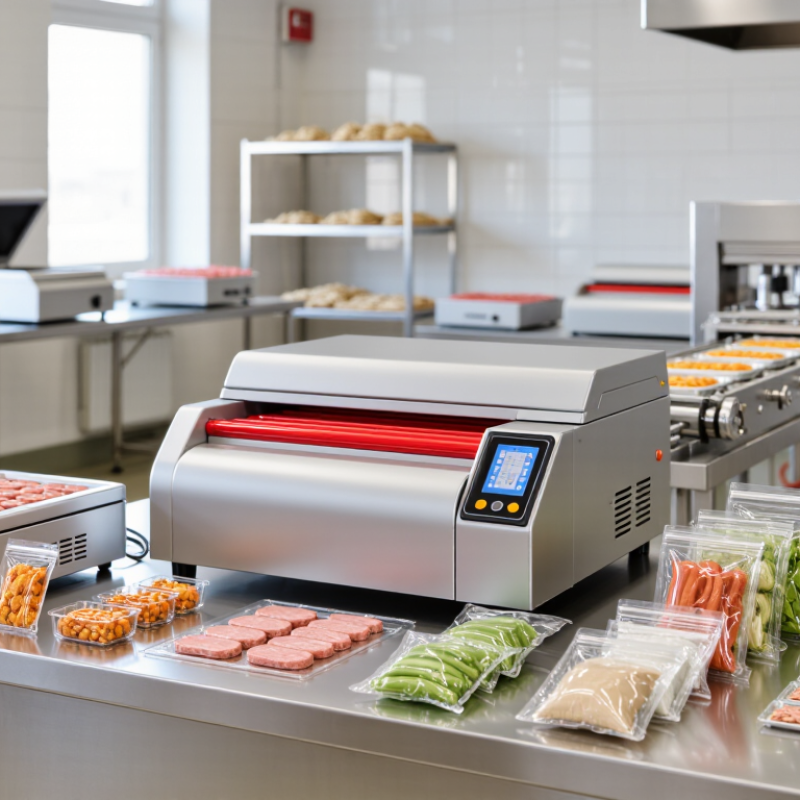
| 1 | Single-Chamber Tabletop | The product bag is placed inside a sealed chamber. Air is removed from the chamber, the bag is sealed, and the chamber returns to atmospheric pressure. | Pre-made vacuum pouches | Small food businesses, kitchens, laboratories, and low-volume packaging tasks | Compact design; straightforward operation; the product remains inside the chamber during evacuation. | Production capacity is limited by chamber size, sealing-bar length, and the time needed to load and unload each cycle. |
| 2 | Single-Chamber Floor Model | Uses the same chamber-vacuum process as a tabletop unit, with a larger chamber and typically longer sealing bars. | Pre-made vacuum pouches | Meat, seafood, cheese, prepared foods, and other products packed in batches | Accommodates larger bags or more bags per cycle than many tabletop units. | Check chamber dimensions, usable sealing length, pump capacity, and compatibility with the intended pouch material. |
| 3 | Double-Chamber Vacuum Packer | Two chambers alternate: while one chamber runs a vacuum-and-seal cycle, the operator can prepare the other chamber for the next load. | Pre-made vacuum pouches | Medium- to higher-volume batch packing of food and industrial products | Can reduce operator waiting time compared with a single-chamber workflow. | Requires more floor space and operator coordination; actual output depends on loading, cycle time, and product characteristics. |
| 4 | Belt-Conveyor Chamber Machine | A conveyor moves loaded bags into a chamber area for repeated automatic vacuum and sealing cycles. | Pre-made vacuum pouches | Regular production of bagged foods, including products that benefit from controlled chamber evacuation | Supports a more continuous loading workflow than manually cycling a single chamber. | Confirm the allowed product dimensions, conveyor layout, cleaning access, and whether the machine suits the required line speed. |
| 5 | Continuous Belt-Type Vacuum Packer | Bags are fed along a conveyor and pass through a continuous vacuum-and-seal process; machine designs vary by product and bag handling method. | Pre-made vacuum pouches | Production lines packaging repeated batches of similar products | Designed for repeated operation and integration with upstream or downstream conveying equipment. | Verify bag opening and presentation requirements, sealing performance, product handling, and line synchronization. |
| 6 | Rotary Pre-Made-Pouch Vacuum System | A rotating indexing platform moves pouches through stations that may include pouch loading, filling, vacuuming, sealing, and discharge. | Pre-made pouches; exact pouch styles depend on machine configuration | Automated packaging of foods and other products in flexible pouches | Combines multiple packaging steps in a repeatable rotary workflow. | Check pouch dimensions, product dosing method, number of stations, changeover needs, and required vacuum or gas-flush functions. |
| 7 | Rotary Chamber Vacuum Packer | Work positions rotate through chamber-based vacuum and sealing stages, allowing loading and unloading to take place alongside machine operation. | Pre-made vacuum pouches | Higher-throughput bag packaging where products are suitable for chamber vacuum processing | Can support a steady operator workflow when loading and sealing stages are arranged around the rotary system. | Confirm the actual chamber layout, operator access, product size limits, and whether the rotary design matches the facility’s available space. |
| 8 | Vacuum Thermoforming Machine | A lower forming web is heated and shaped into cavities; products are loaded, the package is evacuated, and a top web is sealed before cutting. | Formed bottom web with a lidding top web | Meat, cheese, seafood, medical products, and other items packed in shaped compartments | Forms packages in-line and can produce consistent cavity shapes for repeated products. | Requires compatible forming and lidding materials; evaluate tooling, cavity layout, changeover time, and material usage. |
| 9 | Thermoforming Machine with Modified Atmosphere Packaging | After forming and loading, the package area is evacuated and flushed with a selected gas mixture before sealing; the process is commonly called vacuum-gas-flush or MAP packaging. | Formed bottom web with a sealed top web | Foods for which a specified package atmosphere and sealed presentation are required | Allows gas flushing as part of an integrated form-fill-seal process. | Gas selection and residual oxygen targets must be validated for the product; packaging does not replace proper food-safety controls. |
| 10 | Multi-Lane Thermoforming System | Multiple package cavities are formed across the web width and processed through loading, evacuation or gas flushing, sealing, and cutting stages. | Multiple formed packs per web cycle | Large-scale, standardized production with repeatable product and package dimensions | Uses the web width to create multiple packs in a production cycle. | Assess product uniformity, tooling and web width, loading automation, line footprint, and the effects of format changes on output. |