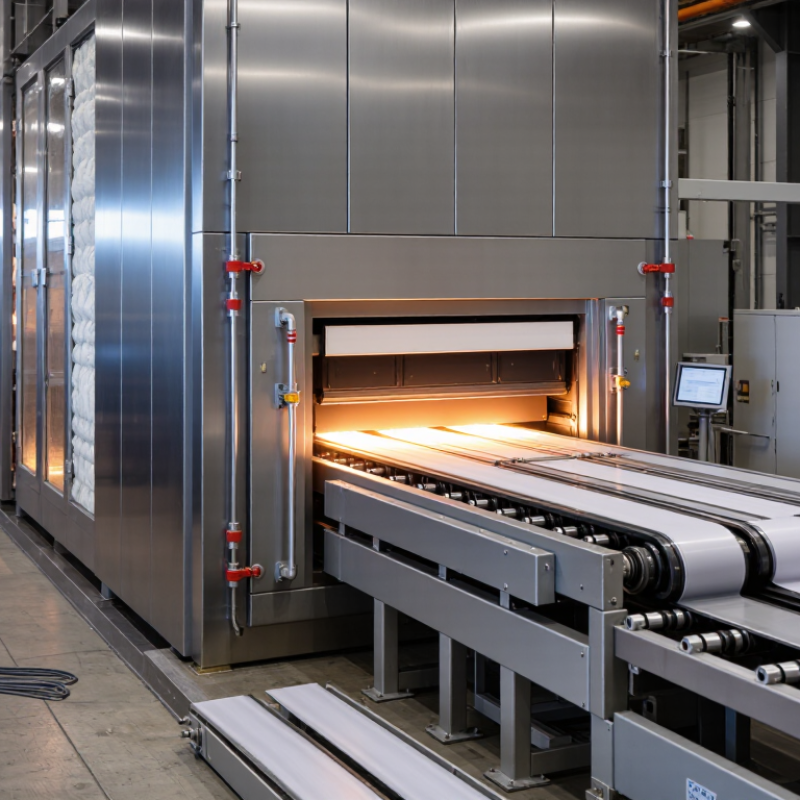
| Typical Furnace Configuration | Continuous mesh-belt or solid-belt furnace with preheating, heating, cooling, and discharge sections. | Multi-zone continuous furnace with sealed chambers, atmosphere control, rapid cooling, and integrated dew-point monitoring. | Engineered production line combining loading, cleaning, annealing, cooling, inspection, unloading, and plant-level controls. |
| Common Operating Temperature | Approximately 600–950 °C, depending on alloy, component geometry, and annealing cycle. | Approximately 850–1,200 °C for high-temperature ferrous, stainless-steel, copper, and nickel-alloy applications. | Approximately 600–1,250 °C, with the usable range defined by the selected heating elements, insulation, atmosphere, and process recipe. |
| Atmosphere Options | AirNitrogenLow-oxygen air | NitrogenNitrogen-hydrogenEndothermic gasDew-point control | Multi-gas recipesOxygen monitoringHydrogen safety systemRecipe-based control |
| Usual Effective Belt Width | About 100–600 mm for general-purpose component production. | About 300–1,200 mm for higher-throughput or atmosphere-sensitive production. | Approximately 200–1,500 mm, subject to product size, loading pattern, thermal uniformity, and factory layout. |
| Typical Throughput Approach | Batch size and belt speed are selected for small-to-medium production volumes and relatively stable product families. | Throughput is calculated from belt width, product loading density, belt speed, residence time, and required heating or cooling rate. | Line capacity is matched to takt time, upstream forming or machining, downstream inspection, and planned annual output. |
| Temperature-Zone Arrangement | Commonly 3–8 independently controlled zones, including preheat, soak, and cooling sections. | Often 6–15 or more controlled zones, allowing tighter ramp, soak, atmosphere, and cooling management. | Zone count is custom-designed using thermal modeling, product trials, heat-balance calculations, and required production takt time. |
| Temperature Uniformity Target | Typically around ±5–10 °C after stabilization, depending on furnace size and process requirements. | Typically around ±3–5 °C in the working zone when properly loaded and commissioned. | Project-specific acceptance criteria, commonly verified through temperature uniformity surveys and production-load testing. |
| Heating Technology | Electric resistance heating with ceramic, metallic, or silicon-carbide heating elements selected for the operating range. | Multi-zone electric resistance heating with high-temperature elements, independent power control, and thermal insulation optimized for atmosphere service. | Heating, cooling, exhaust, and energy systems are selected through a complete thermal and utility assessment. |
| Cooling Capability | Natural or forced-air cooling for components that do not require an accelerated or atmosphere-protected quench. | Controlled forced-air or indirect gas cooling, commonly with closed-loop temperature monitoring. | Custom cooling tunnels, gas cooling, water-jacket systems, or staged cooling may be integrated according to metallurgy and cycle-time requirements. |
| Belt Materials | Heat-resistant stainless-steel mesh, balanced-weave mesh, or solid belt selected for load, temperature, and product geometry. | High-temperature stainless-steel or nickel-alloy belt options for demanding temperature, atmosphere, and service-life conditions. | Belt construction is selected after reviewing product weight, contact marks, abrasion, distortion risk, atmosphere, and maintenance strategy. |
| Process Control | PLC-based control with touchscreen HMI, temperature recording, alarms, and basic recipe storage. | PLC/SCADA control with recipe management, atmosphere feedback, data logging, password levels, and remote diagnostic capability. | Factory-wide integration may include MES connectivity, barcode or RFID tracking, OEE reporting, historian systems, and automated quality release. |
| Atmosphere and Safety Features | Basic exhaust, gas-flow control, over-temperature protection, door or access interlocks, and emergency shutdown. | Gas leak detection, purge sequences, oxygen monitoring, hydrogen-safe ignition and shutdown logic, pressure control, and interlocked access protection. | Full safety review covering gas storage, ventilation, combustion or electrical systems, hazardous-area requirements, emergency response, and operator access. |
| Customization Scope | Belt width, furnace length, heating zones, loading height, atmosphere option, and discharge arrangement. | Thermal profile, gas mixing, dew-point control, cooling rate, belt material, data acquisition, and product-specific fixtures. | Complete line layout, robotics, washing, pre-treatment, quenching, inspection, traceability, material handling, and plant utilities. |
| Best-Fit Applications | General steel parts, fasteners, stamped components, small hardware, copper parts, and repetitive production with moderate atmosphere sensitivity. | Stainless-steel parts, precision components, wire products, electronic or electrical materials, copper alloys, and applications requiring controlled surface condition. | Automotive, aerospace, energy, appliance, and high-volume industrial programs requiring validated recipes, traceability, and integrated automation. |
| Validation and Documentation | Operating manuals, electrical drawings, spare-parts lists, calibration records, and basic factory acceptance testing. | Includes process recipes, instrument calibration, atmosphere records, temperature uniformity testing, factory acceptance testing, and commissioning reports. | May include complete design qualification, installation qualification, operational qualification, performance qualification, risk assessments, and digital documentation packages. |
| Relevant Technical Frameworks | Requirements are commonly aligned with applicable machinery, electrical, pressure, and workplace-safety regulations in the destination market. | May additionally require heat-treatment control practices such as AMS2750-style temperature measurement and uniformity methods where contractually specified. | Project compliance is defined by the buyer’s industry, destination-country regulations, customer specifications, and required certification scheme. |
| Service Model | Remote troubleshooting, commissioning support, operator training, planned maintenance guidance, and replacement parts. | Application engineering, process trials, atmosphere tuning, preventive maintenance programs, calibration support, and remote diagnostics. | Project management, installation supervision, production ramp-up, operator certification, spare-parts planning, lifecycle upgrades, and service-level agreements. |
| Most Important Buyer Checks | Actual temperature profile, belt life, energy consumption, spare-parts availability, and suitability for the intended product mix. | Atmosphere stability, dew point, oxygen level, uniformity under production load, cooling performance, safety system design, and data integrity. | Reference-cycle results, guaranteed throughput, integration responsibility, acceptance criteria, utility consumption, cybersecurity, training, and long-term support. |