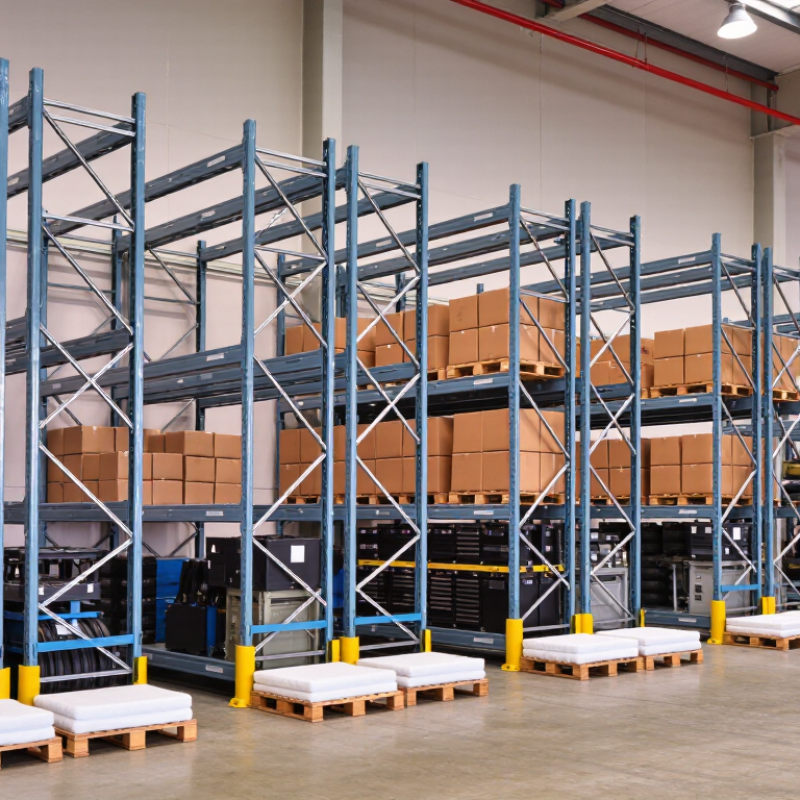
| Product Type | Heavy-duty boltless shelving, pallet racking, wall-mounted systems, workbenches, cabinets, and overhead storage. | Confirm whether the supplier manufactures the core structure or only trades finished products. | Product configuration should match garage size, ceiling height, loading method, and intended frequency of access. | High |
| Load Capacity | Common shelf capacities range from approximately 150 kg to 1,000 kg per level, depending on structure and design. | Request tested load ratings, evenly distributed load conditions, beam specifications, and safety factors. | Capacity should be stated per shelf or per bay, not only as a general product description. | Critical |
| Material and Thickness | Cold-rolled steel is widely used; structural thickness varies according to load and rack type. | Check steel grade, component thickness, weld quality, corrosion protection, and material inspection records. | Ask for component drawings and a sample measurement before approving mass production. | Critical |
| Surface Treatment | Powder coating is commonly used for indoor garage racks; galvanized finishes are more suitable for humid environments. | Verify coating thickness, adhesion, color consistency, pretreatment process, and corrosion-resistance testing. | Standard colors may reduce cost and lead time; custom colors generally require an agreed color reference. | High |
| Dimensional Customization | Typical customization includes width, depth, height, shelf spacing, upright profile, and cabinet layout. | Confirm tolerance requirements, installation clearance, CAD drawing approval, and whether tooling charges apply. | Custom dimensions are practical when the supplier provides engineering drawings and pre-production samples. | High |
| Modular Design | Adjustable shelves, extendable bays, interchangeable accessories, and boltless assembly improve long-term usability. | Check connector strength, shelf-adjustment increments, compatibility of replacement parts, and expansion options. | Modular products generally simplify flat-pack export, storage, and after-sales replacement. | High |
| Safety Features | Recommended features include anti-tip devices, safety pins, reinforced beams, rounded edges, and stable feet. | Request assembly instructions, stability test results, maximum bay height guidance, and anchoring recommendations. | Free-standing tall racks may require wall or floor anchoring depending on local safety requirements. | Critical |
| Compliance Documentation | Documentation should match the destination market and product category. | Ask for material declarations, test reports, packing specifications, user manuals, and applicable conformity documents. | Documentation requirements may differ for household storage, commercial shelving, and industrial pallet racking. | High |
| Quality Control | A reliable process includes incoming-material inspection, in-process checks, final inspection, and packing inspection. | Confirm inspection checkpoints, sampling standards, corrective-action procedures, and third-party inspection acceptance. | Pre-shipment inspection is especially useful for custom orders and mixed-container shipments. | Critical |
| Prototype and Sample Service | A physical sample or approved production sample should be available before large-scale production. | Clarify sample cost, sample lead time, freight responsibility, and whether the sample fee is refundable. | Sample approval should cover dimensions, finish, assembly, packaging, and accessory compatibility. | High |
| Export Packaging | Flat-pack cartons, protective foam, corner protection, moisture control, and labeled hardware are commonly used. | Check carton compression strength, drop-test approach, palletization, container utilization, and spare-part packing. | Efficient nesting and flat packing can reduce shipping volume and damage risk. | High |
| Container and Shipping Efficiency | Shipping efficiency depends on product volume, packing method, and the selected container type. | Request a packing list showing carton dimensions, gross weight, net weight, cubic volume, and loading quantity. | Compare total landed cost rather than factory price alone, including freight, duties, inspection, and local handling. | High |
| Minimum Order Quantity | MOQ varies by product complexity, customization level, packaging requirements, and production setup. | Confirm separate MOQs for standard items, custom colors, custom dimensions, private packaging, and mixed models. | Standard products generally offer more flexible trial-order quantities than fully customized designs. | Medium |
| Lead Time | Standard orders commonly require several weeks; custom designs may require additional engineering and sampling time. | Obtain a written schedule covering drawing approval, sampling, production, inspection, and shipment readiness. | Lead time can increase during peak manufacturing periods or when special steel and coatings are required. | High |
| Trade Terms | Common international trade terms include EXW, FOB, CIF, and DDP, subject to contract conditions. | Confirm exactly which costs, risks, customs responsibilities, and delivery points are included in the quotation. | For a comparable supplier evaluation, request quotations under the same Incoterm and destination assumptions. | High |
| Payment Terms | Payment arrangements should be linked to order confirmation, sample approval, production, and inspection milestones. | Review deposit percentage, balance timing, payment security, refund conditions, and documentation required before release. | Use a written purchase contract covering specifications, tolerances, delivery dates, and remedies for nonconformity. | Critical |
| After-Sales Support | Essential support includes spare parts, replacement components, assembly guidance, and response procedures. | Check warranty scope, claim evidence requirements, response time, replacement policy, and technical support channels. | Suppliers should retain drawings and component records for repeat orders and replacement requests. | High |
| Supplier Verification | Use business-license checks, factory audits, production-capacity reviews, reference orders, and inspection records. | Verify legal entity details, factory location, export history, manufacturing equipment, and consistency of product information. | Independent audits and pre-shipment inspections reduce the risk of capacity, quality, and documentation discrepancies. | Critical |
| Total Cost of Ownership | Evaluate purchase price, shipping volume, installation labor, maintenance, spare parts, damage rate, and expected service life. | Compare equivalent specifications rather than comparing price alone. | A slightly higher unit price may be justified by stronger steel, better packaging, lower damage risk, or longer support. | Critical |