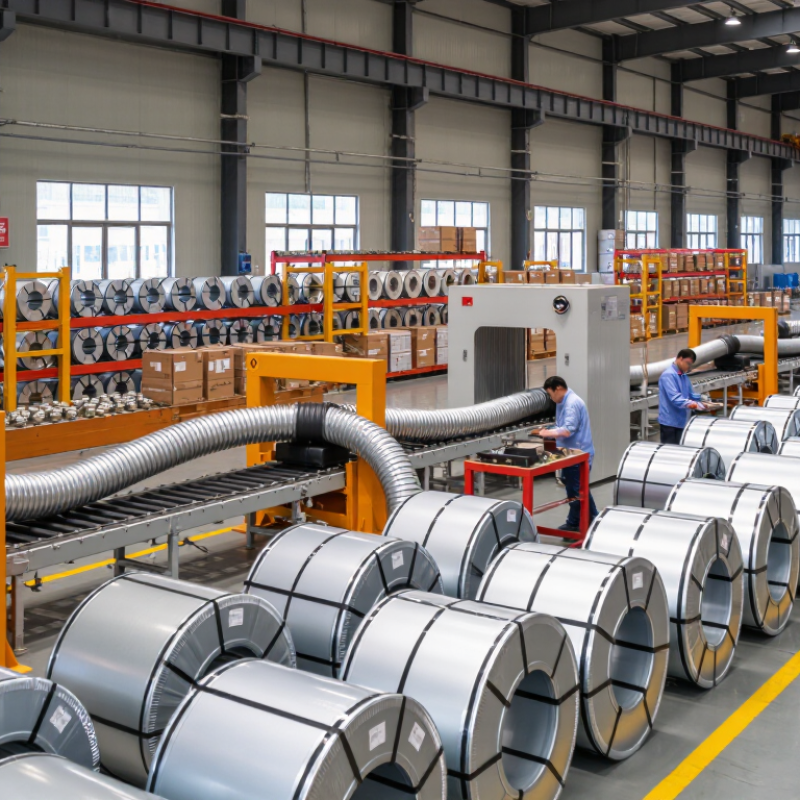
| Core Conduit Construction | Flexible metallic raceway with a liquid-resistant outer jacket | Helically wound galvanized-steel strip or stainless-steel strip with a polymer jacket | Confirm the metal type, strip thickness, winding method, and jacket adhesion |
| Applicable Product Standard | Compliance with the destination-market standard | UL 360 for liquid-tight flexible steel conduit; CSA C22.2 No. 56 for flexible metallic conduit; IEC 61386 series where applicable | Request current certificates, test reports, and the exact product-size range covered |
| Available Metal Materials | Material selection based on corrosion exposure and installation environment | Galvanized steel for general applications; stainless steel grades such as 304 or 316 for more demanding environments | Check material certificates, surface treatment, and corrosion-resistance test results |
| Nominal Trade Sizes | Size selection according to cable quantity, bend radius, and local electrical code | Common ranges include 3/8 in to 4 in; metric equivalents may also be available | Compare actual inside diameter, outside diameter, and tolerance rather than nominal size alone |
| Jacket Material | Resistance to water, oil, sunlight, abrasion, and temperature variation | PVC or other engineered polymer jackets selected according to the required environment | Review temperature range, UV resistance, oil resistance, flame behavior, and jacket flexibility |
| Ingress Protection | Protection against water and dust when the complete conduit system is correctly assembled | Liquid-tight performance depends on the conduit, fittings, seals, and installation method | Verify the tested assembly configuration; do not assess protection from conduit alone |
| Operating Temperature | Stable performance under the ambient and conductor-temperature conditions of the project | The allowable range varies by jacket compound, construction, and certification; many products are specified around -20°C to +60°C ambient conditions | Use the manufacturer’s datasheet for the exact temperature rating and installation limitations |
| Mechanical Performance | Resistance to crushing, impact, repeated bending, and tensile stress | Performance depends on steel strip profile, metal thickness, interlocking design, and jacket construction | Request compression, impact, flexibility, and minimum-bend-radius test data |
| Fittings and Accessories | Secure mechanical connection and continuous liquid-tight protection | Straight, 45-degree, and 90-degree fittings; metallic or polymer sealing components may be offered | Confirm thread type, fitting material, sealing method, and compatibility with the conduit series |
| Typical Application Areas | Flexible wiring protection in locations exposed to vibration, moisture, or movement | Industrial machinery, HVAC equipment, pumps, motors, control panels, outdoor installations, and transportation equipment | Match the product to chemical exposure, washdown conditions, vibration level, and local code requirements |
| Quality-Control Indicators | Consistent dimensions, reliable jacket bonding, traceable raw materials, and repeatable batch quality | Incoming-material inspection, dimensional checks, leak testing, mechanical testing, and documented final inspection | Ask for inspection plans, batch traceability, sample reports, factory audit access, and production lead times |