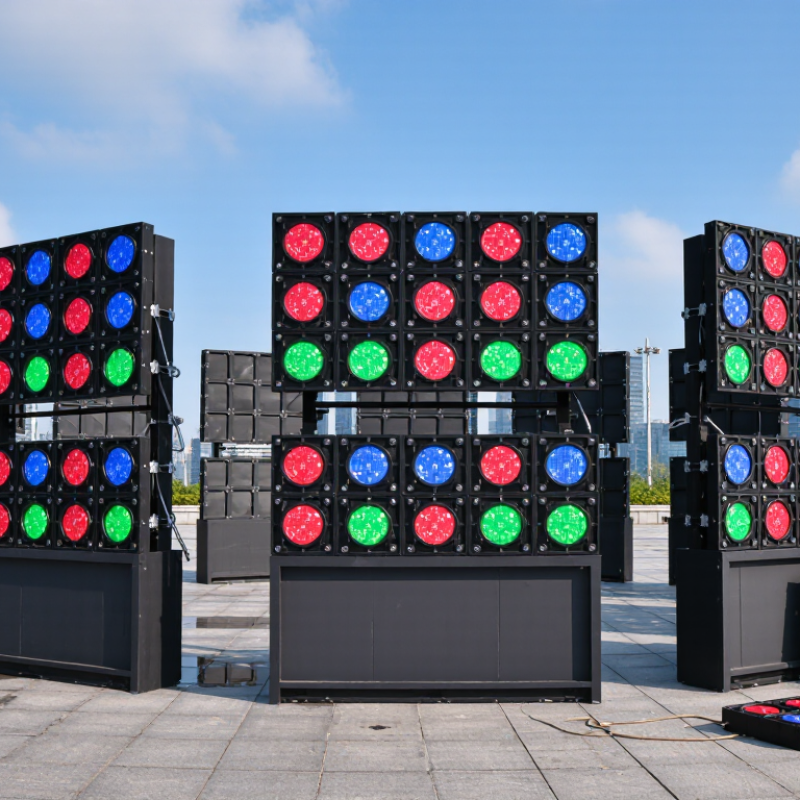
| Outdoor DIP LED expertise | Through-hole DIP pixels are commonly used in outdoor displays where high brightness and visibility over longer viewing distances are priorities. | Helps assess whether the display technology suits billboards, stadium perimeters, and other large-format installations. | Ask for a working sample, pixel-pitch options, viewing-distance guidance, and project references for comparable environments. |
| Brightness and daylight readability | Outdoor LED displays are commonly specified in the several-thousand-nit range; the required level depends on sunlight exposure, orientation, and local conditions. | Adequate brightness supports legibility in daylight, while brightness control can reduce unnecessary power use at night. | Request measured brightness data, measurement conditions, automatic dimming options, and nighttime operating settings. |
| Weather resistance | Outdoor cabinets and modules are designed with sealed construction; IP ratings should be stated separately for the front and rear where applicable. | Ingress protection is important for installations exposed to rain, dust, and outdoor cleaning. | Check the exact IP rating, applicable test standard, test report, drainage design, and maintenance access. |
| Heat management and reliability | Cabinet design, ventilation, component selection, and operating temperature limits all affect performance in hot or cold climates. | Effective thermal design can help reduce heat-related failures and maintain stable operation. | Request operating-temperature limits, thermal test results, cooling details, and the proposed maintenance schedule. |
| Power efficiency | Power consumption varies with pixel pitch, brightness, content, refresh settings, and cabinet design; maximum and typical values should both be provided. | A realistic power estimate helps buyers size electrical infrastructure and forecast operating costs. | Compare power figures at stated brightness and content conditions, and confirm voltage, peak load, and power-supply redundancy. |
| Cabinet customization | Cabinet dimensions, mounting structure, service access, and module layout can be configured to suit the installation. | A suitable cabinet design can simplify installation and ongoing maintenance. | Confirm cabinet drawings, total weight, wind-load requirements, access method, and responsibility for structural engineering. |
| Quality control and testing | Relevant checks may include incoming-material inspection, module aging, cabinet testing, and final display testing. | Documented quality procedures make production consistency easier to evaluate. | Request inspection records, acceptance criteria, test videos, and details of how pixel defects are handled. |
| Control system compatibility | The display system should specify supported input formats, control hardware, software, network options, and remote-monitoring functions. | Compatibility affects content workflows, system integration, and troubleshooting. | Confirm supported interfaces, software licensing, remote access requirements, and spare-part availability. |
| Warranty and after-sales support | Warranty duration, covered components, response times, and spare-parts arrangements differ by supplier and contract. | Clear support terms help reduce operational risk over the display’s service life. | Review written warranty terms, exclusions, remote-support process, replacement-part lead times, and local service coverage. |