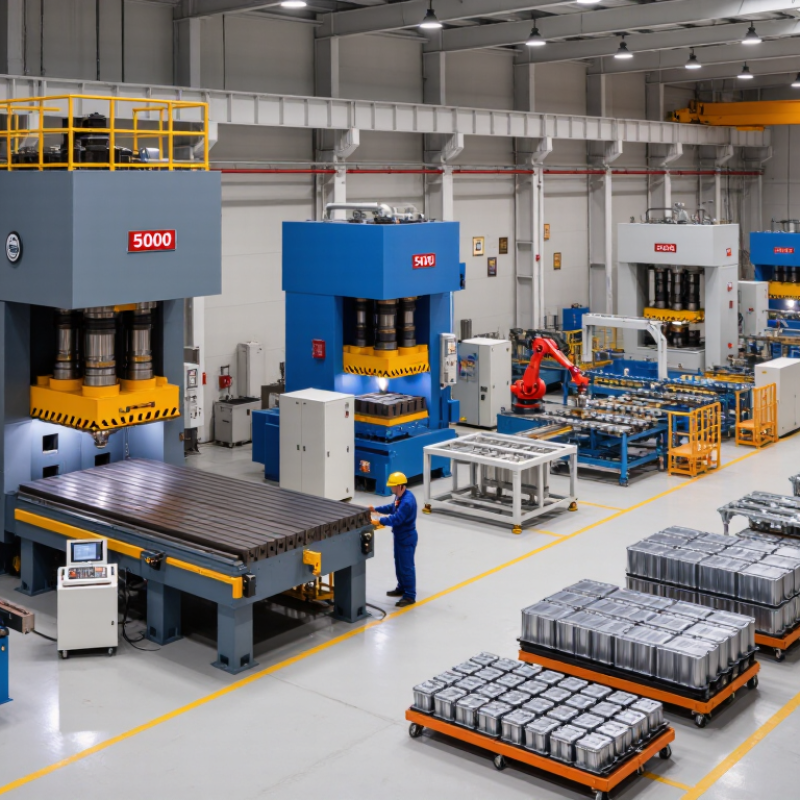
| Press Type and Application Fit | Confirm that the supplier’s mechanical, hydraulic, servo, or transfer press design matches the forming process, material, die structure, and required production volume. | The rated tonnage, stroke, shut height, bolster dimensions, slide area, and speed should match the approved die and part drawings with engineering margin. | Equipment datasheet, die-layout review, load calculation, sample-part validation, and technical quotation. | 15% |
| Rated Capacity and Structural Rigidity | Assess whether the frame, slide, crankshaft, connecting rods, and guides can withstand continuous loads without excessive deflection or premature wear. | The machine should provide the required nominal force within the manufacturer’s specified operating range, rather than relying on short-duration overload capacity. | Structural drawings, allowable-load chart, static-load test results, guide-clearance data, and third-party inspection report. | 12% |
| Accuracy and Repeatability | Review slide parallelism, shut-height repeatability, feeder accuracy, stroke consistency, and part-to-part dimensional stability. | Acceptance limits should be agreed in writing according to the part tolerance, die design, and applicable machine standard; avoid accepting unspecified “high precision” claims. | Factory acceptance test, calibrated measurement records, sample run, dimensional inspection report, and agreed tolerance sheet. | 14% |
| Safety and Compliance | Verify guarding, emergency stops, two-hand controls, light curtains, safety relays, electrical protection, and documentation for the destination market. | The final configuration should satisfy the buyer’s applicable legal and safety requirements, such as machinery, electrical, and workplace-safety rules in the importing country. | Risk assessment, circuit diagrams, safety-component list, conformity documentation, inspection certificate, and witnessed safety test. | 15% |
| Automation and Integration | Evaluate compatibility with decoilers, straighteners, servo feeders, transfer systems, sensors, die protection, production monitoring, and factory networks. | Interface specifications, communication protocols, cycle timing, signal lists, and mechanical connection points should be defined before order placement. | Automation layout, I/O list, control architecture, trial-run video, interface drawings, and integration responsibility matrix. | 10% |
| Quality Management and Traceability | Check how incoming materials, machining, welding, assembly, painting, electrical wiring, and final testing are controlled and recorded. | A documented quality system, controlled drawings, inspection checkpoints, nonconformance process, and serial-number traceability should be available. | Quality certificates, inspection plans, material certificates, calibration records, process photographs, and audit findings. | 10% |
| Service, Spare Parts, and Training | Assess commissioning support, operator training, troubleshooting capability, spare-parts availability, remote assistance, and local service coverage. | The contract should specify response times, warranty scope, exclusions, recommended spare-parts list, training hours, and escalation contacts. | Service-level agreement, warranty terms, spare-parts quotation, training plan, service records, and customer references with similar applications. | 12% |
| Delivery, Installation, and Documentation | Review manufacturing lead time, export packing, transport dimensions, foundation requirements, installation scope, manuals, and commissioning milestones. | The supplier should provide a milestone schedule, shipping dimensions and weights, utility requirements, foundation drawings, and complete operation and maintenance manuals. | Project schedule, packing specification, bill of materials, installation method statement, manuals, and pre-shipment inspection checklist. | 7% |
| Total Cost of Ownership | Compare purchase price with energy consumption, tooling compatibility, maintenance, consumables, downtime risk, freight, installation, and future upgrades. | Use a multi-year cost model instead of comparing equipment prices alone; include all accessories, taxes, shipping, commissioning, and critical spare parts. | Itemized commercial offer, energy data, maintenance schedule, spare-parts pricing, operating-cost assumptions, and lifecycle-cost calculation. | 5% |