Top CNC Turning Machining Companies Worldwide?

The global Cnc Turning Machining industry is changing quickly. Buyers now expect accuracy, repeatability, speed, and documented quality from every supplier. A polished website is not enough. Real capability appears in the workshop, beside the machine.

Dr. W. Edwards Deming, a leading manufacturing quality expert, said, “Quality comes not from inspection, but from the improvement of the production process.” His principle remains highly relevant to CNC turning. Strong companies control the entire route, from material certification and CAD preparation to tool selection, probing, inspection, and final packing. A stable production line should produce consistent shafts, bushings, threads, and complex profiles without excessive correction.

This guide examines leading Cnc Turning Machining companies worldwide through practical criteria. These include machine capability, tolerance control, engineering support, production capacity, surface-finish performance, delivery reliability, and traceability. Some suppliers excel at prototypes. Others manage thousands of repeat parts. Few perform equally well in every category.

That difference matters.

A supplier may advertise five-axis equipment, yet lack disciplined process control. Another may operate older lathes but deliver remarkably stable results. This is where evaluation becomes less comfortable. Equipment lists can impress, but measured parts tell the truth.

The following overview also considers industries such as aerospace, automotive, medical devices, energy, and industrial automation. Each demands different materials, tolerances, certifications, and documentation. No single company is automatically the best choice for every project. Careful comparison remains essential, especially when cost pressure hides risks in quality, communication, or delivery.

Top CNC Turning Machining Companies Worldwide?

What Is CNC Turning and Why Does It Matter Globally?

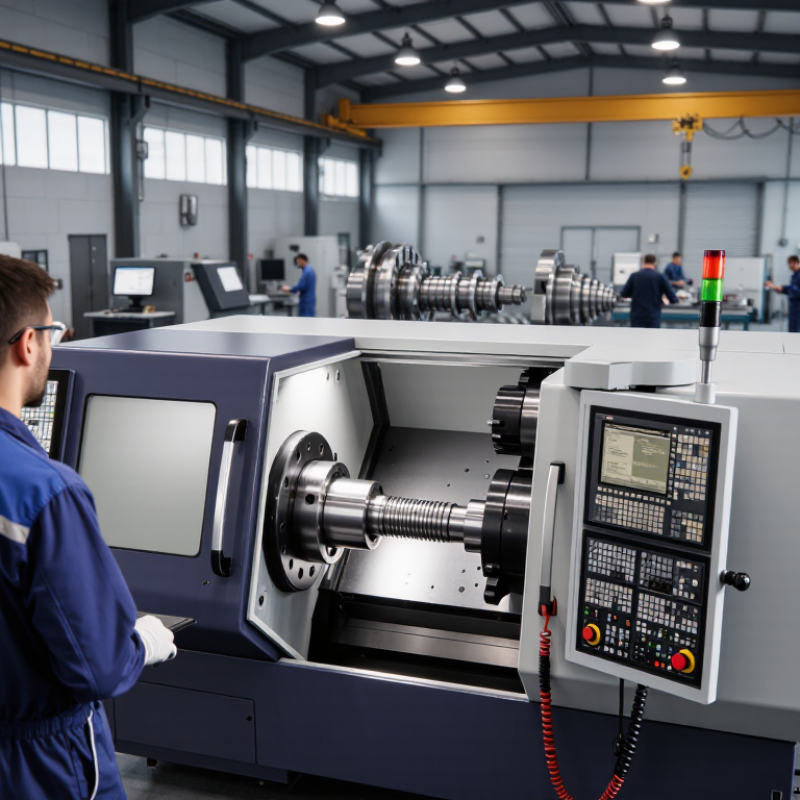
CNC turning is a subtractive process built around rotation. The workpiece spins in a chuck while a cutting tool removes material. This produces shafts, bushings, threads, and precise cylindrical features. Modern machines can combine turning, drilling, milling, and automated inspection. That flexibility matters globally.

The International Federation of Robotics reported 541,302 industrial robots installed worldwide in 2023. Many support machine tending, loading, and unloading. This helps turning workshops maintain production across different labor markets. A 2024 CNC machine market analysis also projected strong growth through the next decade. Estimates differ, however. Market forecasts are useful signals, not guarantees. Energy costs, tooling skills, and supply disruptions can change the result quickly. No process is flawless.

Tips: Check spindle speed, feed rate, tool wear, and coolant flow together. A shiny surface can still hide poor dimensional accuracy. Ask suppliers for inspection records, material certificates, and capability data. ISO 230 testing principles can support machine accuracy checks. In practice, experienced operators often catch problems before software does. That human judgment remains important.

Top CNC Turning Machining Companies Worldwide? – What Is CNC Turning and Why Does It Matter Globally?

CNC turning is a subtractive manufacturing process in which a computer-controlled lathe rotates a workpiece while cutting tools remove material. Its global importance comes from repeatable accuracy, efficient production, and compatibility with metals and engineering plastics used in automotive, aerospace, medical, energy, and industrial equipment manufacturing.

The chart shows representative dimensional tolerance targets commonly associated with CNC turning operations. Lower values indicate tighter dimensional control. Actual results vary according to machine condition, tooling, workpiece material, geometry, thermal stability, measurement method, and production requirements.

How Are Leading CNC Turning Companies Evaluated?

Leading CNC turning companies are evaluated through evidence, not attractive machine photos. Buyers inspect dimensional accuracy, repeatability, spindle capacity, tooling control, and delivery performance. ISO 230-2 testing can verify positioning accuracy and repeatability under defined conditions. ISO’s 2023 Survey recorded over 1.26 million ISO 9001 certificates worldwide, showing why documented quality systems matter. Certification alone proves little without recent inspection records.

Operational depth also matters. Ask for sample inspection reports, material traceability, calibration dates, and corrective-action records. A reliable supplier should explain how it manages tolerance drift during long production runs. It should also reveal average lead times and on-time delivery rates. Deloitte’s 2024 Smart Manufacturing survey found that 86% of manufacturing leaders expect smart operations to remain important for competitiveness. Still, digital dashboards cannot replace skilled operators. That is where many evaluations become too optimistic.

Tips: Request a small trial batch before approving larger volumes. Measure critical diameters, thread profiles, surface finish, and concentricity independently. Compare the results with the supplier’s report. Also check how quickly the team responds when a measurement fails. World Economic Forum research reports that 44% of workers’ core skills may change by 2027, so training records deserve attention. A polished factory can still hide weak process discipline. Look closer.

Which Companies Lead the Global CNC Turning Industry?

Which companies lead the global CNC turning industry?

The strongest performers are not always the largest factories. They are usually suppliers that combine accurate equipment, skilled operators, stable processes, and dependable communication.

Global leaders often serve demanding aerospace, medical, automotive, and industrial customers. Their facilities may use multi-axis turning centers, automatic bar feeders, robotic loading, and in-process inspection.

More importantly, they control temperature, tooling wear, and material traceability. A finished shaft should match its drawing at 7 a.m. and late afternoon.

Consistency matters more.

Reliable companies support claims with evidence.

Look for ISO 9001 certification, documented inspection plans, calibrated measuring equipment, and clear corrective-action records. Advanced suppliers may also hold sector-specific approvals, but certificates alone do not guarantee excellent work.

A polished website proves little. Production samples, audit results, and realistic delivery records reveal much more.

Regional specialists can lead in complex, low-volume work. Large international groups may offer broader capacity and stronger supply continuity. The better choice depends on tolerance, alloy, annual volume, and required documentation.

During supplier evaluations, ask how they handle tool breakage, rejected parts, and engineering changes. Their answers often expose operational maturity.

Even experienced buyers can overvalue machine count.

That is a mistake. A smaller shop with disciplined inspection may outperform a larger facility with weak process control. Data exposes weakness.

Real leadership appears in repeatable parts, honest lead-time updates, and corrective action when the process fails.

What Industries and Applications Do These Companies Serve?

Top CNC Turning Machining Companies Worldwide

Leading CNC turning companies serve far more than general metalworking. Their capabilities support aerospace, medical devices, automotive systems, energy equipment, robotics, and industrial automation. Each sector demands different results. Aerospace components often require lightweight alloys, tight tolerances, and complete material traceability. Medical parts need clean surfaces, repeatable dimensions, and careful inspection records. Automotive customers usually prioritize volume, cycle time, and consistent pricing.

Applications can be surprisingly specific. A turned shaft may guide a robotic joint. A threaded medical component may fit inside a surgical instrument. In energy equipment, precision bushings can withstand vibration, heat, and pressure. Experienced suppliers combine CNC lathes, live tooling, automated measurement, and documented process controls. However, no supplier is perfect. A strong production record does not guarantee success with every alloy or geometry. Trial parts still matter. So does direct technical communication.

Tips: Ask for sample inspection reports, tolerance capability data, and material certificates. Confirm whether the shop can manage prototypes and larger production runs. Review surface-finish methods before approving the design. Clear drawings prevent expensive corrections. Also, discuss packaging and corrosion protection early. These details seem minor. They often affect field performance.

How Is the Global CNC Turning Market Evolving?

The global CNC turning market is shifting from low-cost volume work toward faster, smarter, and more flexible production. Manufacturers now serve automotive, medical, aerospace, energy, and electronics customers with tighter tolerances. A typical modern cell may combine a turning center, bar feeder, probing system, and automated inspection. This setup reduces handling time and supports stable production across multiple shifts.

Demand is growing for smaller batches and complex parts. Buyers increasingly expect digital production records, shorter lead times, and consistent surface finishes. Connected machines help operators monitor tool wear, spindle load, and cycle variation before defects spread. Skilled technicians still matter, especially when materials behave differently during cutting. Automation helps, but it does not replace judgment.

The market is not perfectly balanced. Regional labor costs, energy prices, and supply risks continue to influence sourcing decisions. Some companies are bringing production closer to customers, while others maintain overseas capacity for large recurring orders. Forecasts can overstate the speed of this transition. Many workshops still use older equipment because replacement costs remain high. That reality creates a mixed market, where advanced automation operates beside manual inspection and paper-based procedures. Reliability depends on measurable process control, qualified operators, and honest communication about capability.

Top CNC Turning Machining Companies Worldwide? - How Is the Global CNC Turning Market Evolving?

Global CNC turning market benchmark table based on manufacturing, industrial-robotics, energy-efficiency, and international machine-tool standards data

Market Dimension Verified Data Point Current Benchmark Market Direction Relevance to CNC Turning Authoritative Source
Global industrial robot installations Annual installations of industrial robots worldwide 541,302 units in 2023 Stable at a historically high level Supports automated loading, unloading, part transfer, tending, inspection, and palletizing for turning cells. International Federation of Robotics, World Robotics 2024
Asia-Pacific automation demand Share of global industrial robot installations located in Asia in 2023 Approximately 73% Strong regional concentration Creates the largest demand center for automated CNC turning lines, especially in automotive, electronics, and general engineering. International Federation of Robotics, World Robotics 2024
European automation demand Share of global industrial robot installations located in Europe in 2023 Approximately 15% Mature and automation-intensive Encourages high-accuracy turning, flexible production cells, traceability, and energy-management upgrades. International Federation of Robotics, World Robotics 2024
Americas automation demand Share of global industrial robot installations located in the Americas in 2023 Approximately 11% Steady adoption Supports reshoring, lights-out production, and automated machining for automotive, aerospace, medical, and industrial components. International Federation of Robotics, World Robotics 2024
Machine-tool energy efficiency International methodology available for measuring and improving machine-tool energy efficiency ISO 14955 series Increasing importance Drives demand for efficient spindle systems, standby modes, optimized hydraulics, regenerative drives, and energy monitoring. ISO 14955-1:2017
Geometric accuracy evaluation International standard covering geometric accuracy testing of machine tools ISO 230-1:2012 Established quality baseline Provides a common framework for evaluating positioning, alignment, straightness, squareness, and rotational accuracy in CNC turning equipment. ISO 230-1
Machine-tool safety requirements International safety framework for machining centres and milling machines ISO 16090-1:2022 More stringent compliance focus Reflects the market shift toward guarded automation, interlocks, risk assessment, and safer integrated production cells. ISO 16090-1:2022
Digital production monitoring Common data requirements for connecting manufacturing assets and collecting production information OPC UA and ISO 23247-related digital-twin practices Rapidly expanding Enables real-time machine monitoring, utilization analysis, predictive maintenance, quality records, and production scheduling. ISO 23247-1:2021
CNC turning process flexibility Typical production capability enabled by live tooling, automatic tool offsets, bar feeding, and robotic tending Suitable for high-mix and high-volume production Broader application range Modern turning systems increasingly combine turning, drilling, milling, inspection, and automated material handling in one cell. ISO 14955 machine-tool energy methodology
Primary end-use sectors Industries using precision turned components Automotive, aerospace, medical, energy, electronics, hydraulics, and general engineering Diversified demand base Sector diversification reduces reliance on a single industry and increases demand for different size, tolerance, material, and traceability requirements. UNIDO Industrial Statistics
Key purchasing criteria Common technical and commercial evaluation factors Accuracy, cycle time, uptime, automation compatibility, serviceability, energy use, and total cost of ownership More data-driven procurement Buyers increasingly evaluate complete production-cell performance instead of machine purchase price alone. ISO 14955-1:2017
Data note: The table intentionally excludes company names, brands, vendor rankings, and company-specific financial figures. Regional robot-installation shares are rounded values reported by the International Federation of Robotics. International standards are shown as technical market benchmarks rather than market-size estimates.
Top