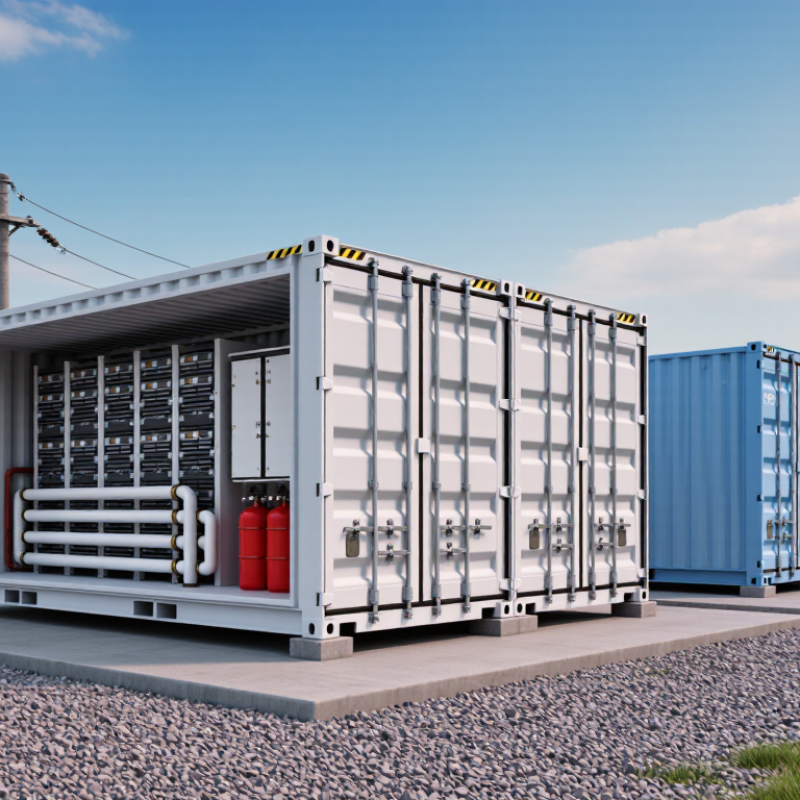
| Container Size and Energy Capacity | Standard 20-foot and 40-foot container formats; many commercial systems are configured from approximately 1 MWh to more than 5 MWh per container. | Determines transport requirements, site footprint, installation cost, and the amount of energy available for the intended application. | Usable versus nominal capacity, dimensional drawings, total shipping weight, module layout, and expansion options. |
| Battery Chemistry | Lithium iron phosphate is widely used in stationary storage because of its thermal stability and cycle-life characteristics; other lithium chemistries may be selected for specific power or energy requirements. | Chemistry affects safety behavior, energy density, operating temperature, degradation, and total cost of ownership. | Cell chemistry, cell manufacturer, independent test results, degradation model, and end-of-life capacity definition. |
| Power Rating and Duration | Common systems range from a few hundred kilowatts to several megawatts, with durations often specified from 1 to 4 hours. | A system designed for frequency regulation has different power and duration needs from one designed for peak shaving or renewable-energy shifting. | Continuous power, short-term overload capability, charge/discharge duration, auxiliary-load assumptions, and performance at partial load. |
| Round-Trip Efficiency | Approximately 85% to 95% at the system level is a commonly stated range, depending on operating conditions and whether auxiliary consumption is included. | Higher efficiency reduces energy losses and improves operating economics over the project lifetime. | Test conditions, AC- or DC-side calculation method, temperature assumptions, auxiliary consumption, and guaranteed efficiency. |
| Cycle Life and Degradation | Cycle-life claims commonly depend on depth of discharge, temperature, charge/discharge rate, and end-of-life capacity; stationary-system warranties often define 70% to 80% remaining capacity at the warranty endpoint. | Degradation directly affects available energy, revenue potential, augmentation requirements, and lifetime cost. | Guaranteed capacity curve, annual throughput limit, depth-of-discharge assumptions, augmentation plan, and warranty remedies. |
| Thermal Management | Air cooling and liquid cooling are both used; liquid cooling is often selected for higher energy density and tighter temperature control. | Uniform cell temperature can improve safety, performance, and battery life. | Cooling architecture, HVAC energy use, temperature uniformity, refrigerant or coolant requirements, and maintenance intervals. |
| Fire Detection and Suppression | A complete design may include smoke, heat, and off-gas detection, alarms, emergency shutdown, ventilation, and an application-specific suppression strategy. | Thermal-event detection and mitigation are essential for personnel safety, asset protection, and permitting. | Detection locations, alarm sequence, gas-management method, suppression agent, thermal-runaway test evidence, and emergency-response procedures. |
| Electrical and Safety Compliance | Depending on the market, projects may require standards or certifications such as UL 9540, UL 9540A testing, NFPA 855, IEC 62619, IEC 62933, and local grid codes. | Compliance supports permitting, grid interconnection, insurance review, and safe operation. | Current certificates, test reports, scope of certification, applicable local standards, and responsibility for authority approvals. |
| Ingress Protection and Environmental Rating | Outdoor enclosures are commonly specified at IP54 or higher, with the exact rating depending on the enclosure, climate, and installation design. | Protection against dust and water ingress is important for outdoor reliability and maintenance planning. | IP rating, corrosion protection, salt-mist testing, humidity limits, seismic requirements, altitude derating, and wind-load data. |
| Operating Temperature | Many systems are designed for an ambient range near -20°C to 50°C, subject to power derating and HVAC operation. | Temperature affects available power, efficiency, degradation, and the suitability of the system for local weather conditions. | Guaranteed operating range, derating curve, cold-start behavior, HVAC backup, and performance under extreme-weather conditions. |
| Response Time and Grid Services | Battery inverters can typically respond in milliseconds to seconds, depending on controls, interconnection equipment, and operating mode. | Fast response is valuable for frequency regulation, voltage support, ramp-rate control, and renewable integration. | Step-response test results, ramp-rate limits, reactive-power capability, grid-forming or grid-following mode, and utility requirements. |
| Energy Management and Communications | Common interfaces include Modbus TCP, Modbus RTU, and standardized supervisory-control connections; the exact protocol depends on the project. | Reliable controls and data access are required for dispatch, monitoring, cybersecurity, and integration with plant-level systems. | SCADA interface, API availability, remote-access controls, data ownership, cybersecurity measures, and local or cloud operating options. |
| Warranty and Service Support | Product warranties are often structured around approximately 5 to 10 years, with separate terms for capacity, equipment, and availability. | Service quality influences uptime, repair time, spare-parts availability, and financial risk throughout the project. | Response-time commitments, spare-parts strategy, local technicians, remote diagnostics, warranty exclusions, and guaranteed availability. |
| Delivery and Commissioning | Schedule depends on cell availability, customization, shipping regulations, permitting, site preparation, and grid-connection approval. | A technically suitable system can still fail commercially if delivery, installation, or commissioning is delayed. | Manufacturing lead time, factory acceptance testing, shipping plan, installation responsibilities, commissioning protocol, and delay provisions. |
| Total Cost of Ownership | Evaluate capital cost together with installation, HVAC consumption, augmentation, maintenance, insurance, replacement parts, energy losses, and end-of-life handling. | The lowest purchase price does not necessarily provide the lowest lifetime cost or the highest project return. | Use a common financial model with identical assumptions for usable capacity, degradation, efficiency, operating profile, service life, and recycling obligations. |