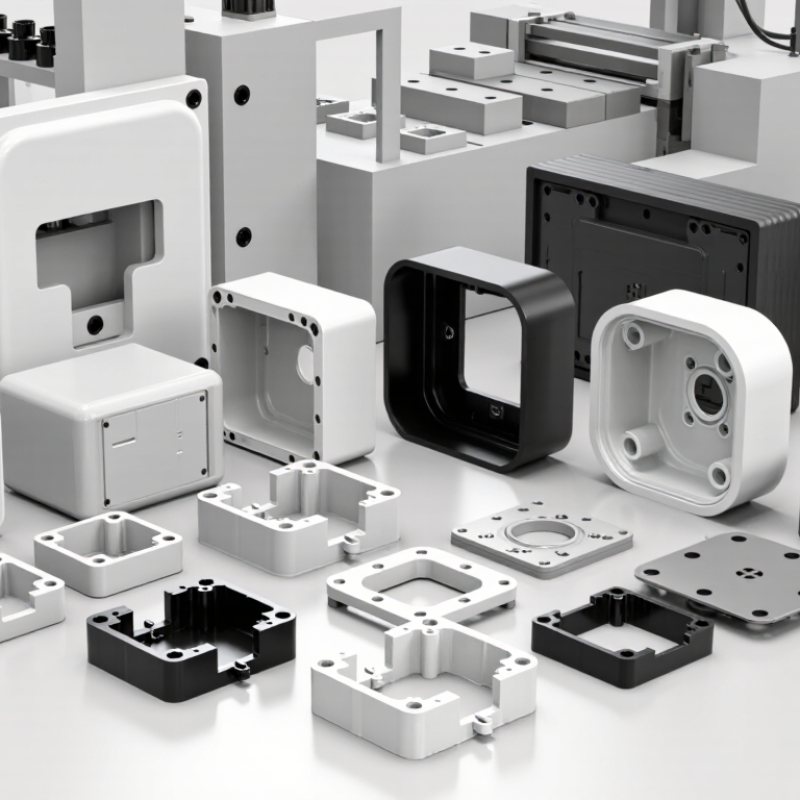
Top 10 Custom Plastic Housing Manufacturers Worldwide

Choosing a custom plastic housing manufacturer is rarely just a price comparison. A housing must protect its contents, fit surrounding components, and survive the conditions of everyday use. Small details matter: screw bosses, snap-fits, wall thickness, surface texture, and the alignment of cable openings. A polished sample can look convincing. Production consistency is harder to judge.

This guide introduces ten manufacturers worldwide and the capabilities buyers may want to examine, including design support, tooling, molding processes, quality controls, and production scale. Injection-molding educator John Bozzelli’s work offers a useful principle, paraphrased here: repeatable parts depend on controlling the process, not simply selecting capable equipment. That distinction can shape a supplier review. Ask how a company checks dimensions, handles design changes, and manages the transition from prototype to production. Request evidence where possible.

The list is a starting point, not a universal verdict. A company suited to a compact electronics enclosure may not fit a large, rugged housing project. Geography, communication, material choices, and order volume also change the calculation. Details count. Even an overlooked draft angle or poorly placed gate can affect appearance and assembly. Manufacturer claims deserve careful review, and this overview cannot replace project-specific testing. Use the comparisons to form better questions, then validate the answers with drawings, samples, and documented requirements.

Top 10 Custom Plastic Housing Manufacturers Worldwide

Defining Custom Plastic Housings: Materials, Processes, and Applications

Custom plastic housings protect electronics and influence how a product feels, mounts, and manages heat. Design begins with operating conditions: temperature, moisture, impact risk, cleaning agents, and expected service life. Material follows function. ABS offers a practical balance of strength and appearance for indoor devices. Polycarbonate handles demanding impact conditions, while polypropylene can suit parts exposed to moisture or chemicals. No resin is ideal for every environment.

The manufacturing process affects cost, finish, and design freedom. Injection molding supports consistent, high-volume production, but tooling requires upfront investment. Designers must consider draft angles, wall thickness, ribs, and screw bosses before the mold is made. Thick sections can cool unevenly and leave sink marks. Small details matter. CNC machining works for prototypes and lower quantities, though it can create more material waste. Additive manufacturing helps test unusual shapes, but its surface and strength may differ from molded parts.

Applications range from sensor enclosures and control panels to handheld instruments and appliance components. A housing may need snap fits, ventilation slots, gasket channels, or clear windows for status lights. These features should be tested with the actual components, not only on a screen. Tolerances, heat buildup, and assembly access can surprise even experienced teams. A neat CAD model is not proof of a reliable enclosure. Physical samples reveal awkward seams and brittle clips. Sometimes, the first design is simply too optimistic.

Comparing the Top 10 Manufacturers by Capacity, Certifications, and Markets

Comparing ten custom plastic housing manufacturers requires more than ranking annual output. Capacity depends on press size, mold cavities, shift patterns, and available assembly lines. A supplier with many machines may still struggle when several large projects launch together. Ask for capacity by process and part family, not just a headline figure. Details matter.

Certifications help show how consistently a factory manages quality, but they do not guarantee a flawless housing. ISO 9001 may indicate a documented quality system; automotive or medical programs may require additional, sector-specific controls. Check whether the certificate covers the actual production site and process. Also review inspection records, material traceability, and how defects are handled. Paperwork alone is not enough.

Market experience can reveal practical strengths. Automotive suppliers often manage tight tolerances and repeat production, while medical projects may demand controlled handling and detailed records. Consumer electronics work may prioritize thin walls, clean surfaces, and fast design changes. Compare sample parts, tooling plans, and realistic lead times alongside claimed capacity. This comparison is imperfect: public figures rarely explain utilization, downtime, or how much capacity is already committed. A factory tour can clarify some gaps, though even a polished tour cannot predict every production issue. Ask for evidence from a part similar to yours.

Injection-Molding Design Data: Typical Resin Shrinkage of 0.2%–2.0%

Top 10 Custom Plastic Housing Manufacturers Worldwide

Injection-Molding Design Data: Typical Resin Shrinkage of 0.2%–2.0%

A molded housing can miss its target dimensions even when the mold looks perfect. Typical resin shrinkage ranges from about 0.2% to 2.0%, depending on polymer type and processing conditions. Amorphous materials such as ABS and polycarbonate commonly shrink around 0.4%–0.8%. Semi-crystalline materials such as polypropylene and nylon can approach 1%–2%. These are design estimates, not guarantees. Small differences matter.

Rosato and colleagues’ Injection Molding Handbook describes how material choice and molding conditions influence shrinkage. ISO 294-4:2018 provides a standard method for measuring molding shrinkage; it does not prescribe one universal value for each resin. Mold temperature, packing pressure, wall thickness, and flow direction can all shift the result. Glass reinforcement may also create uneven shrinkage, leaving a housing slightly warped. A neat table is useful, but real parts can still surprise you.

Tips: Ask for the resin’s current technical data and confirm the test conditions behind its shrinkage figures. For a tight-fitting cover, record measurements across several molded parts, not just one. Check dimensions after the parts have cooled and stabilized. That extra check can catch a mismatch before tooling changes become expensive.

Injection-Molding Design Data: Typical Resin Shrinkage (0.2%–2.0%)

Indicative linear shrinkage ranges for common plastic housing materials.

Shrinkage varies with resin grade, part geometry, tooling, and processing conditions. Treat these ranges as preliminary design guidance and confirm the selected grade’s data sheet and mold design requirements.

Evaluating Global Suppliers: Tooling, Quality Systems, and Production Scale

A credible comparison of the top ten custom plastic housing manufacturers starts with tooling evidence, not brochure claims. Ask for mold-flow studies, tool-steel specifications, cooling-channel layouts, and documented maintenance intervals. During a factory review, inspect a recent mold and its first-article measurement report. Small details matter. Uneven cooling can warp a thin enclosure, even when its outer surface looks clean.

Quality systems need proof at part level. The ISO Survey 2023 tracks valid management-system certificates worldwide, but certification alone does not show how a supplier controls each molding run. Request control plans, resin-lot traceability, dimensional inspection records, and corrective-action examples. PlasticsEurope’s Plastics—The Fast Facts 2024 estimates global plastics production at 413.8 million tonnes in 2023. That scale makes consistent material identification and process records especially important across multi-site supply chains.

Production scale is more than press count. Compare available tonnage, machine range, cavity capacity, shift coverage, and actual utilization against your forecast. Ask how the supplier handles a sudden design revision or a tool transferred between facilities. Grand View Research estimated the global injection-molding market at about US$278.5 billion in 2023, indicating a broad, competitive supply base. Still, market size cannot verify one factory’s delivery performance. This is where comparisons get messy: a large plant may offer capacity, while a smaller shop may provide closer engineering support. Review sample data and audit the specific production site before ranking either one.

Top 10 Custom Plastic Housing Manufacturers Worldwide - Evaluating Global Suppliers: Tooling, Quality Systems, and Production Scale

A practical supplier-evaluation framework covering ten capabilities. No company rankings or company-specific performance claims are presented.

# Evaluation Dimension What to Evaluate Objective Evidence to Request Why It Matters
1 Tooling engineering and ownership Mold design capability, tool maintenance planning, repair response, and clarity around tool ownership and transfer. Mold-flow or design review records, preventive-maintenance logs, tool register, and written ownership and transfer terms. Tool condition and project control influence part consistency, downtime, and the ability to move production.
2 Injection molding process control Control of resin drying, machine setup, process parameters, changeovers, and production records. Documented process instructions, setup sheets, machine-maintenance records, and traceable production batches. Repeatable process controls help reduce variation between runs and lots.
3 Quality management system A documented system for inspection, nonconformance handling, corrective action, and continual improvement. Current certificate and scope, audit results, corrective-action examples, and inspection procedures. ISO 9001 specifies requirements for quality management systems. Certification is useful evidence of a formal system, but does not by itself guarantee product performance.
4 Industry-specific quality requirements Whether the supplier has the systems and experience required by the intended end market. For automotive programs, verify the applicable IATF 16949 certification and scope. For medical-device work, verify relevant ISO 13485 certification and customer-specific requirements. Industry standards apply to defined scopes; confirm that the certified site and processes cover the proposed work.
5 Inspection and measurement capability Ability to verify critical dimensions, appearance, fit, and function using appropriate calibrated equipment. Inspection plans, measurement-equipment list, calibration records, sample reports, and capability studies when required by the customer. The measurement approach should match the drawing tolerances and the part’s intended use.
6 Resin and material traceability Control of approved resin grades, colorants, regrind policy, incoming inspection, and batch identification. Material specifications, supplier certificates or lot documents, receiving records, and batch-to-shipment traceability samples. Material grade and lot can affect appearance and mechanical, thermal, or regulatory properties.
7 Secondary operations and assembly In-house or controlled access to finishing, decoration, joining, insert installation, and assembly processes needed for the housing. Process flow, work instructions, approved subcontractor controls, first-article samples, and inspection records for finished assemblies. A coordinated process chain can simplify quality responsibility and delivery planning.
8 Production scale and capacity planning Available machine range, current loading, shift plan, expected ramp-up, and capacity for the required product mix. Machine list, capacity model, recent utilization data, production schedule assumptions, and a documented contingency plan. Capacity is project- and site-specific; validate it against the buyer’s forecast rather than relying on a general production-volume claim.
9 Delivery, location, and business continuity Lead-time assumptions, logistics routes, inventory arrangements, and resilience to site or supply disruptions. Quoted lead-time breakdown, on-time delivery history, continuity plan, and documented critical-material sourcing approach. Geographic reach alone does not establish delivery reliability; performance should be checked against records and the proposed route.
10 Environmental and regulatory controls Environmental management, applicable substance restrictions, customer material declarations, and any required controlled-production conditions. Relevant compliance declarations, material documentation, waste-handling procedures, and, where applicable, an in-scope ISO 14001 certificate. Requirements depend on market and application; confirm the regulations and customer specifications that apply to the particular product.

Note: This table is a screening framework, not a verified ranking of manufacturers. Certifications, capacity, and process scope should be confirmed directly with each prospective supplier and checked against the requirements of the specific project.

Qualifying a Manufacturer: ISO Standards, Part Validation, and Lifecycle Support

A capable custom plastic housing manufacturer should show more than a certificate. ISO’s 2023 Survey of Management System Standard Certifications recorded over 1.26 million valid ISO 9001 certificates across 189 countries and economies. This signals broad adoption, not guaranteed part quality. Ask for the supplier’s audit scope, corrective-action records, and controls for resin batches, mold changes, and inspection equipment.

Validate the actual housing, not just a sample drawing. Request dimensional reports, assembly-fit checks, and tests for impact, heat, and chemical exposure under expected use conditions. ISO 20457 provides tolerances and acceptance conditions for molded plastic parts. Keep signed samples and agreed test criteria. Small details matter: a warped screw boss can slow an assembly line. No checklist catches every surprise, so review failures and revise specifications together.

Tips: Ask who owns tooling records and how long they are retained. Confirm how engineering changes are approved, spare parts are sourced, and material substitutions are communicated. The ISO survey counts certificates, not lifecycle support. Get support commitments in writing, including response times and end-of-life notice. A useful question: what happens when the original resin is unavailable?

Top