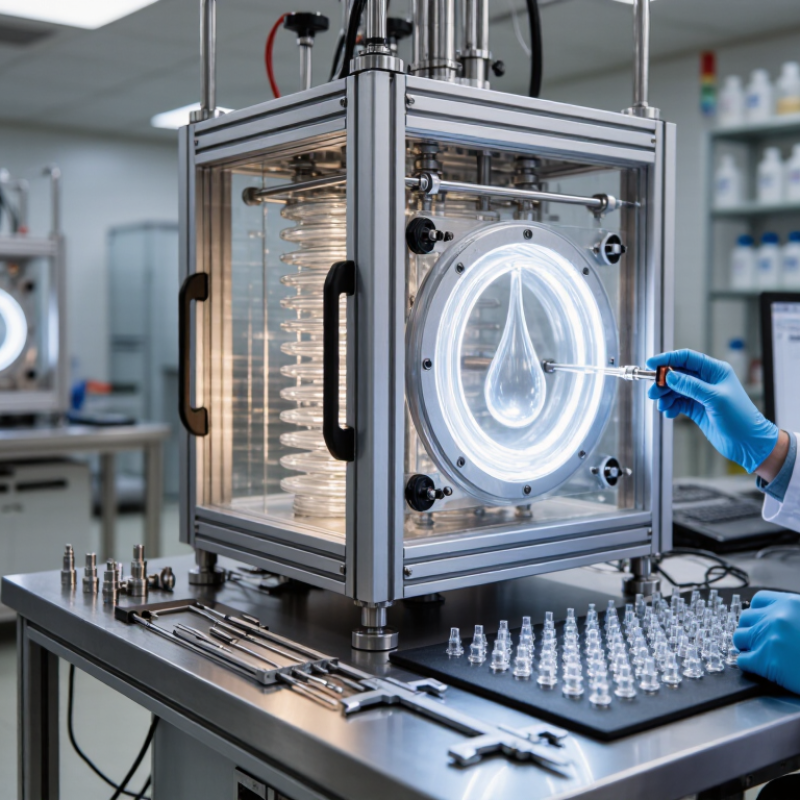
| Flow-Focusing Microfluidics | A continuous phase hydrodynamically narrows and pinches a dispersed phase into uniform droplets at a microchannel junction. | Approximately 10–500 µm, depending on channel geometry, flow rate and fluid properties. | Water-based solutions, oils, polymers, hydrogels, biological fluids and photocurable resins. | Computer-controlled pressure or syringe pumps, flow meters, temperature control and optical monitoring. | Monodisperse beads, microcapsules, cell encapsulation, diagnostics and laboratory-scale formulation. | High size uniformity, low sample consumption and precise control of droplet size. |
| T-Junction Microfluidics | A dispersed phase intersects a continuous phase at a perpendicular channel junction, where shear forces break the dispersed stream into droplets. | Approximately 50–1,000 µm in common laboratory configurations. | Aqueous solutions, oils, emulsions, polymer solutions, alginate and gelatin formulations. | Independent flow-rate control, pressure regulation, channel-temperature monitoring and camera-based measurement. | Emulsion preparation, encapsulation, reagent screening and controlled particle production. | Simple geometry, repeatable droplet generation and relatively straightforward scale-out using parallel channels. |
| Vibrating-Nozzle Droplet Formation | A liquid jet exiting a nozzle is destabilized by controlled mechanical vibration and separates into regularly spaced droplets. | Approximately 50–1,000 µm, primarily determined by nozzle diameter and operating frequency. | Alginate, polymers, cell suspensions, ceramic slurries and aqueous biomaterials. | Piezoelectric or mechanical excitation, pressure control, nozzle heating and stroboscopic visualization. | Cell-laden beads, hydrogel particles, immobilized biocatalysts and encapsulated active ingredients. | Good production repeatability, gentle handling of many formulations and scalable nozzle arrangements. |
| Piezoelectric Inkjet Droplet Ejection | A piezoelectric actuator changes chamber volume and ejects discrete liquid droplets through a fine nozzle. | Typically about 20–100 µm, depending on nozzle size, viscosity and waveform settings. | Low-to-moderate-viscosity inks, functional polymers, biomaterials, conductive fluids and resin formulations. | Waveform programming, drop-on-demand control, nozzle inspection, stroboscopic imaging and automated alignment. | Micro-patterning, additive manufacturing, printed electronics and localized material deposition. | Digital pattern control, low material waste and precise placement of individual droplets. |
| Electrospray Droplet Generation | An applied electric field transforms a liquid meniscus into a charged cone-jet that produces fine droplets. | Submicron to approximately 50 µm, depending on conductivity, flow rate and applied voltage. | Polymer solutions, pharmaceutical formulations, nanoparticles, ceramics and aqueous or organic solvents. | High-voltage regulation, flow control, grounded-collector positioning and environmental monitoring. | Fine particle production, encapsulation, coating and electrohydrodynamic deposition. | Very small droplets, high surface-area production and compatibility with advanced particle engineering. |
| Pressure-Driven Multi-Phase Molding | Controlled pressure differentials move two or more immiscible phases through a mold or microstructured cavity to form droplets or capsules. | Approximately 100 µm to several millimeters, depending on mold dimensions. | Thermoplastics, silicone-based materials, hydrogels, waxes, resins and encapsulation polymers. | Closed-loop pressure control, mold-temperature regulation, valve timing and in-line optical inspection. | Encapsulated products, composite particles, polymer beads and structured soft materials. | Suitable for repeatable molding cycles and integration with curing, solidification or coating stages. |
| Centrifugal Droplet Generation | Rotation creates centrifugal forces that drive liquids through radial channels and produce droplets at controlled outlets. | Approximately 100–2,000 µm, depending on outlet geometry and rotational speed. | Aqueous reagents, oils, polymer solutions, hydrogels and biological suspensions. | Programmable rotational speed, timed dispensing, cartridge balancing and integrated imaging. | Parallelized sample preparation, bead production, screening and portable laboratory workflows. | Reduced dependence on external pumps and convenient parallel processing in compact systems. |
| Microfluidic Droplet Sorting and Encapsulation | Generated droplets are detected and selectively routed, merged, split or encapsulated using valves, electric fields or optical triggers. | Commonly about 20–500 µm, based on the upstream droplet-generation method. | Aqueous droplets in oil, hydrogel precursors, cells, enzymes, nucleic-acid reagents and polymer solutions. | High-speed imaging, fluorescence detection, pneumatic valves, dielectrophoresis and programmable control software. | Single-cell analysis, digital assays, directed screening and high-throughput formulation development. | Automated selection of droplets and improved process consistency for high-value samples. |