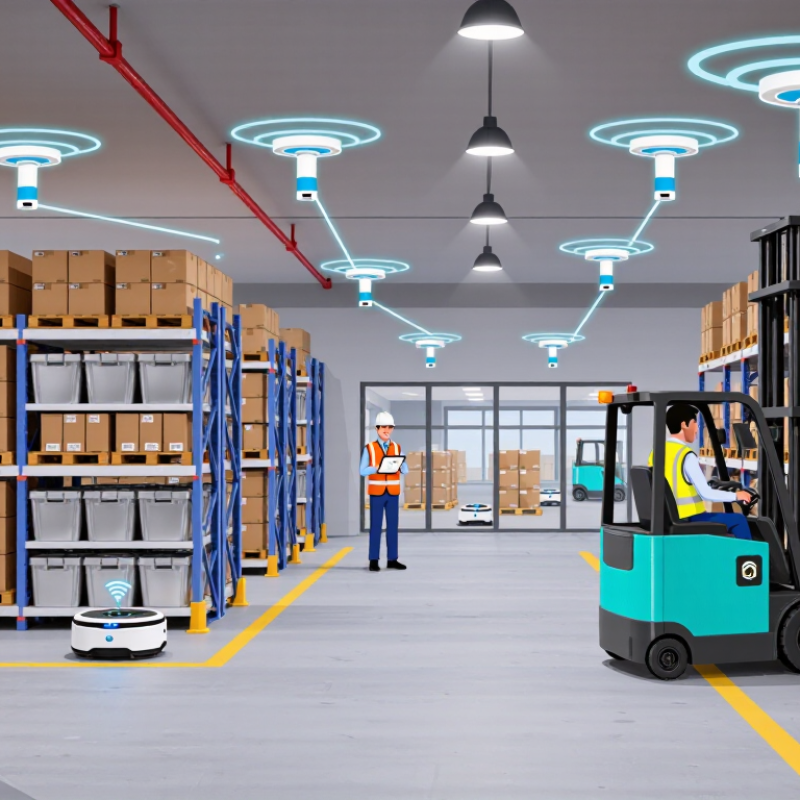
| 1 | Indoor Asset-Tracking UWB System | Warehouses, distribution centers, and production floors | Fixed anchors transmit synchronized UWB downlink packets to battery-powered tags | Two-way ranging or time-difference-of-arrival | Typically 10–30 cm in suitable indoor conditions | Approximately 30–100 m per anchor zone | 1–10 updates per second | Requires anchor placement surveys, multipath mitigation, and integration with inventory software |
| 2 | Autonomous Mobile Robot Navigation System | Factories, fulfillment centers, and controlled logistics facilities | Ceiling or wall anchors provide continuous downlink reference signals to robot tags | TDoA, TWR, or hybrid UWB plus inertial navigation | Typically 10–20 cm for open line-of-sight areas | Up to roughly 100 m between infrastructure points, depending on obstructions | 5–20 updates per second | Low latency, reliable handover, safety zoning, and sensor fusion with wheel odometry are important |
| 3 | Worker Safety and Personnel-Locating System | Construction sites, mines, utilities, and industrial plants | Anchors broadcast scheduled downlink frames to wearable or helmet-mounted tags | TWR or TDoA with geofencing software | Typically 20–50 cm, subject to obstructions and body blocking | Approximately 50–150 m in open areas; less in dense structures | 1–10 updates per second | Must support emergency alerts, zone-entry detection, durable enclosures, and long battery life |
| 4 | Forklift and Vehicle Collision-Avoidance System | Warehouses, loading bays, ports, and industrial yards | Vehicle-mounted and fixed anchors exchange downlink ranging frames with tags on people and vehicles | Two-way ranging with distance thresholds | Typically 20–50 cm for distance estimation | About 10–100 m, based on radio layout and operating environment | 10–50 updates per second for proximity alerts | Fast alert response, configurable warning zones, and careful separation from functional safety controls are required |
| 5 | Healthcare Equipment and Patient-Flow System | Hospitals, laboratories, and assisted-care facilities | Room or corridor anchors transmit downlink frames to equipment and wearable tags | TDoA or TWR with room-level location logic | Typically 20–50 cm; room-level accuracy is common | Approximately 20–80 m indoors | 1–5 updates per second | Requires privacy protection, low-power tags, electromagnetic compatibility testing, and washable or medical-grade housings |
| 6 | Sports Performance and Indoor Training System | Gyms, arenas, training centers, and indoor courts | Perimeter anchors deliver scheduled downlink signals to athlete-worn tags | TDoA or TWR, often combined with inertial measurements | Typically 10–30 cm in an open indoor venue | Roughly 20–100 m, depending on venue geometry | 10–50 updates per second | Needs high update rates, lightweight tags, accurate calibration, and resistance to rapid body movement |
| 7 | Mining and Underground Navigation System | Tunnels, underground work areas, and extraction sites | Ruggedized anchors are installed along tunnels and send downlink reference packets to mobile tags | TWR or TDoA with inertial dead reckoning | Typically 30–100 cm, depending on tunnel geometry | Approximately 30–150 m between anchors | 1–10 updates per second | Requires intrinsically safe or certified equipment where applicable, robust synchronization, dust protection, and reliable operation around metal structures |
| 8 | Smart Building Room-Level Navigation System | Offices, campuses, museums, and public buildings | Ceiling-mounted anchors provide downlink location references to mobile devices or badges | TDoA, TWR, or angle-assisted ranging | Typically 20–50 cm; room-level identification is widely achievable | Approximately 20–80 m indoors | 1–10 updates per second | Should minimize infrastructure visibility, manage occupant privacy, and coexist with Wi-Fi and other indoor radio systems |
| 9 | Robotic Arm and Indoor Manipulator Positioning System | Flexible manufacturing cells and laboratory automation areas | Local anchors transmit downlink timing references to moving tools, carts, or robotic platforms | TWR or TDoA combined with encoders and machine-vision references | Typically 10–30 cm for system-level tracking; tighter control requires additional sensors | Approximately 10–50 m within a work cell | 10–100 updates per second, depending on the control architecture | UWB should supplement, rather than replace, calibrated encoders, machine vision, and deterministic motion-control feedback |
| 10 | Drone and Indoor Aerial-Robot Navigation System | Indoor inspection zones, warehouses, hangars, and test facilities | Fixed anchors transmit downlink reference frames to airborne tags mounted on the vehicle | TDoA or TWR fused with inertial and barometric sensing | Typically 10–30 cm in open indoor spaces | Approximately 30–100 m per anchor zone | 10–50 updates per second | Requires low-latency data handling, accurate vertical references, interference management, and fail-safe behavior during signal loss |