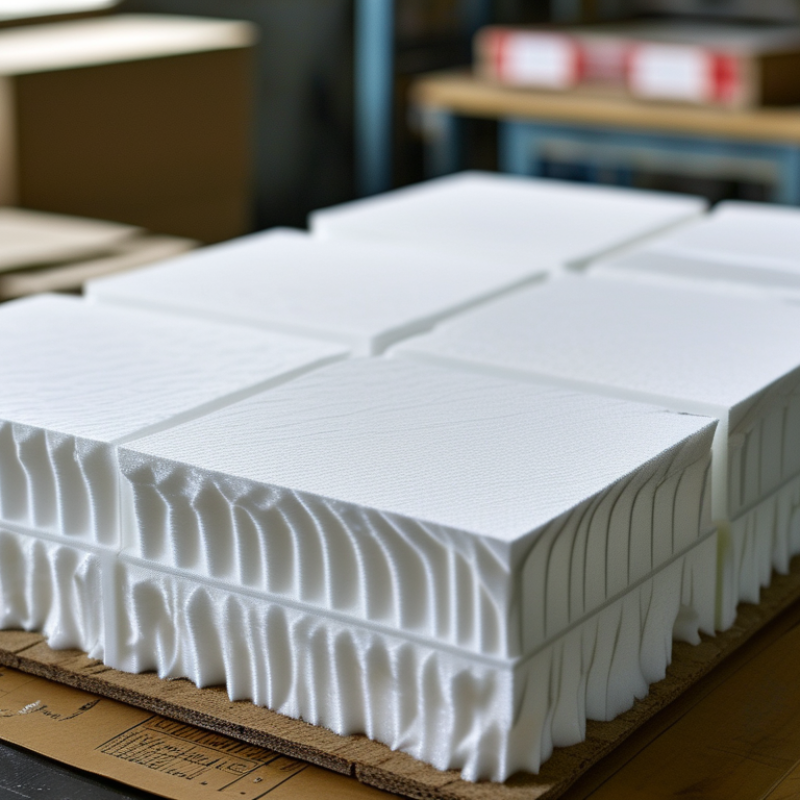
| Foam Type | Flexible open-cell polyurethane slabstock foam | Commonly supplied in continuous blocks, buns, sheets, or cut components for furniture, bedding, packaging, automotive interiors, and acoustic products. |
| Target Density | 15–60 kg/m³ | Lower densities reduce material cost and weight; higher densities generally improve load-bearing capacity, durability, and compression performance. |
| Density Calculation | Density = mass ÷ volume; expressed in kg/m³ | Density should be measured after conditioning and from representative samples because skin, trimming, rise direction, and local cell variation can affect results. |
| Primary Polyol | Polyether polyol, commonly with hydroxyl numbers approximately 25–60 mg KOH/g for flexible foam formulations | The polyol contributes hydroxyl groups, flexibility, softness, resilience, and part of the final polymer network. |
| Isocyanate Component | Polymeric or modified MDI; some flexible systems use TDI-based or blended isocyanate technology | The selected isocyanate affects reaction speed, hardness, resilience, tensile strength, airflow, and processing tolerance. |
| Polyurethane Formation | R–NCO + R′–OH → R–NH–CO–O–R′ | The urethane reaction links isocyanate groups with hydroxyl groups to form the polymer backbone. |
| Water-Blowing Reaction | Isocyanate + water → unstable carbamic acid → amine + CO₂; the amine reacts further with isocyanate to form urea groups | Water generates carbon dioxide in situ, expanding the foam and influencing density, cell size, firmness, and dimensional stability. |
| Isocyanate Index | Often approximately 90–110 for flexible foam; the exact target is formulation-specific | Index is the ratio of actual NCO equivalents to theoretical NCO equivalents multiplied by 100. It must be confirmed in the technical data sheet. |
| Catalyst Package | Balanced amine and organometallic catalyst system, selected for cream, rise, gel, and cure control | An incorrect catalyst balance can cause poor cell opening, scorching, collapse, excessive shrinkage, or incomplete cure. |
| Silicone Surfactant | Polyurethane-compatible silicone surfactant; dosage is formulation-dependent | Stabilizes rising cells, influences cell opening, and helps control uniformity and surface quality. |
| Cream Time | Typically a few seconds after mixing, depending on the system and equipment | The interval before visible expansion begins; it affects mixing, pouring, laydown, and block formation. |
| Rise Time | Usually tens of seconds to a few minutes, depending on block size and formulation | The foam must rise evenly without voids, splits, excessive crown, or side-wall distortion. |
| Cure and Conditioning | Initial handling may be possible after cooling; final conditioning commonly requires approximately 24–72 hours | Testing too early can produce misleading density, hardness, odor, compression-set, and dimensional-stability results. |
| Cell Structure | Predominantly open-cell structure for flexible grades; cell size and openness vary by formulation and process | Cell structure controls airflow, softness, recovery rate, acoustic behavior, and suitability for cushioning applications. |
| Hardness Measurement | Indentation Force Deflection or Indentation Load Deflection, commonly reported at 25% or 40% compression | Hardness is not interchangeable with density. Two foams with the same density can have different firmness levels. |
| Resilience | Commonly evaluated by ball-rebound testing; exact performance depends on grade and test method | Higher resilience is generally preferred for responsive seating and mattress comfort, while lower resilience may suit packaging or special cushioning. |
| Compression Set | Reported as a percentage after defined compression, temperature, and recovery conditions | Lower compression set generally indicates better ability to recover thickness after prolonged loading; the test standard must be specified. |
| Dimensional Stability | Evaluated after controlled temperature and humidity exposure; limits depend on the product specification | Important for export packaging, mattress panels, furniture components, and products exposed to changing climates. |
| Block Uniformity | Typical buyer specification: consistent density and hardness across the block, subject to agreed tolerances | Sampling should cover the center, edges, top, bottom, and different rise directions to detect process variation. |
| Cutting and Conversion | Horizontal and vertical cutting, contour cutting, peeling, laminating, and CNC conversion | Cut accuracy, surface finish, and yield should be reviewed together with block dimensions and recovery behavior. |
| Fire Performance | Must be specified by the destination market and end-use standard; untreated flexible PUR foam is combustible | Request the exact test method, classification, sample thickness, treatment level, and certificate rather than relying on a general “fire-retardant” claim. |
| VOC and Odor Control | Controlled through raw-material selection, formulation, curing, ventilation, and storage | For indoor applications, buyers should define VOC, odor, emissions, and restricted-substance requirements before production. |
| Documentation to Request | Technical data sheet, safety data sheet, certificate of analysis, test reports, lot traceability, and agreed inspection record | A complete document package supports customs clearance, regulatory review, incoming inspection, and consistent repeat orders without relying on brand identity. |