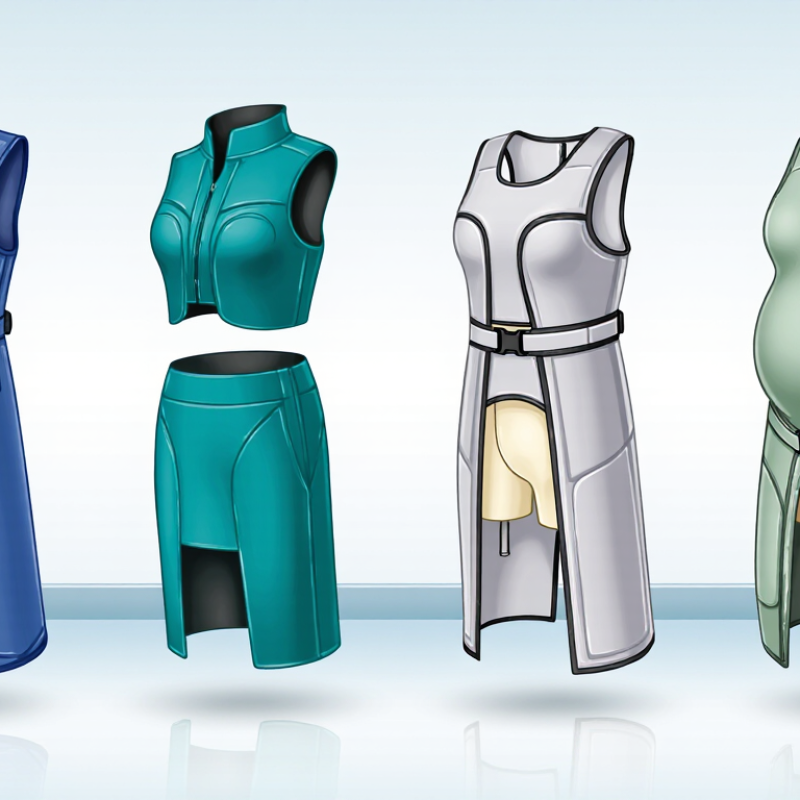
| Front Protection | 0.35 mm lead equivalent | Provides the primary shielding across the chest and abdomen, where occupational exposure is commonly managed during diagnostic X-ray and fluoroscopy procedures. | Suitable when the wearer may remain near the patient or X-ray field for repeated procedures, subject to the facility’s radiation-protection program. |
| Back Protection | 0.25 mm lead equivalent | Offers rear coverage while reducing material compared with a fully 0.35 mm design. | Useful for staff who need wraparound coverage and frequently turn, bend, or move around the imaging table. |
| Coverage Pattern | Front overlap with protection extending around the sides and back | Helps reduce gaps that can occur with a simple front-only apron, especially during angled or mobile work positions. | Check that the front panels overlap fully when fastened and that the sides and back remain covered during normal movement. |
| Radiation Protection Rating | Nominal lead-equivalent values stated in millimetres of lead (mm Pb) | Lead equivalence is the recognized way to describe attenuation performance; actual attenuation also depends on X-ray energy, beam quality, construction, and testing method. | Verify the garment’s label, conformity documentation, and applicable local or national requirements before purchase. |
| Typical Applications | Fluoroscopy, interventional imaging, mobile radiography, and other occupational diagnostic X-ray settings | These environments may involve longer procedures, repeated exposures, or close positioning to the patient. | Use a wraparound design when staff movement and side or rear exposure are realistic concerns; follow the site-specific dose assessment. |
| Weight Consideration | Generally heavier than front-only designs; total weight varies with size, coverage, material, and construction | Additional coverage can improve protection but may increase shoulder, back, and hip loading during extended wear. | Choose the correct size, use adjustable fasteners, and consider a two-piece skirt-and-vest design when procedures are lengthy. |
| Fit and Overlap | Close-fitting without restricting breathing, reaching, or walking | Poor fit can create gaps, increase discomfort, and encourage incorrect wearing practices. | Measure the wearer according to the garment’s sizing instructions and confirm complete front overlap in the working posture. |
| Inspection Requirement | Routine visual inspection plus periodic imaging or other approved integrity testing | Repeated folding, creasing, compression, and improper storage can damage internal shielding materials without obvious external signs. | Inspect before use, follow the facility’s testing schedule, and remove garments from service if cracks, tears, or shielding defects are found. |
| Storage and Handling | Hang vertically or store according to the manufacturer’s approved method; do not fold sharply | Sharp folds and heavy objects can create permanent creases that compromise protective performance. | Keep aprons away from excessive heat, moisture, chemicals, and unnecessary mechanical stress. |
| Best-Fit User Profile | Personnel requiring greater mobility and broader coverage than a front-only apron provides | The 0.35 mm front and 0.25 mm back configuration balances enhanced front protection with wraparound coverage. | Confirm the design with a qualified radiation-safety professional; protective apparel supplements, but does not replace, time, distance, shielding, and proper positioning. |