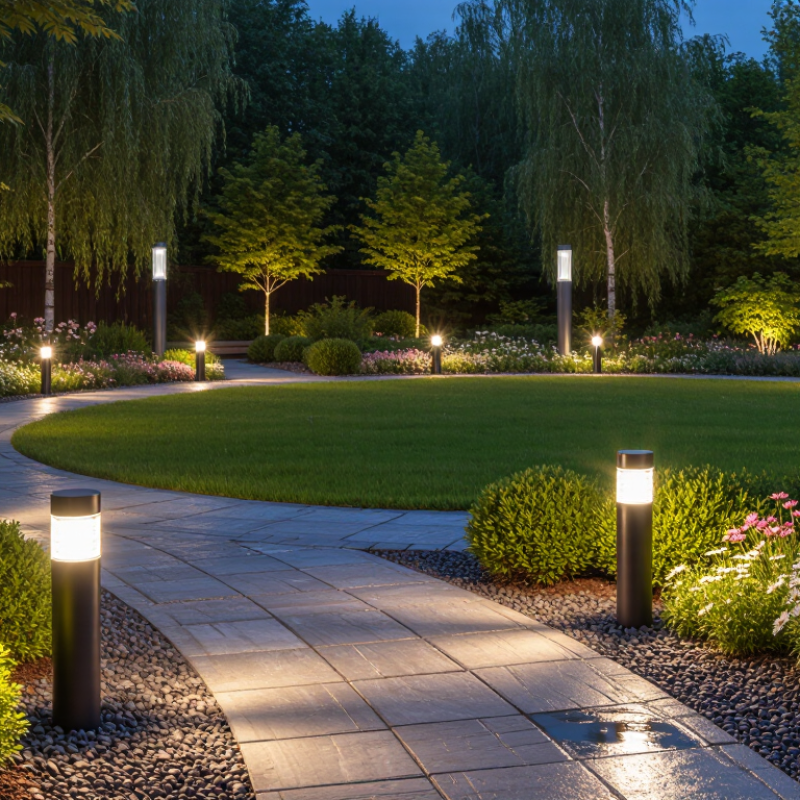
| Supplier evaluation matrix. Suggested benchmarks are purchasing guidelines, not universal legal requirements; confirm suitability for the project and destination market. |
| Product range and application | Check whether the supplier offers the required garden-light formats, such as bollards, pathway lights, spike lights, wall lights, or landscape spotlights. Confirm mounting, beam angle, and intended use. | Request a current product catalogue, dimensional drawings, installation instructions, and a written list of available configurations. | A product designed for a sheltered pathway may not suit exposed coastal, wet, or high-impact locations. |
| Ingress protection | Check the IP rating of the complete luminaire, including cable entries and installed seals, rather than relying only on component-level ratings. | IEC 60529 defines IP-code test classifications. IP65 is a common starting point for exposed outdoor fixtures; consider higher protection where the installation conditions call for it. | Water and dust protection depend on the finished assembly and correct installation. |
| Impact resistance | Ask whether the lens, housing, and assembled fixture have been tested for the impact exposure expected at the site. | IEC 62262 defines IK impact-protection classifications. Specify a required IK rating in the purchase contract when impact resistance is important. | Pathway and public-area fixtures may be exposed to accidental knocks, maintenance equipment, or vandalism. |
| Safety and applicable standards | Identify the destination market and intended product type, then verify the standards and approvals applicable to that exact model. | Request model-specific test reports and certificates. IEC 60598-1 covers general luminaire requirements; applicable part-two requirements depend on the luminaire type and use. | A certificate for a different model or product family may not establish compliance for the goods being purchased. |
| Photometric performance | Review measured lumen output, beam distribution, glare, and light intensity at the intended mounting height and spacing. | Request an IES or LDT photometric file and a report identifying the tested model and operating conditions. Check whether the data describes the complete luminaire or only the LED source. | Photometric data helps designers assess coverage, uniformity, and light spill before installation. |
| Light colour and colour rendering | Specify correlated colour temperature (CCT), colour consistency, and colour-rendering requirements for the landscape and project. | For residential landscape projects, 2700–3000 K is a common warm-light choice; CRI 80 or above is a practical general-purpose target. Confirm the actual specification for the application. | Colour temperature and rendering affect ambience and how plants, paving, and architectural finishes appear at night. |
| LED and driver documentation | Ask for the LED and driver specifications, rated input range, dimming compatibility, and replacement availability. | Request component datasheets and model-specific electrical test information. For LED-package lifetime claims, ask for relevant LM-80 data and the method used to project maintenance, such as TM-21. | Component data supports evaluation of operating performance and helps avoid unsupported lifetime claims. |
| Thermal design and lifetime claims | Check how the housing manages heat and whether lifetime or lumen-maintenance claims state the assumptions and operating conditions. | Request temperature measurements or test reports for the complete luminaire. Distinguish LED-source projections from the rated life of the whole fixture. | Heat, ambient temperature, and driver conditions can affect the performance and service life of the complete product. |
| Materials and corrosion resistance | Confirm housing, fastener, coating, and lens materials, especially for coastal, humid, or chemically exposed sites. | Ask for material specifications, coating details, and relevant corrosion-test evidence. Check whether the stated material applies to the housing, fasteners, and exposed fittings. | Material and finish choices influence durability and appearance in outdoor environments. |
| Electrical and surge protection | Check input voltage and frequency, earthing or insulation class, power factor where relevant, and surge-protection provisions. | Request the electrical specification and test documentation for the intended market. State required surge protection in the project specification rather than assuming it is included. | Electrical compatibility and installation conditions vary by market and site. |
| Controls and smart features | Confirm whether the fixture supports the required dimming, photocell, motion sensor, timer, or network-control system. | Request a compatibility list, wiring diagram, and a sample test with the actual control equipment where interoperability is essential. | Control features can affect wiring, commissioning, energy use, and maintenance. |
| Quality assurance and production consistency | Review incoming-material checks, in-process inspections, final testing, and procedures for handling defects or changes. | Ask for the quality-management certificate scope, inspection records, and a sample final-inspection checklist. Verify that documents cover the manufacturing site and relevant products. | Documented controls help buyers assess whether repeat orders are likely to match approved samples. |
| Samples and pre-shipment inspection | Approve a production-representative sample and define inspection criteria before placing a volume order. | Record model, finish, CCT, dimensions, accessories, packaging, and test criteria in the approval. Consider an independent inspection before shipment. | A clearly approved reference sample reduces ambiguity about appearance and configuration. |
| Warranty and after-sales support | Review warranty duration, covered parts, exclusions, claim process, response time, and availability of replacement drivers or lenses. | Obtain written warranty terms for the quoted model and destination market. Treat a three-to-five-year warranty as a negotiation target, not an assumed industry guarantee. | Clear terms help buyers understand the supplier’s responsibilities after delivery. |
| Export, packaging, and order terms | Confirm packaging protection, labelling, lead time, minimum order quantity, payment terms, shipping responsibilities, and required export documents. | Request a written quotation, packing details, production schedule, and document list. Agree on the applicable Incoterms® rule and named place in the sales contract. | Written commercial and shipping details reduce delays and disagreements between buyer and supplier. |