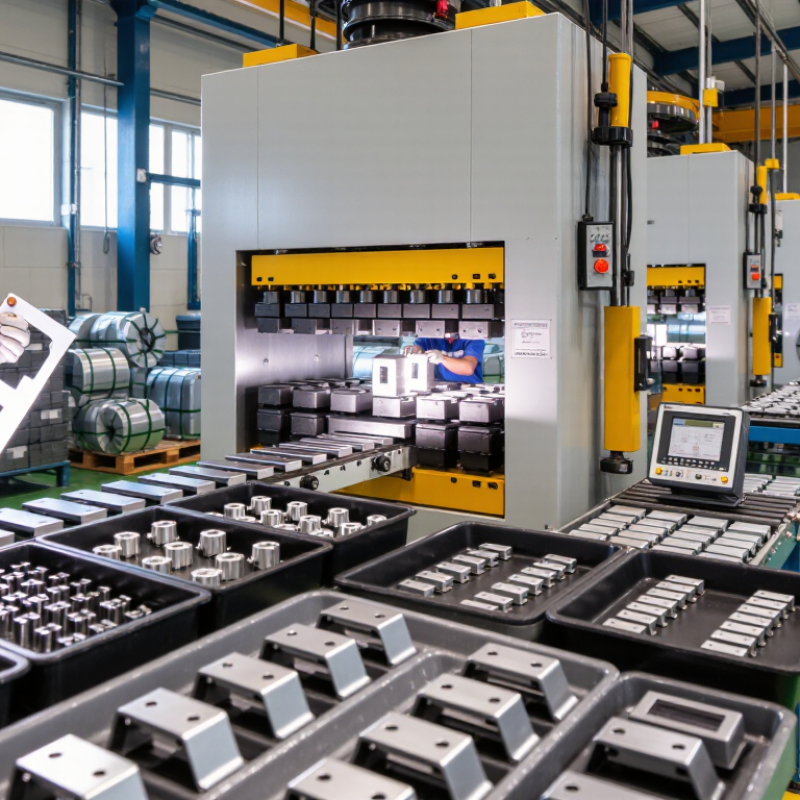
| Stamping Processes | Progressive die, four-slide, compound, deep drawing, and transfer stamping | From single-operation prototypes to high-volume automated production | Electrical terminals, brackets, clips, shields, housings, and formed enclosures | Confirm whether tooling, feeding, inspection, and secondary operations are managed under one production program. | Core Capability |
| Press Capacity | Mechanical and servo presses covering light, medium, and heavy-duty work | Approximately 10–1,000 metric tons, depending on part geometry and material | Precision small parts through automotive, industrial, and appliance components | Press tonnage alone is not sufficient; review bed size, stroke, shut height, feed width, and operating speed. | Core Capability |
| Material Compatibility | Low-carbon steel, stainless steel, galvanized steel, aluminum, copper, brass, and selected alloys | Material selection based on strength, conductivity, corrosion resistance, and formability requirements | Conductive contacts, structural parts, corrosion-resistant hardware, and lightweight assemblies | Specify material grade, temper, thickness tolerance, surface condition, and applicable international standard. | Broad Coverage |
| Material Thickness | Thin-gauge precision stamping through heavier structural stamping | Commonly about 0.1–6.0 mm; actual limits vary by material, tooling, and press capacity | Electronic parts, automotive reinforcements, machinery brackets, and appliance panels | Provide flatness, burr-height, hardness, and grain-direction requirements when thickness is critical. | Application Dependent |
| Dimensional Control | In-process monitoring, coordinate measurement, optical inspection, and gauge-based verification | General tolerances commonly follow drawing standards; tighter tolerances require controlled tooling and inspection | Parts requiring repeatable fit, alignment, hole location, and assembly interchangeability | Define critical-to-function dimensions separately from general tolerances to control cost and manufacturing risk. | Quality Controlled |
| Tooling and Die Engineering | 3D design, simulation, die construction, tryout, maintenance, and engineering change management | Tool life commonly depends on material, production volume, lubrication, maintenance, and die construction | Repeat production requiring stable dimensions and predictable cycle times | Request die ownership terms, spare-part policy, maintenance intervals, and approval samples before mass production. | Critical Selection Factor |
| Secondary Operations | Deburring, tapping, riveting, welding, clinching, bending, assembly, and marking | Integrated or separately controlled operations according to part complexity and annual volume | Finished subassemblies, fastener-ready components, and multi-feature stamped parts | Combining operations can reduce handling and logistics costs, but process validation should cover every added step. | Value-Added |
| Surface Finishing | Plating, powder coating, painting, anodizing, passivation, and chemical conversion treatments | Finish selection depends on corrosion exposure, conductivity, appearance, wear, and regulatory requirements | Outdoor hardware, electrical contacts, visible panels, and corrosion-sensitive assemblies | Specify coating type, thickness, color, adhesion, salt-spray expectations, masking areas, and restricted substances. | Available by Specification |
| Production Volume | Prototype, low-volume, medium-volume, and high-volume manufacturing programs | From hundreds of pieces for validation to millions of pieces per year for automated programs | New product launches, replacement parts, contract manufacturing, and recurring OEM supply | Compare piece price with tooling amortization, minimum order quantity, setup costs, and forecast flexibility. | Scalable |
| Quality Management | Documented inspection plans, control plans, first-article inspection, traceability, and corrective action systems | Quality requirements should be aligned with the buyer’s industry, drawing, and supplier-audit expectations | Safety-related, regulated, high-reliability, and repeat-order components | Evaluate calibration control, lot traceability, nonconformance handling, process capability data, and audit access. | Essential |
| Engineering Support | Design-for-manufacturing review, material substitution analysis, tolerance review, and prototype validation | Support may cover concept review, tooling design, pilot runs, and production optimization | Parts with complex forms, tight tolerances, difficult materials, or frequent design revisions | Early engineering involvement can reduce die rework, springback issues, scrap, and production delays. | Buyer Advantage |
| Export and Packaging Readiness | Export documentation, protective packaging, labeling, palletization, and shipment coordination | Packaging should be selected according to part sensitivity, stacking method, transport distance, and delivery frequency | Cross-border supply programs and just-in-time or scheduled deliveries | Confirm packaging validation, country-of-origin documentation, shipping terms, spare quantity policy, and damage claims process. | Logistics Ready |