| Pole-Mounted Distribution Transformer | A compact liquid-filled transformer installed on a utility pole. Its core and windings are immersed in insulating liquid, which provides electrical insulation and carries heat away from the windings. | Overhead distribution networks serving homes, farms, and small businesses. | Confirm the required phase configuration, primary and secondary voltages, kVA rating, mounting arrangement, protection, and local utility requirements. |
| Pad-Mounted Distribution Transformer | A ground-level transformer housed in a locked, weather-resistant enclosure. Internal high- and low-voltage compartments are separated to provide access control and help protect energized components. | Underground distribution systems in residential developments, commercial sites, and industrial facilities. | Check the enclosure layout, cable-entry arrangements, radial or loop-feed requirements, site clearances, and applicable safety standards. |
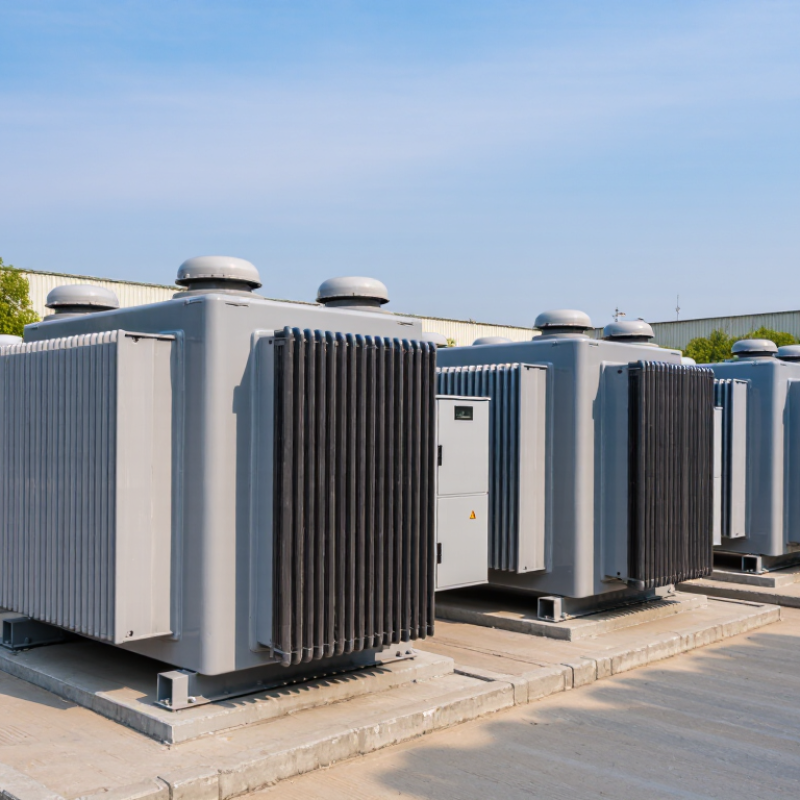
| Substation Distribution Transformer | An outdoor or indoor liquid-filled unit that steps voltage down for a distribution network. Radiators or other heat-transfer surfaces help release heat from the insulating liquid to the surrounding air. | Utility substations and large facilities supplying multiple feeders or substantial local loads. | Assess the load profile, voltage ratio, impedance, tap-changer needs, cooling capacity, footprint, and maintenance access. |
| Power Transformer | A liquid-filled transformer designed for high-voltage transmission, grid interconnection, or major industrial power systems. Its windings transfer electrical energy between voltage levels by electromagnetic induction. | Generating stations, transmission substations, and large industrial power systems. | Specifications are system-dependent. Coordinate rated power, voltage levels, insulation, impedance, cooling, protection, and grid requirements with qualified engineers. |
| Conservator-Type Construction | Uses an auxiliary conservator tank to accommodate changes in liquid volume as the transformer heats and cools. A breather or sealed expansion arrangement may be used, depending on the design. | Common in many medium- and large-sized liquid-filled transformers. | Review the expansion system, moisture-control arrangement, inspection requirements, and installation space. |
| Sealed-Tank Construction | Uses a sealed tank designed to accommodate liquid expansion without an open connection to ambient air. The specific expansion method depends on the transformer design. | Often used for distribution transformers and installations where a compact, sealed design is preferred. | Confirm the manufacturer’s stated pressure and temperature limits, maintenance guidance, and suitability for the intended environment. |
| ONAN Cooling | Oil Natural, Air Natural: liquid circulates through the transformer by natural convection, while heat dissipates to surrounding air through the tank or radiators. | Transformers whose specified rating can be met with natural liquid and air circulation. | Check the continuous rating at the expected ambient temperature and site conditions; do not assume cooling codes are interchangeable. |
| ONAF Cooling | Oil Natural, Air Forced: liquid circulates naturally, while fans move air across radiators to increase heat dissipation. | Transformers designed for additional cooling capacity when forced-air equipment is operating. | Verify fan stages, auxiliary power needs, controls, noise limits, and the rating available if fans are unavailable. |
| Insulating Liquid and Operating Principle | The liquid insulates energized components and transfers heat away from the core and windings. Alternating current in one winding creates a changing magnetic field in the core, inducing voltage in another winding. | Applies broadly to oil-immersed transformer designs using mineral oil or an approved ester-based insulating liquid. | Confirm liquid type, environmental and fire-safety requirements, compatibility, testing procedures, and applicable regulations for the installation site. |