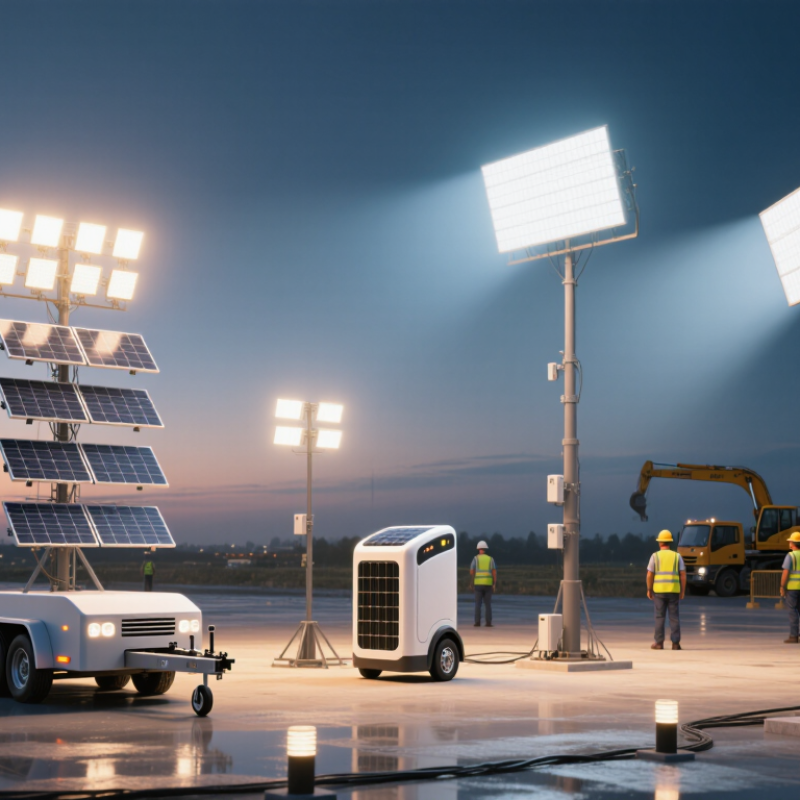
| All-in-One LED Solar Tower | Construction areas, roadwork, events, parking areas and emergency lighting | Approximately 400–1,200 Wp of monocrystalline or polycrystalline PV modules | Approximately 2–10 kWh, commonly using lithium-ion or lithium iron phosphate batteries | LED floodlights mounted on a compact telescopic mast; often 2–4 light heads | Usually designed for dusk-to-dawn operation with automatic photocell control and battery-based overnight autonomy | Compact layout, relatively simple installation, low operating noise and no routine fuel consumption |
| Trailer-Mounted Solar Light Tower | Large construction sites, utility projects, temporary work zones and outdoor infrastructure maintenance | Approximately 800–2,400 Wp, frequently arranged on folding or deployable panels | Approximately 5–20 kWh, depending on lighting load and required autonomy | Four adjustable LED fixtures on a hydraulic or manual telescopic mast | Trailer chassis supports towing, leveling jacks and deployment at multiple locations; operating time depends on solar resource and load | High mobility, larger panel area and good coverage for extended work zones |
| Vertical Mast Solar Tower | Mining sites, military or disaster-response areas, ports, rail yards and high-mast illumination | Approximately 600–2,000 Wp, with panels positioned around or beside the mast | Approximately 4–16 kWh | High-mounted directional LED luminaires, commonly 2–6 fixtures | Mast heights commonly range from about 5–12 m; higher mounting improves light distribution but increases wind-load requirements | Broad illumination area and improved light uniformity for large open spaces |
| Hybrid Solar-Battery Light Tower | Critical work sites, locations with variable sunlight, winter operations and high-availability lighting | Approximately 600–2,000 Wp | Approximately 5–25 kWh, often based on lithium iron phosphate chemistry | High-efficiency LED floodlights with dimming and programmable lighting schedules | May include grid input or a backup generator connection; energy management prioritizes solar charging and battery use | Greater resilience during cloudy periods and more predictable service availability |
| Fixed Solar Lighting Tower | Permanent parking facilities, public spaces, logistics yards, campuses and remote access roads | Approximately 200–1,000 Wp, sized according to local solar irradiation and lighting demand | Approximately 1–10 kWh | One or more fixed LED luminaires mounted on a permanent pole or structure | Requires engineered foundation, wind-load assessment and planned access for battery or controller maintenance | Long-term installation, minimal cabling and reduced need for trenching or grid extension |
| Foldable-Panel Solar Tower | Temporary events, rental fleets, disaster relief and sites requiring compact transport | Approximately 500–1,500 Wp using hinged or sliding PV panels | Approximately 3–12 kWh | Two or four LED floodlights, typically adjustable for area or perimeter coverage | Panels fold inward for transport and deploy when the unit is positioned; stabilizers are required during operation | Efficient transport profile, rapid deployment and increased solar collection area when opened |