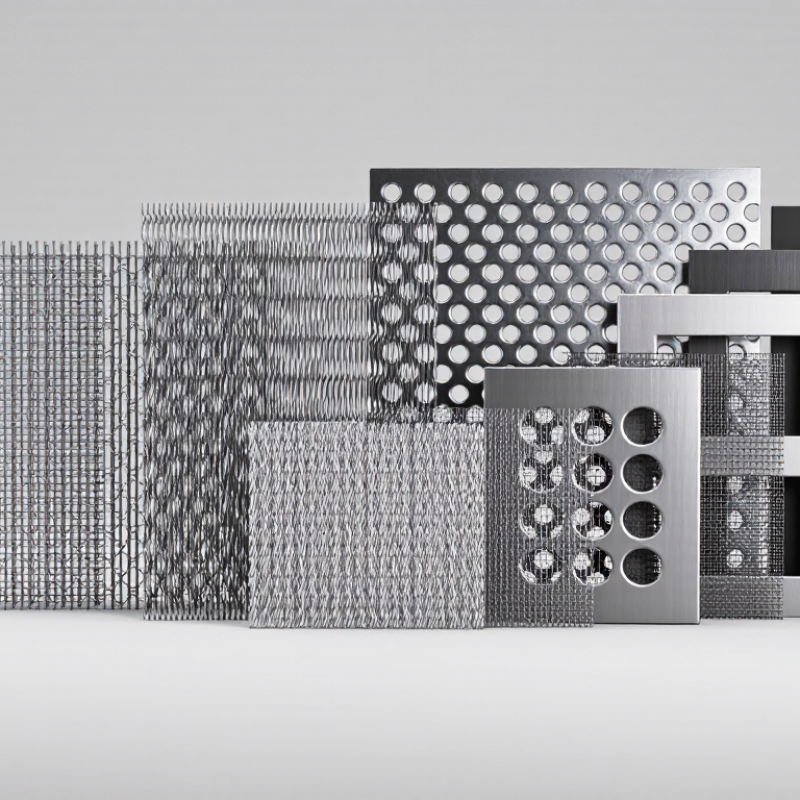
| 1 | Plain Weave Wire Mesh | Each warp wire passes alternately over and under each weft wire. | 20 mesh to 400 mesh; approximately 38 µm to 1.00 mm openings, depending on wire diameter. | 304, 304L, 316, 316L | Commonly supplied in rolls or cut sheets up to approximately 1.2 m × 30 m; custom sizes are available. | Balanced strength, accurate openings, broad availability, and easy fabrication. | Filtration, sieving, screening, ventilation panels, protective covers, and laboratory equipment. |
| 2 | Dutch Weave Mesh | Uses different wire diameters and wire counts in the warp and weft directions to create a dense filter structure. | Usually specified by micron retention rather than mesh count; approximately 5 µm to 250 µm filtration ratings. | 304, 316, 316L | Frequently supplied as rolls or precision-cut sheets; size depends on filtration specification. | High mechanical strength, fine filtration, and good resistance to pressure and particle migration. | Hydraulic filtration, polymer filtration, fuel filtration, chemical processing, and pressure screens. |
| 3 | Twill Weave Wire Mesh | Each wire passes over two and under two adjacent wires, producing a diagonal surface pattern. | Typically 20 mesh to 400 mesh; fine openings are possible with comparatively heavier wire. | 304, 304L, 316, 316L | Commonly available in rolls and cut panels, often up to about 1.5 m in width. | Higher load capacity than plain weave at similar mesh counts and good dimensional stability. | Fine screening, abrasive material separation, filter elements, and high-strength sieves. |
| 4 | Welded Wire Mesh Sheet | Longitudinal and transverse wires are resistance-welded at each intersection. | Typical apertures range from 6 mm to 100 mm; wire diameters commonly range from 1.0 mm to 6.0 mm. | 304, 304L, 316, 316L | Common panel sizes include 1.0 m × 2.0 m, 1.2 m × 2.4 m, and 1.5 m × 3.0 m. | Rigid construction, uniform openings, easy installation, and strong load-bearing performance. | Machine guards, partitions, cages, storage racks, animal enclosures, and architectural panels. |
| 5 | Expanded Metal Mesh Sheet | A solid stainless steel sheet is slit and stretched to form diamond-shaped openings without waste from punched-out material. | Short way of opening commonly 2 mm to 100 mm; thickness commonly 0.5 mm to 6.0 mm. | 304, 316, 316L | Typical panels range from approximately 1.0 m × 2.0 m to 1.5 m × 3.0 m. | High strength-to-weight ratio, slip resistance, ventilation, and a continuous integral structure. | Walkways, platforms, stair treads, safety screens, facades, ceilings, and equipment guards. |
| 6 | Perforated Stainless Steel Sheet | Round, square, slotted, or decorative holes are punched or laser-cut into stainless steel sheet. | Hole diameters commonly range from 0.5 mm to 20 mm; open area may range from about 20% to 60%. | 304, 304L, 316, 316L | Common sheet sizes include 1.0 m × 2.0 m, 1.2 m × 2.4 m, and 1.5 m × 3.0 m. | Consistent hole geometry, clean appearance, controlled airflow, and good rigidity. | Acoustic panels, screens, filters, ventilation covers, equipment housings, and architectural cladding. |
| 7 | Crimped Woven Mesh | Pre-crimped wires interlock at crossing points before or during weaving. | Openings commonly range from 3 mm to 100 mm; wire diameters commonly range from 1.0 mm to 10 mm. | 304, 304L, 316, 316L | Often supplied as cut panels up to approximately 2.0 m × 4.0 m, depending on wire diameter. | Strong, rigid, stable under vibration, and suitable for heavy-duty screening. | Quarry screens, mining screens, vibrating screens, aggregate separation, and security barriers. |
| 8 | Hexagonal Wire Mesh | Wires are woven or twisted to form a repeating hexagonal aperture pattern. | Typical hexagonal openings range from 13 mm to 80 mm; wire diameter commonly ranges from 0.7 mm to 2.5 mm. | 304, 316, 316L | Common roll widths range from 0.5 m to 2.0 m, with lengths often between 10 m and 30 m. | Flexible, lightweight, corrosion-resistant, and easy to shape around curved surfaces. | Animal enclosures, baskets, gabions, insulation retainers, erosion-control products, and ventilation guards. |
| 9 | Sintered Multi-Layer Mesh | Several woven mesh layers are stacked and sintered under heat and pressure to form a rigid laminate. | Typical filtration ratings range from approximately 1 µm to 200 µm. | 304, 316L | Commonly produced as discs, cylinders, cartridges, and sheets; sheet sizes are often customized. | High strength, stable filtration rating, cleanability, and resistance to pressure and temperature. | Process filtration, pharmaceutical equipment, food processing, chemical systems, and gas filtration. |
| 10 | Knitted Wire Mesh | Stainless steel wire is knitted into an interlocking loop structure, sometimes compressed into pads. | Wire diameters commonly range from 0.08 mm to 0.30 mm; mesh density is specified by wire diameter and knitted construction. | 304, 316, 316L | Usually supplied as rolls, strips, demister pads, or cut sections rather than rigid flat sheets. | Flexible, resilient, highly permeable, and effective for liquid droplet and mist separation. | Demister pads, oil mist eliminators, gas-liquid separators, vibration damping, and sealing components. |