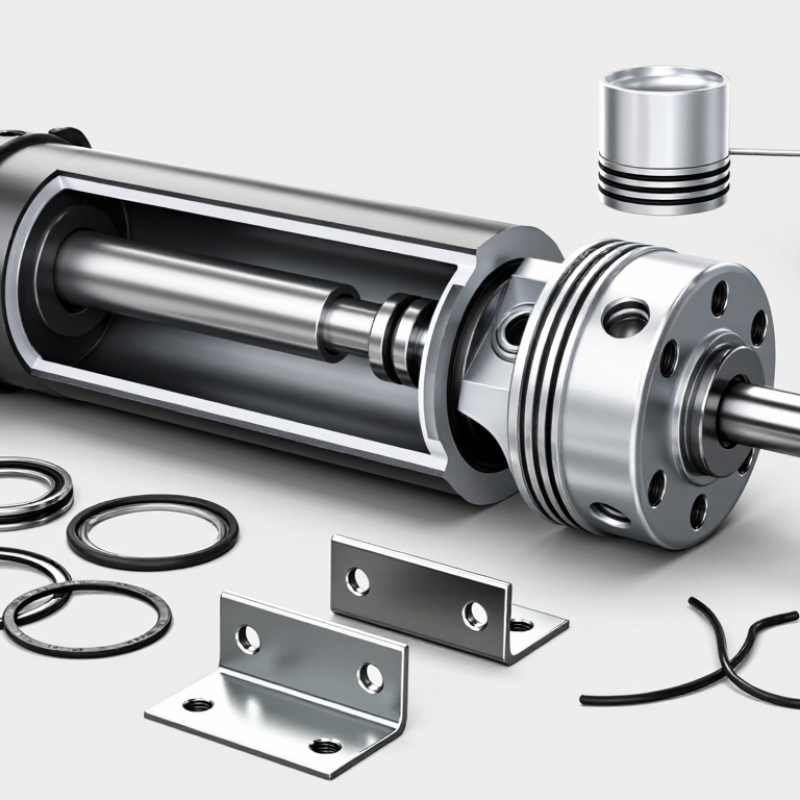
| Piston seal | Installed around the piston, between the piston and cylinder bore | Limits fluid bypass across the piston, helping maintain pressure and controlled movement. | Polyurethane, nitrile rubber (NBR), PTFE compounds, or elastomer-energized PTFE | Match the seal profile to pressure, speed, fluid, temperature, bore finish, and whether the cylinder is single- or double-acting. |
| Rod seal | Located in the cylinder head or gland around the moving rod | Retains hydraulic fluid as the rod moves in and out of the cylinder. | Polyurethane, NBR, PTFE compounds, or combinations of elastomers and engineered plastics | Consider operating pressure, reciprocating speed, fluid compatibility, temperature, rod surface finish, and resistance to extrusion. |
| Wiper (scraper) seal | At the outer edge of the cylinder head, facing the environment | Removes dirt, moisture, and other contaminants from the rod during retraction, helping protect internal components. | Polyurethane, NBR, or other application-suitable elastomers | Choose a profile and material suited to the level of contamination, outdoor exposure, temperature, and rod condition. |
| Static seal | Between stationary parts, such as a cylinder head and barrel or a port connection | Prevents leakage at joints where the sealed components do not move relative to one another. | NBR, fluorocarbon rubber, polyurethane, or PTFE, depending on the seal design and service conditions | Selection depends on groove dimensions, fluid compatibility, temperature, pressure, and the joint’s assembly requirements. |
| Piston wear ring (guide ring) | Fitted around the piston, usually in a dedicated groove | Guides the piston and helps prevent metal-to-metal contact with the cylinder bore; it is not a pressure seal. | Fabric-reinforced phenolic resin, PTFE-based materials, or other engineered bearing plastics | Consider load, clearance, temperature, fluid, bore condition, and the manufacturer’s specified ring dimensions. |
| Rod wear ring (guide ring) | Installed in the cylinder head or gland to guide the rod | Supports side loads and helps keep the rod centered, reducing contact between the rod and gland. | Fabric-reinforced phenolic resin, PTFE-based materials, or other engineered bearing plastics | Check rod diameter, guide width, available clearance, side-loading conditions, and compatibility with the hydraulic fluid. |