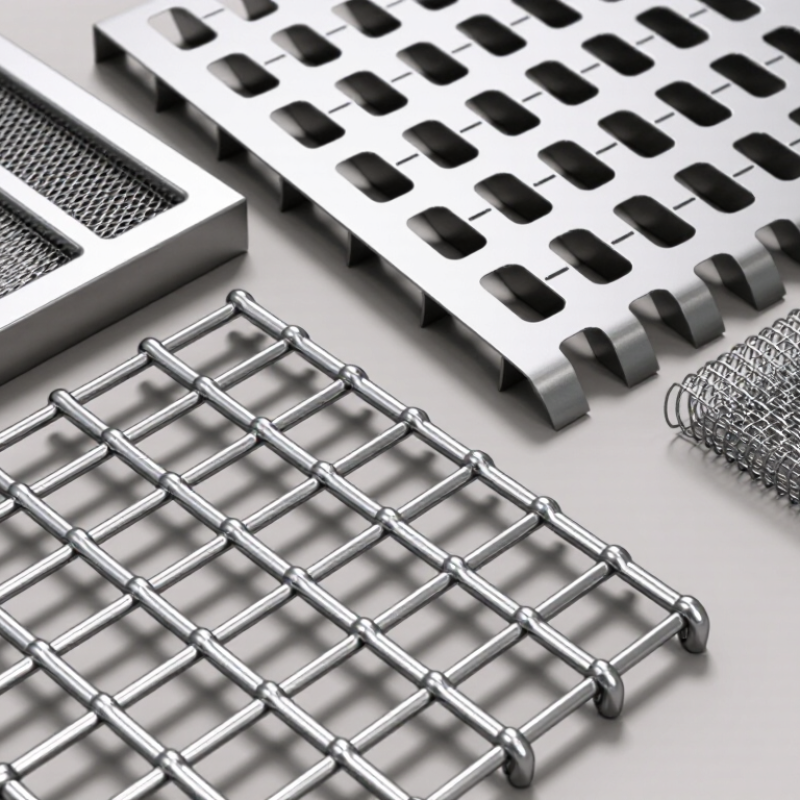
| Welded Wire Grate | Intersecting stainless steel wires are joined by resistance welding at their crossing points. | Regular square or rectangular openings; wire spacing and diameter vary by design. | Fixed intersections provide a stable, uniform panel. Rigidity depends on wire diameter, spacing, panel size, and support. | Machine guards, racks, partitions, baskets, and light-duty platforms. | Check the required load, support spacing, opening size, weld quality, and stainless steel grade. |
| Plain-Weave Wire Grate | Each warp wire passes alternately over and under each weft wire. | Balanced, regular mesh with generally square openings. | Offers a simple, uniform mesh structure and is commonly available in a broad range of wire diameters and openings. | Screening, straining, protective panels, and general-purpose baskets. | Confirm that the mesh and wire are suitable for the intended load; fine woven mesh is not automatically a walkable grate. |
| Twill-Weave Wire Grate | Each wire passes over and under two wires in succession, creating a diagonal pattern. | Closely spaced wires with a visible diagonal weave. | Can accommodate finer wires or denser mesh than many plain weaves of comparable wire size. | Fine screening, filtration, and applications requiring smaller openings. | Evaluate mesh opening, wire diameter, flow requirements, and cleaning needs. |
| Dutch-Weave Wire Mesh | Woven with different wire diameters and spacing in the warp and weft directions. | Often has a fine, dense filtration surface and no clearly open square pattern. | Designed primarily for particle retention and filtration rather than as a load-bearing walking surface. | Liquid or gas filtration and process screening. | Specify the filtration requirement, flow direction, pressure conditions, and cleaning method. |
| Crimped Woven Wire Grate | Wires are pre-crimped before weaving so they interlock at their crossings. | Regular openings with a corrugated or textured wire profile. | The crimped profile helps maintain spacing and can provide a more textured surface than smooth woven mesh. | Screening, sorting, guards, and selected shelf or basket applications. | Match the opening, wire profile, panel support, and expected impact or abrasion to the application. |
| Heavy-Duty Welded Bar Grating | Load-bearing bars are joined to crossbars, commonly by welding; stainless steel versions are available. | Open rectangular panels with wider bearing bars and crossbars. | Designed for structural support when properly specified and supported; load capacity depends on bar dimensions, span, and loading. | Walkways, platforms, drains, and industrial access areas. | Use engineered load tables for the specific panel, span, support arrangement, and applicable safety requirements. |
| Note: Stainless wire-grate performance varies with alloy grade, wire or bar dimensions, opening size, fabrication, finish, supports, and service conditions. Confirm the material grade and load rating with the project specification or supplier before use. |