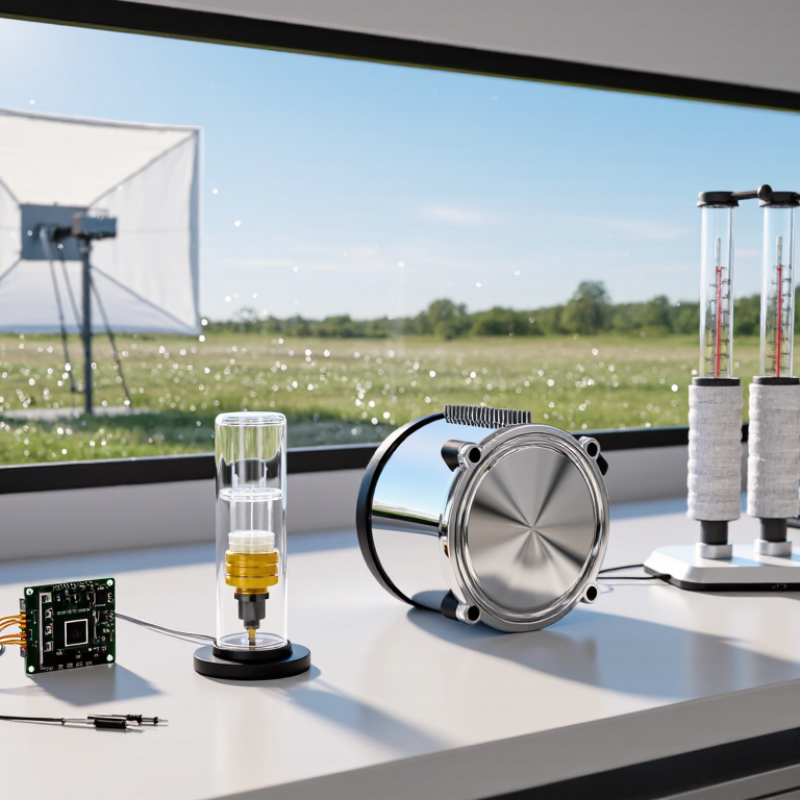
| Sensing principle | A hygroscopic sensing film absorbs or releases water vapor, changing its electrical resistance as relative humidity changes. | The instrument’s electronics measure the resistance and convert it into a relative-humidity reading. |
| Common sensing materials | Humidity-sensitive films may use conductive polymers, ceramic materials, or ionic compounds. | Material choice affects sensitivity, temperature dependence, response time, and long-term stability. |
| Resistance response | In many designs, resistance decreases as humidity rises because absorbed water increases ionic or electrical conduction. | The direction and shape of the response depend on the sensor design; calibration is needed to interpret resistance as humidity. |
| Useful humidity range | Many designs are intended for non-condensing conditions across a broad portion of the relative-humidity range; specified ranges vary by model. | Check the sensor’s rated range and accuracy limits, especially near very low or very high humidity. |
| Accuracy | Accuracy is specified by the manufacturer and commonly varies with humidity, temperature, calibration, and sensor age. | Do not assume a single accuracy value applies across the full operating range; consult the individual sensor specification. |
| Response time | Response may take seconds to minutes, depending on the sensing film, airflow, protective housing, and size of the humidity change. | A ventilated radiation shield can help the sensor track ambient air more effectively, while filters or enclosures can slow response. |
| Temperature influence | Resistance can be affected by temperature as well as moisture. | Weather-station designs may use temperature compensation or a separate temperature measurement to improve humidity readings. |
| Condensation limit | Liquid water on the sensing element can cause saturation, slow recovery, temporary reading errors, or lasting drift, depending on the construction. | Resistive humidity sensors are generally intended for non-condensing operation, not direct measurement of wet surfaces or immersion. |
| Hysteresis and recovery | Readings may differ slightly depending on whether humidity is rising or falling; recovery after exposure to very high humidity can take time. | Allow the sensor to return to stable ambient conditions before relying on readings after condensation or prolonged high humidity. |
| Weather-station suitability | Resistive sensors can provide compact, low-power humidity measurement for environmental monitoring. | Use a suitable protective enclosure and follow the specified temperature, humidity, and non-condensing limits. |