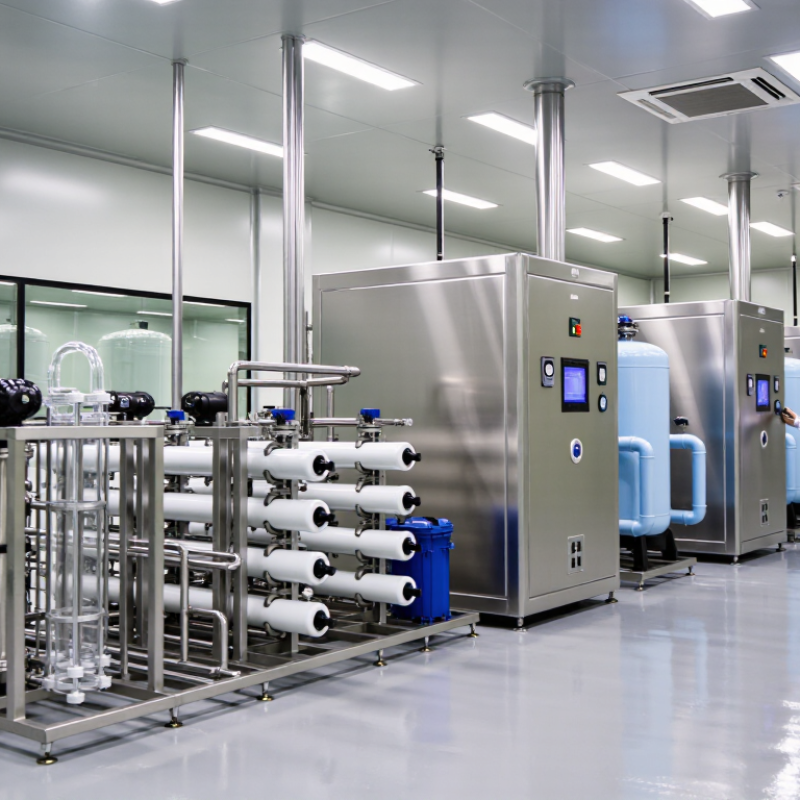
| Product Water Quality | For laboratory Type I applications, resistivity of approximately 18.2 MΩ·cm at 25°C and low organic, microbial, and particulate levels are commonly expected. | Independent water-quality test reports, operating specifications, online monitoring functions, and defined acceptance criteria. | Stable water quality is essential for sensitive analytical, molecular biology, pharmaceutical, and semiconductor processes. |
| Purification Process | A suitable combination of pretreatment, reverse osmosis, deionization or electrodeionization, UV oxidation, ultrafiltration, and final filtration according to feed-water conditions. | Process-flow diagram, component specifications, consumables list, and protection measures for each purification stage. | A properly designed process improves reliability, protects the final polishing unit, and reduces operating costs. |
| Feed-Water Adaptability | The equipment should be selected using actual feed-water parameters, including conductivity, hardness, silica, chlorine, temperature, pressure, and microbial load. | Feed-water analysis requirements, pretreatment design limits, and documented performance under local water conditions. | Incorrect feed-water assumptions can cause membrane fouling, resin exhaustion, corrosion, and unstable output quality. |
| Standards and Compliance | Design and documentation should be aligned with applicable references such as ASTM D5127, USP <1231>, European Pharmacopoeia requirements, or project-specific standards. | Declaration of conformity, test methods, calibration records, validation documents, and quality-management certification where applicable. | Relevant standards make performance claims measurable and support regulatory or quality audits. |
| System Capacity | Capacity should match actual peak demand, operating hours, storage volume, circulation requirements, and future expansion plans rather than only nominal daily output. | Flow-rate curves, recovery rate, peak-load calculations, storage-tank sizing, and redundancy options. | Correct sizing prevents shortages, excessive equipment cycling, unnecessary energy use, and quality degradation during low demand. |
| Monitoring and Control | Continuous or scheduled monitoring should cover key parameters such as resistivity or conductivity, temperature, total organic carbon where required, pressure, flow, and leak status. | Sensor accuracy, calibration interval, alarm settings, data logging, access control, and communication protocols. | Good monitoring helps detect quality drift before it affects experiments or production. |
| Sanitary Design | Product-water pathways should minimize dead legs, stagnation, particle release, and microbial growth; materials should be compatible with purified water service. | Piping layout, tank design, recirculation strategy, drainability, material certificates, and sanitization procedures. | Hygienic design reduces biofilm formation and helps maintain microbiological control. |
| Energy and Water Efficiency | Compare specific energy consumption, reverse-osmosis recovery, reject-water use, standby consumption, and the expected replacement frequency of consumables. | Measured operating data, recovery calculations, utility requirements, and life-cycle cost estimates. | Utility efficiency affects both environmental impact and long-term ownership cost. |
| Installation and Commissioning | The supplier should provide installation drawings, utility requirements, commissioning procedures, operator training, and site-acceptance testing. | Factory-acceptance and site-acceptance test protocols, commissioning records, training materials, and handover documents. | Professional commissioning reduces start-up problems and establishes a documented performance baseline. |
| Maintenance and Consumables | Routine maintenance should be clearly defined for pretreatment filters, membranes, cartridges, UV lamps, sanitization, sensors, and polishing media. | Maintenance schedule, replacement criteria, spare-parts availability, service response process, and consumables compatibility. | Predictable maintenance improves uptime and prevents avoidable quality failures. |
| Documentation and Validation | A complete documentation package should include user requirements, functional specifications, manuals, drawings, certificates, calibration records, and test reports. | Document index, revision control, traceability of critical components, and qualification support such as IQ, OQ, or PQ when required. | Traceable documentation supports quality management, troubleshooting, and regulatory inspections. |
| After-Sales Support | Evaluate technical support coverage, response procedures, spare-parts logistics, remote diagnostics, warranty terms, and local service capability. | Written service-level commitments, escalation contacts, warranty exclusions, and evidence of support for comparable applications. | Reliable support reduces downtime and helps preserve water quality throughout the equipment life cycle. |
| Total Cost of Ownership | Compare purchase price together with installation, utilities, consumables, preventive maintenance, calibration, wastewater, validation, and expected replacement costs. | Five- to ten-year life-cycle cost model with assumptions stated clearly and separately from the initial quotation. | The lowest initial price does not necessarily represent the lowest operating cost or best value. |