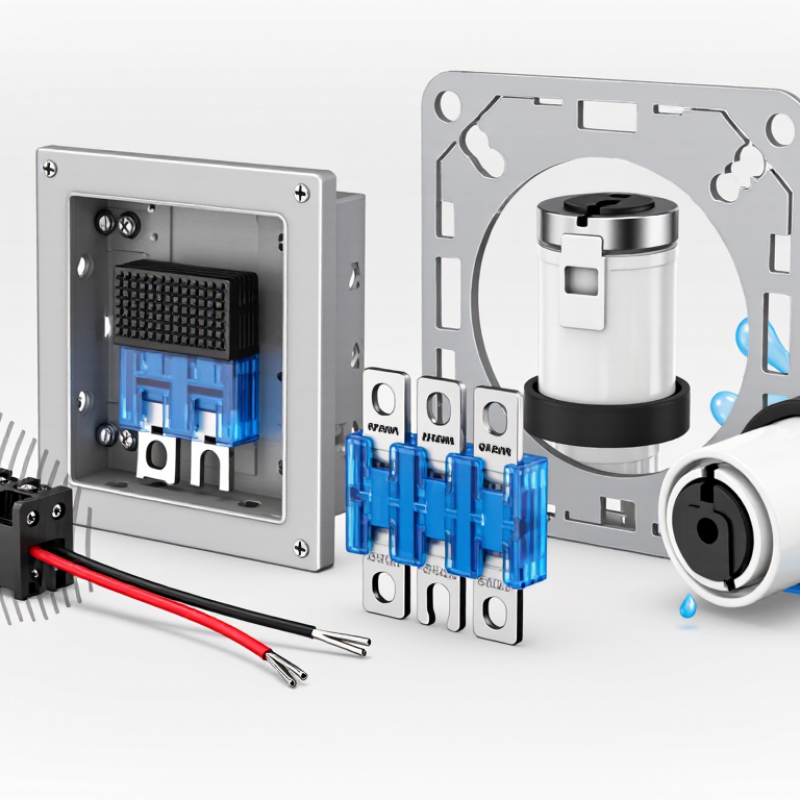
| Inline Blade Fuse Holder | Automotive blade fuses such as ATO, ATC, mini, or micro formats | Low-voltage vehicle wiring, accessory circuits, battery leads, and control panels | Approximately 5–40 A, depending on the housing, terminals, and wire size | Commonly 12–32 V DC; some designs are rated higher by the manufacturer | Insulated housing Crimp terminals Splash-resistant options | Automotive fuse and terminal requirements; verify the exact product rating, temperature rise, and environmental test data | Confirm fuse family, wire gauge, terminal material, sealing level, and compatibility with regional automotive requirements |
| Inline Glass Fuse Holder | 5 × 20 mm, 6.3 × 32 mm, or other cylindrical glass fuses | Consumer electronics, appliances, instruments, lighting, and low-power control equipment | Typically 0.1–15 A | Commonly 125–250 V AC, depending on the holder and fuse combination | Finger protection Flame-retardant insulation Replaceable fuse access | IEC 60127 fuse systems may apply; the assembled product should also be checked against the equipment safety standard | Useful for cost-sensitive applications; check creepage, clearance, heat resistance, and availability of slow-blow and fast-acting fuses |
| Inline Ceramic Fuse Holder | 5 × 20 mm, 6.3 × 32 mm, and other cylindrical ceramic fuses | Power supplies, industrial controls, appliances, and circuits requiring higher interrupting capability | Typically 1–20 A, with higher values available in selected designs | Commonly 250–500 V AC, subject to the specific holder and fuse rating | Higher heat resistance Improved arc control Higher interrupt rating options | IEC 60127 series and applicable equipment-level dielectric, temperature, and flammability tests | Preferred where fault energy or operating temperature is higher; verify fuse interrupt rating rather than relying only on voltage marking |
| Panel-Mount Fuse Holder | Cylindrical cartridge fuses, commonly 5 × 20 mm or 6.3 × 32 mm | Control cabinets, test equipment, power supplies, instrumentation, and machinery panels | Typically 1–20 A | Commonly 250–500 V AC | Touch-safe cap Panel retention nut Clear fuse inspection | IEC 60127 or relevant national adoption; panel equipment may require additional enclosure and insulation testing | Check panel cutout dimensions, mounting method, terminal style, torque limits, and accessibility for maintenance |
| PCB-Mount Fuse Holder | 5 × 20 mm, 6.3 × 32 mm, radial, or surface-mount fuse formats | Printed circuit boards, chargers, industrial electronics, meters, and embedded power assemblies | Typically 0.5–15 A | Commonly 125–250 V AC; higher ratings depend on design and spacing | Defined PCB footprint Flame-retardant body Optional touch protection | IEC 60127 where applicable; PCB creepage, clearance, solderability, and flammability requirements must also be considered | Compare lead spacing, board thickness, wave or reflow compatibility, automated assembly suitability, and replacement access |
| DIN-Rail Fuse Holder | Cartridge fuses, miniature cylindrical fuses, or modular fuse links | Industrial control panels, distribution boards, automation systems, and building services | Typically 2–32 A; higher ratings are available in larger modular systems | Commonly 250–690 V AC, depending on the fuse system and holder design | Touch-safe terminals Clear status marking Secure rail mounting | IEC 60947-3 may apply to switchgear and controlgear assemblies; IEC 60269 may apply to low-voltage fuse systems | Confirm DIN-rail profile, terminal capacity, busbar compatibility, width per pole, short-circuit rating, and local panel rules |
| Automotive Bolt-Down Fuse Holder | High-current bolt-down or strip fuses | Battery distribution, commercial vehicles, construction equipment, marine systems, and high-current DC circuits | Approximately 30–500 A, depending on the fuse and terminal design | Commonly 32–80 V DC | High-current terminals Insulating cover Vibration resistance | Automotive and low-voltage DC requirements; verify vibration, corrosion, temperature-rise, and short-circuit test results | Prioritize conductor cross-section, bolt torque, heat dissipation, busbar layout, enclosure protection, and service access |
| Water-Resistant Inline Fuse Holder | Blade fuses or cylindrical fuses with sealed cable entries | Outdoor equipment, marine accessories, agricultural machinery, battery systems, and mobile equipment | Typically 5–30 A | Commonly 12–32 V DC | Sealed cable glands Gasketed cap Corrosion-resistant terminals | Ingress protection should be verified against IEC 60529 testing; automotive or marine application requirements may also apply | Do not assume “waterproof” means a specific IP rating; request the tested IP level, temperature range, and salt-spray evidence |
| Resettable Circuit Breaker Holder | Thermal or thermal-magnetic resettable protectors | Vehicle accessories, battery equipment, DC distribution, and applications requiring convenient reset | Typically 5–150 A | Commonly 12–48 V DC | Manual reset Overcurrent indication Reusable protection | Applicable circuit-breaker or automotive protection requirements; verify trip curves, interrupt capacity, and temperature derating | Suitable where downtime from fuse replacement is undesirable; compare reset behavior, nuisance-trip resistance, and replacement availability |
| High-Voltage DC Fuse Holder | Specialized cylindrical, square-body, or high-voltage DC fuse links | Energy storage, electric mobility, charging equipment, solar battery systems, and DC power conversion | Often 50–600 A or more, depending on the system design | Commonly 400–1,000 V DC or higher in specialized systems | Arc-quenching design Touch-safe construction Pre-charge or service isolation options | IEC 60269 and applicable battery, photovoltaic, vehicle, or power-conversion standards; system-level validation is essential | Match DC voltage, interrupt rating, time-current curve, clearances, cooling, and fault-energy requirements before purchase |
| Special-Purpose Semiconductor Fuse Holder | Ultra-fast semiconductor fuse links | Variable-speed drives, rectifiers, inverters, UPS equipment, and industrial power electronics | Commonly 10–1,000 A, depending on the fuse system | Often 500–1,000 V AC or DC, subject to the complete assembly | Low-inductance connection High fault protection Optional blown-fuse indication | IEC 60269-1 and applicable semiconductor fuse requirements; verify I²t, interrupt rating, and temperature performance | Focus on fuse-class compatibility, contact pressure, heat dissipation, replacement lead time, and matched fuse-holder geometry |