| Ingredient Receiving | Ingredient identity, lot traceability, and storage condition | Receiving accuracy and traceability coverage | 100% lot identification; cocoa and dry ingredients kept dry and protected from contamination | Document review, barcode scanning, visual inspection, and sampling | Prevents incorrect batches and reduces material-related downtime |
| Mixing and Refining | Particle-size reduction and ingredient dispersion | Chocolate mass particle size | Commonly about 18–30 micrometres for a smooth eating texture | Particle-size testing and sensory assessment | Consistent texture supports stable forming and consumer acceptance |
| Conching | Moisture reduction, aeration, and flavor development | Moisture content and viscosity | Moisture commonly below 1.5%; viscosity maintained within the recipe specification | Moisture analyzer, temperature checks, and rheological testing | Improves flavor consistency and prevents filling or molding problems |
| Tempering | Stable cocoa-butter crystal formation | Temper index, gloss, snap, and bloom resistance | Dark chocolate is commonly cooled to approximately 31–32°C before molding; exact values depend on formulation | Continuous temperature monitoring and temper meter testing | Reduces fat bloom, surface dullness, and demolding defects |
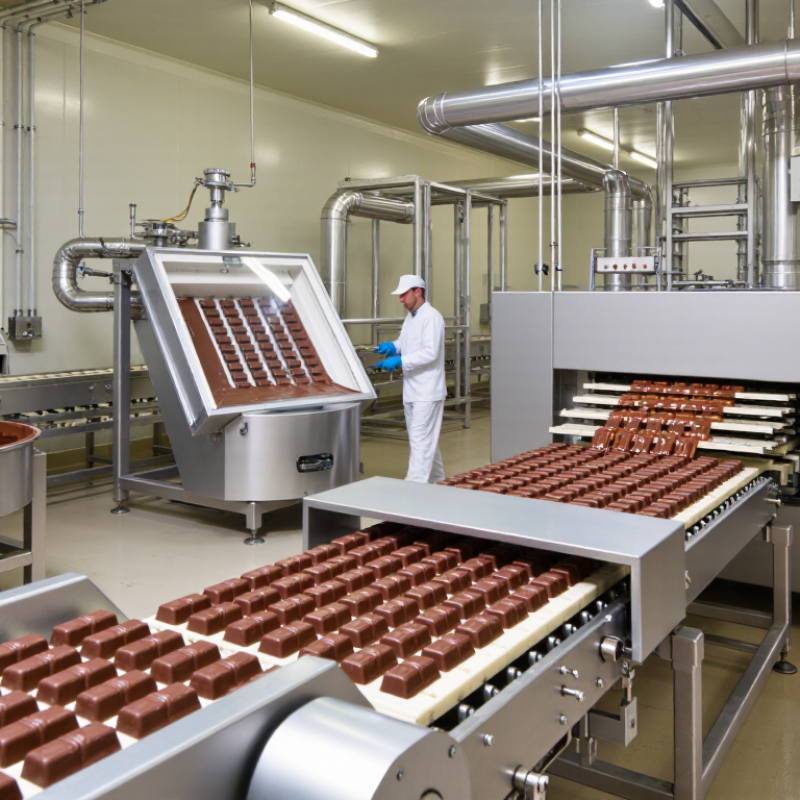
| Molding and Depositing | Accurate portioning, mold cleanliness, and inclusions distribution | Bar weight and dimensional consistency | Net weight maintained within the approved legal and internal tolerance | Checkweigher, sampling plan, and visual inspection | Controls giveaway, rework, and underweight risk |
| Cooling and Demolding | Cooling profile and release from the mold | Surface appearance, breakage rate, and release performance | Cooling conditions commonly controlled around 8–12°C, subject to product design and equipment layout | Temperature and humidity logging, visual checks, and defect counts | Stable cooling reduces cracking, sticking, and production interruptions |
| Primary Packaging | Wrapping accuracy, seal quality, and coding | Seal integrity and coding accuracy | No open seals, damaged film, unreadable codes, or incorrect date information | Seal inspection, leak or burst testing where applicable, and code verification | Protects the bar from moisture, odors, light, and handling damage |
| Secondary Packaging | Counting, case packing, and pallet configuration | Pack-count accuracy and case damage rate | Correct units per case and secure cases without crushed cartons | Automated counting, weight checks, and case inspection | Improves warehouse handling and reduces shipment discrepancies |
| Line Performance | Throughput, availability, speed, and quality losses | Overall Equipment Effectiveness (OEE) | A practical improvement benchmark is to monitor availability, performance, and quality separately; 75–85% OEE is commonly treated as a strong operating range | Production records, downtime logs, and quality reports | Identifies the largest losses and supports targeted improvement projects |
| Waste and Rework Control | Start-up waste, packaging rejects, and off-specification product | Material waste and first-pass yield | Many efficient lines aim to keep avoidable process waste below approximately 3%, depending on product complexity | Mass-balance calculation, waste weighing, and defect Pareto analysis | Lowers material cost and increases saleable output |
| Food Safety Release | Allergen control, foreign-material prevention, and batch release | Critical control point compliance and traceability | 100% completion of required checks before release; allergen labels must match the approved recipe | HACCP records, metal detection or X-ray checks, label verification, and retain samples | Protects consumers and supports rapid, controlled response to quality incidents |