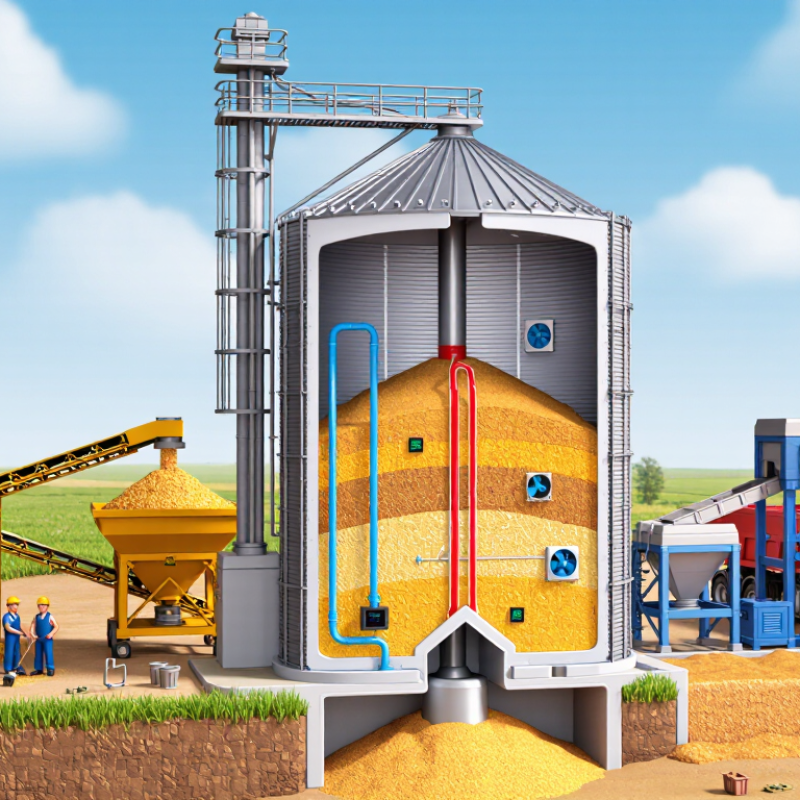
| Silo Definition | Grain silo | Stores dry bulk grains such as wheat, maize, rice, barley, and soybeans while protecting them from weather and contamination. | Common farm and commercial silos range from tens to several thousand tonnes. | Storage performance depends on grain moisture, temperature, airflow, structural condition, and the length of storage. |
| Silo Design | Flat-bottom silo | Provides economical, high-volume storage for longer-term grain holding. | Often used for capacities from several hundred to several thousand tonnes. | Usually requires a bottom unloading conveyor and, for complete emptying, a sweep auger or similar reclaiming device. |
| Silo Design | Hopper-bottom silo | Allows grain to discharge by gravity through a sloped bottom. | Commonly used for smaller storage units, temporary storage, and frequent grain turnover. | The hopper angle must support reliable grain flow; many designs use slopes of approximately 30–45 degrees, depending on grain properties and construction. |
| Loading Equipment | Receiving pit | Receives grain from trucks, trailers, or other transport equipment before conveying it to the silo. | Capacity is matched to the incoming vehicle unloading rate and the downstream conveyor. | A grate, dust control, guards, drainage, and cleanout access are important for safe and hygienic operation. |
| Loading Equipment | Belt conveyor | Moves grain horizontally or on a moderate incline with relatively gentle handling. | Typical installations may handle approximately 50–500 tonnes per hour, depending on belt width and speed. | Suitable for long distances and high throughput; belt alignment, spillage control, and guarding require regular inspection. |
| Loading Equipment | Bucket elevator | Lifts grain vertically using buckets attached to a continuous belt or chain. | Typical grain-handling systems may provide approximately 20–300 tonnes per hour. | Requires a controlled feed, belt or chain monitoring, explosion protection measures, and effective dust management. |
| Loading Equipment | Enclosed screw conveyor | Transfers grain using a rotating helical flight inside a trough or tube. | Often used for short-distance handling at approximately 10–150 tonnes per hour. | Compact and dust-controlled, but excessive speed or long conveying distances can increase grain damage and power consumption. |
| Loading Equipment | Loading spout or distributor | Directs incoming grain into the silo and helps control the discharge point. | Common systems are designed for approximately 50–300 tonnes per hour. | A well-designed inlet reduces segregation, impact damage, dust generation, and uneven filling. |
| Unloading Equipment | Slide gate or gravity outlet | Starts, stops, or regulates grain flow from a hopper or silo outlet. | Flow rate depends on outlet size, gate opening, grain type, and moisture condition. | The gate should be opened gradually to reduce surging, blockage, and excessive load on downstream equipment. |
| Unloading Equipment | Bottom drag conveyor or chain conveyor | Collects and transports grain discharged from a flat-bottom silo. | Typical capacities range from approximately 30–300 tonnes per hour. | Wear-resistant components, proper chain tension, and protection against foreign objects help maintain reliable operation. |
| Unloading Equipment | Sweep auger | Moves remaining grain from the outer floor area toward the center outlet after gravity discharge. | Common systems handle approximately 10–100 tonnes per hour. | It should be operated only according to the manufacturer’s safety procedure because moving machinery remains inside the silo. |
| Unloading Equipment | Pneumatic conveying line | Uses moving air to transport grain or grain products through enclosed pipelines. | Typical systems may handle approximately 5–100 tonnes per hour. | Provides flexible routing and dust containment, but generally uses more energy and can cause additional grain impact than mechanical conveying. |
| Storage Management | Aeration fan and duct system | Moves ambient air through the stored grain to control temperature and help maintain quality. | Airflow is commonly specified in cubic metres per hour per tonne or cubic feet per minute per bushel. | Aeration is not a substitute for drying; air conditions, grain moisture, airflow uniformity, and operating time must be managed carefully. |
| Storage Management | Temperature and moisture monitoring | Detects hot spots, moisture migration, condensation, and conditions that may encourage mold or insects. | Sensor spacing and quantity depend on silo diameter, grain depth, and monitoring requirements. | Regular readings and prompt corrective action are essential because localized heating can develop before surface conditions change. |
| Safety and Maintenance | Dust collection and explosion protection | Controls airborne grain dust and reduces the risk of fire or dust explosions. | System performance is based on airflow, dust loading, equipment layout, and applicable safety requirements. | Use housekeeping, grounding, ventilation, inspection, and appropriate explosion-control measures; never enter a silo without a formal confined-space procedure. |