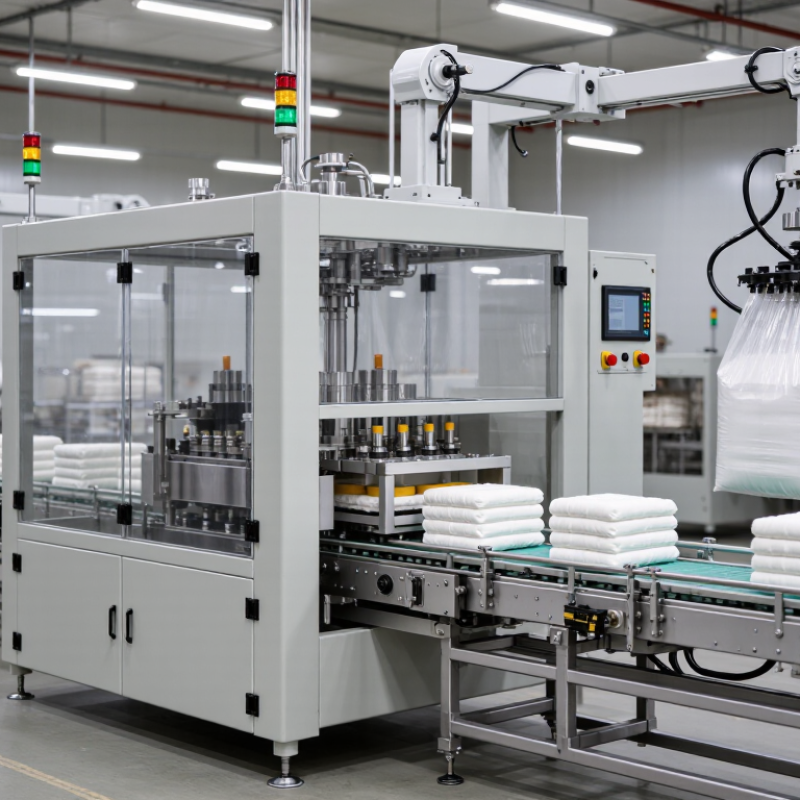
| Machine Definition | Automatic diaper bagging and packing system | Receives counted diapers, forms a product bundle, inserts it into packaging film or pre-made bags, and seals the finished pack. | The machine is normally installed after diaper production, folding, counting, and product transfer equipment. |
| Nominal Packing Speed | 20–60 packs per minute | The stated range represents the number of completed retail packs produced in one minute under specified operating conditions. | Actual output depends on pack count, diaper size, bag dimensions, film performance, changeovers, and line stoppages. |
| Theoretical Hourly Output | 1,200–3,600 packs per hour | Calculated by multiplying the nominal speed by 60 minutes. | This is a theoretical rate; scheduled production output is usually lower because of material loading, cleaning, adjustments, and planned maintenance. |
| Common Pack Counts | Approximately 20–60 diapers per pack | The counting and grouping system prepares the required quantity before bagging. | Higher diaper counts generally require larger bags and may reduce the achievable packs-per-minute rate. |
| Product Types | Baby diapers, training pants, and selected adult incontinence products | The same packing concept can serve several absorbent-hygiene products when the feeding and forming systems are compatible. | Product width, thickness, folding pattern, and compressibility must be matched to the machine configuration. |
| Packaging Materials | Polyethylene-based plastic film, laminated film, or pre-made plastic bags | The packaging material forms the outer protective pack and carries printed product information when required. | Film thickness, coefficient of friction, sealability, and roll quality affect feeding and sealing stability. |
| Primary Packing Method | Film forming, product insertion, heat sealing, and bag discharge | The system converts packaging film into a bag or sleeve, inserts the diaper bundle, and closes the pack. | Seal temperature, pressure, dwell time, and alignment must be controlled to prevent open or wrinkled seals. |
| Counting Accuracy | Controlled by electronic counting and product-detection sensors | Sensors and programmed counters help verify that each pack receives the intended number of products. | Sensor calibration, stable product spacing, and regular inspection are necessary for reliable count control. |
| Automation Functions | Automatic feeding, counting, bag forming, sealing, cutting, discharge, and fault detection | Integrated controls reduce manual handling between diaper production and finished-pack discharge. | The degree of automation varies according to line layout, packing format, and required inspection functions. |
| Pack Formats | Flat packs, pillow-style bags, and selected compressed packs | The selected format determines the bag shape, sealing arrangement, and downstream handling requirements. | Compressed formats may require additional air removal or compression equipment before final sealing. |
| Changeover Capability | Adjustable for different diaper sizes and pack counts | Operators can change production settings for different product specifications and retail pack configurations. | Changeover time depends on tooling, bag dimensions, recipe settings, cleaning requirements, and operator experience. |
| Quality Inspection | Pack presence, seal integrity, product count, film position, and basic dimension checks | Inspection functions help identify incomplete packs, sealing faults, misalignment, and missing products. | Additional checkweighing, vision inspection, or metal detection may be installed when required by the production specification. |
| Utilities | Electrical power and, for many systems, compressed air | Electric motors and controls drive the machine, while pneumatic components may operate cylinders and actuators. | Required voltage, power load, air pressure, and air quality must be confirmed before installation. |
| Production Scope | Medium- to high-volume automated diaper packing | The 20–60 packs-per-minute range is intended for continuous production environments rather than occasional manual packing. | Line balancing is important so that diaper production, packing, conveying, and palletizing capacities are compatible. |
| Key Performance Factors | Speed, count accuracy, seal quality, material utilization, uptime, and changeover time | These indicators provide a more complete evaluation than nominal speed alone. | Actual performance should be verified using the intended diaper sizes, pack counts, film, and production schedule. |