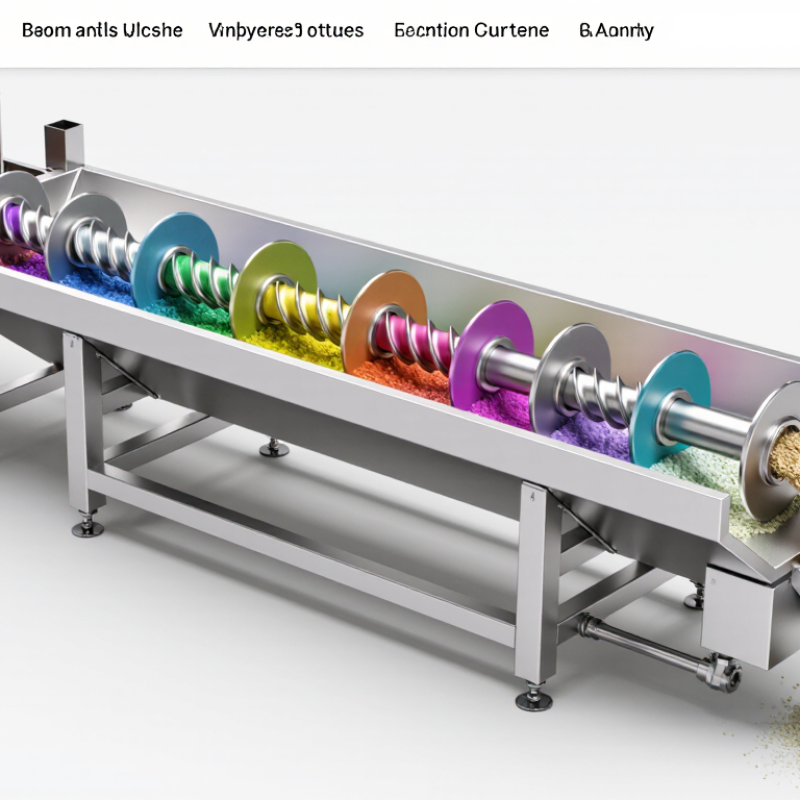
| Horizontal trough | A stationary, elongated vessel holds the batch while a horizontal shaft and ribbon assembly rotate inside it. | Provides the space in which the ingredients circulate and mix. | Troughs are commonly U-shaped or cylindrical, with a cover and an outlet for discharging the batch. |
| Central shaft | A motor and drive turn the shaft along the length of the trough. | Transfers rotational motion to the inner and outer helical ribbons. | Drive speed and equipment design affect mixing time and the amount of mechanical action. |
| Outer helical ribbon | The outer ribbon follows a helical path near the trough wall. In a common arrangement, it conveys material toward the center of the mixer. | Moves material axially along the trough, often from the ends toward the middle. | Conveying direction depends on the ribbon helix and shaft rotation; designs may differ. |
| Inner helical ribbon | The inner ribbon is mounted closer to the shaft and has a helix arranged to convey material opposite to the outer ribbon. | In a common arrangement, it moves material from the center toward the ends. | Together, the opposing axial flows help circulate material through different regions of the batch. |
| Combined circulation | As the ribbons rotate, they create opposing lengthwise movement as well as local lifting, folding, and redistribution. | Ingredients repeatedly pass through different parts of the mixer, supporting bulk blending. | Mixing performance depends on factors such as batch size, ingredient properties, loading pattern, and operating time. |
| Typical materials | Ribbon mixers are commonly used for dry powders and granules, including blends of ingredients with different particle sizes or bulk densities. | Circulation helps distribute ingredients throughout the batch. | Material flow, cohesion, abrasiveness, and sensitivity to shear should be considered when selecting equipment. |
| Liquid addition | Some configurations can introduce a liquid through spray nozzles while the solids are being mixed. | Spraying can distribute a liquid across the moving solids more evenly than pouring it into one spot. | Suitability depends on the liquid quantity, formulation, nozzle arrangement, and mixer design. |
| Loading and discharge | Ingredients are loaded through openings in the cover, and the mixed batch is released through a bottom or end outlet. | Discharge openings allow the blended material to leave the trough for the next process step. | Correct loading and thorough discharge help reduce unmixed pockets and leftover material. |
| Operating considerations | The mixer is run for a process-appropriate period, then stopped before discharge and cleaning. | Operating conditions influence blend uniformity and product handling. | Follow the equipment’s operating and safety instructions; avoid entering or reaching into a mixer unless it is safely isolated. |