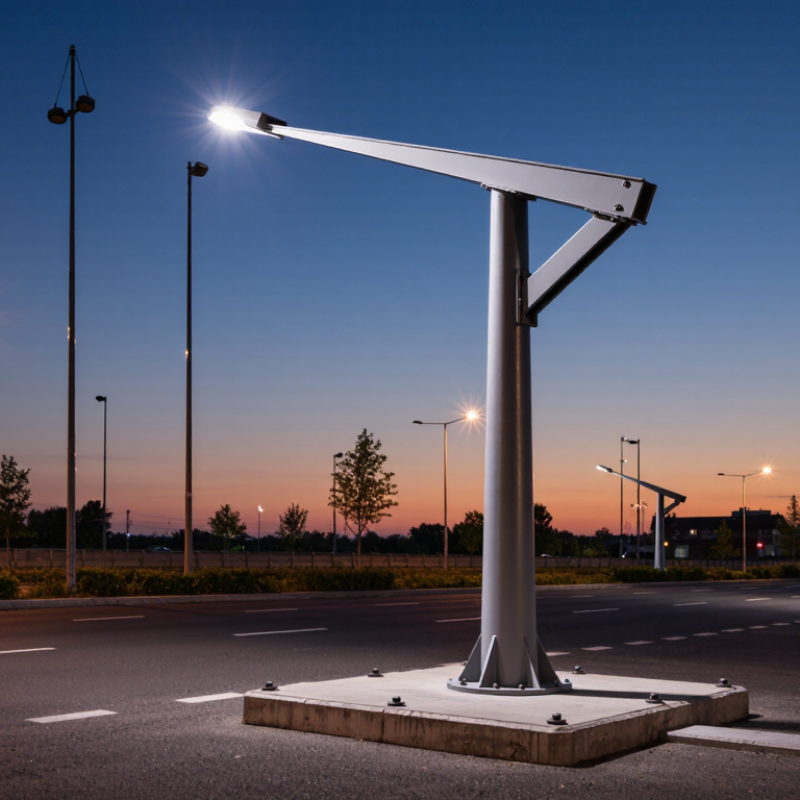
| Steel light pole | A vertical support made from structural steel, commonly formed as a tapered or straight shaft. | May use a bracket arm, davit arm, tenon, or direct-mounted luminaire, depending on the design. | Roads, streets, parking areas, campuses, and public spaces. | Height, wind loading, fixture weight, corrosion protection, and foundation design must suit the site. |
| Octagonal tapered pole | A faceted, typically eight-sided shaft that narrows toward the top. | Often supplied with a side-mounted arm, top-mounted tenon, or multiple arms. | Roadways, parking lots, and general outdoor area lighting. | The tapered shape and shaft design are selected to meet the required structural loads. |
| Round tapered pole | A circular shaft with a gradual reduction in diameter toward the top. | Commonly paired with a curved or straight arm, or a top-mounted fixture. | Streets, pathways, parks, and parking areas. | Check fixture orientation, arm reach, access needs, and compatibility with the pole top. |
| Straight round pole | A circular shaft with a largely uniform diameter along its length. | May use a bracket, tenon-mounted fixture, or purpose-designed multi-fixture assembly. | Walkways, small outdoor areas, and sites requiring a simple pole profile. | Structural capacity depends on the shaft, material thickness, connections, and site loads. |
| Square or rectangular pole | A straight or tapered shaft with a square or rectangular cross-section. | Typically uses a side-mounted bracket or a compatible top mounting arrangement. | Commercial properties, campuses, and architectural outdoor spaces. | Confirm mounting details and directional orientation during layout and installation planning. |
| Single-arm configuration | A pole fitted with one projecting arm. | One luminaire is mounted on the arm; arm length and angle vary by design. | Road edges, sidewalks, and perimeter lighting. | Arm projection affects fixture position and contributes to the structural load on the pole. |
| Double-arm configuration | A pole fitted with two arms, commonly arranged in opposite directions. | Two luminaires are mounted on separate arms. | Roadways, medians, and larger outdoor areas requiring light in more than one direction. | Both fixtures and arms must be included in the structural and foundation design. |
| Tenon-top configuration | A pole with a short vertical mounting section at the top, sized for compatible equipment. | Accepts a compatible luminaire or accessory designed for tenon mounting. | Area lighting and installations using top-mounted fixtures. | Verify the tenon dimensions and mounting method against the selected fixture requirements. |
| Anchor-base configuration | The pole is attached by a base plate and anchor bolts to a concrete foundation. | May support single-arm, double-arm, or top-mounted luminaires. | Many roadway, parking, and site-lighting installations. | Anchor-bolt layout, base plate, foundation, and access for installation must be coordinated. |
| Direct-burial configuration | The lower portion of the pole is embedded directly in the ground or in a prepared foundation. | Mounting options depend on the pole design and lighting layout. | Some roadway, pathway, and site-lighting applications. | Buried-section protection, soil conditions, drainage, and installation depth require attention. |
| High-mast system | A tall pole designed to support a group of luminaires at a single elevated mounting level. | Often uses a ring or frame carrying multiple fixtures; some systems allow lowering for maintenance. | Large interchanges, airports, ports, and expansive outdoor areas. | Requires site-specific structural design, foundation planning, and a safe maintenance strategy. |