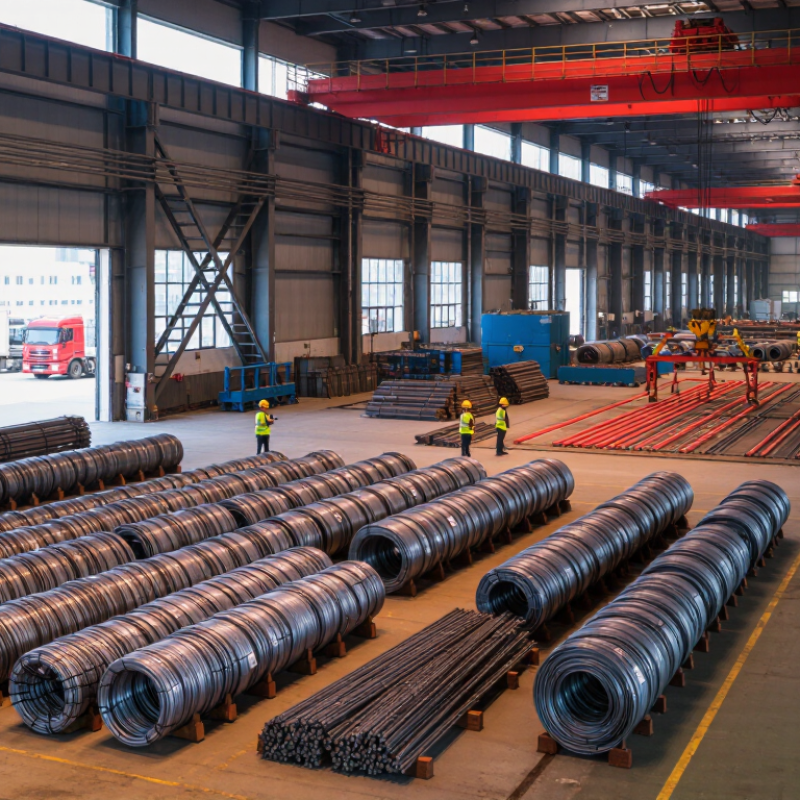
| Production route | Integrated blast furnace–basic oxygen furnace (BF–BOF) | Billets rolled into plain or ribbed reinforcing bars | Uses iron ore and metallurgical coke to make hot metal, which is refined in a basic oxygen furnace. The route can produce a broad range of steel compositions and products. |
| Production route | Electric arc furnace (EAF) | Rebar made from recycled steel scrap, direct-reduced iron, or a mix | Melts metallic feed using electric arcs. Product chemistry and properties depend on feedstock, refining practice, and process controls; the route commonly enables high scrap use. |
| Strengthening method | Thermo-mechanical treatment (TMT), often called quenching and self-tempering | Ribbed bars with a harder outer layer and a more ductile core | Hot-rolled bars are rapidly water-cooled at the surface and then self-tempered by heat from the core. Final properties depend on controlled processing and testing. |
| Strengthening method | Microalloying and controlled rolling | Rebar designed for specified strength and ductility | Small additions of elements such as vanadium or niobium, together with controlled processing, can refine grain structure and improve strength. The permitted chemistry depends on the applicable product standard. |
| United States | ASTM A615/A615M; ASTM A706/A706M | A615 Grades 40, 60, 80, and 100; A706 Grade 60 is a common weldable, low-alloy specification | A615 grade numbers correspond to minimum yield strengths in ksi (for example, Grade 60 is 60 ksi, approximately 420 MPa). A706 includes requirements for controlled chemistry and enhanced weldability. |
| Europe and UK | EN 10080; national product standards, including BS 4449 in the UK | B500B and B500C are commonly specified under BS 4449 | “500” denotes a characteristic yield strength of 500 MPa. The letters indicate ductility classes; requirements and designations depend on the national standard in use. |
| Japan | JIS G 3112 | Examples include SD295A, SD345, SD390, and SD490 | The grade number identifies the specified strength class. The standard also sets requirements such as dimensions, mechanical properties, and testing. |
| India | IS 1786 | Examples include Fe 415, Fe 500, Fe 500D, Fe 550, and Fe 600 | The grade number indicates the minimum yield strength in MPa. The “D” suffix identifies a grade with enhanced ductility requirements compared with the corresponding non-D grade. |
| Quality checks | Mechanical, dimensional, and chemical testing | Yield strength, tensile strength, elongation, bend or rebend performance, mass, and rib geometry | Acceptance criteria are defined by the governing standard and contract. Mill test certificates commonly record grade, heat or batch identification, and test results. |