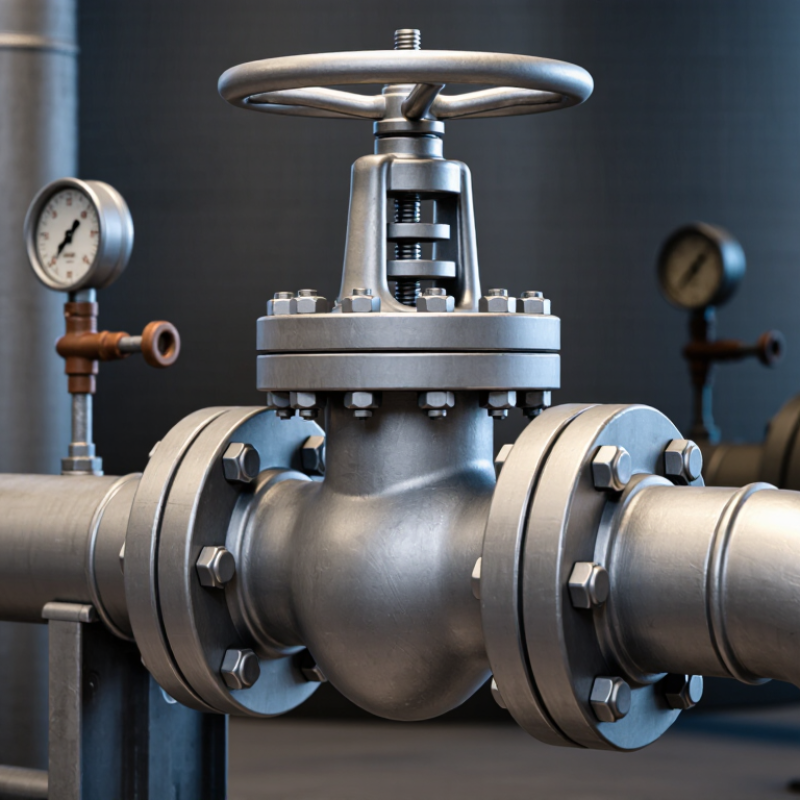
| Valve Type | Flanged-end globe valve | The valve is connected to the pipeline with bolted flanges, allowing secure installation and later removal for inspection or maintenance. |
| Main Function | Flow regulation, throttling, and shutoff | A movable disc changes the opening between the disc and seat, making the valve suitable for controlling flow as well as isolating a line. |
| Operating Principle | Linear stem movement | Turning the handwheel moves the stem and disc vertically. Closing the disc toward the seat reduces the flow area; lifting it increases the flow area. |
| Body Configuration | Straight, angle, or Y-pattern body | The straight pattern is common for general service. Angle and Y-pattern designs can reduce piping changes or pressure loss in selected applications. |
| Flow Direction | Normally indicated by an arrow on the body | Correct flow orientation helps the disc, seat, and body manage fluid forces as intended by the valve design. |
| Common Nominal Sizes | DN15 to DN600 (approximately NPS 1/2 to 24) | Available sizes depend on the pressure class, body pattern, material, end standard, and manufacturer design. |
| Typical Pressure Classes | ASME Class 150, 300, and 600 are common examples | The allowable pressure is determined by the applicable pressure-temperature rating table, body material, size, and design standard; the class number is not a direct pressure value in bar or psi. |
| Flange Standards | ASME B16.5 for many NPS 1/2 to 24 flanges; ASME B16.47 for larger sizes | Standardized flange dimensions simplify alignment with compatible piping, gaskets, bolts, and fittings. |
| Face-to-Face Dimension | Typically selected according to ASME B16.10 or the specified project standard | A standardized face-to-face length supports predictable pipe layout and replacement of compatible valves. |
| Typical Body Materials | Carbon steel, stainless steel, alloy steel, or cast iron, depending on service | Material selection must consider pressure, temperature, corrosion, erosion, fluid compatibility, and applicable material standards. |
| Common Trim Materials | Stainless steel or hard-faced trim; exact grades vary by service | The trim must resist wear, corrosion, cavitation, and wire-drawing effects caused by throttling service. |
| Pressure Drop | Generally higher than a comparable full-port gate valve | The changing flow direction and restricted passage improve throttling control but create greater resistance when the valve is fully open. |
| Control Performance | Good repeatable control for many liquid, gas, and steam applications | The disc position changes progressively with stem travel, allowing more precise regulation than many quarter-turn isolation valves. |
| Shutoff Capability | Tight shutoff is achievable when the seat, disc, actuator force, and standard requirements are properly selected | Actual leakage performance depends on the seat design, manufacturing quality, test standard, fluid, temperature, and operating conditions. |
| Actuation Options | Manual handwheel, electric actuator, pneumatic actuator, or hydraulic actuator | Actuation can be selected according to required torque, control accuracy, fail-safe action, operating frequency, and automation system. |
| Stem Arrangement | Rising stem is common in manual globe valve designs | Visible stem movement provides a simple visual indication of approximate valve position, subject to the specific design. |
| Typical Applications | Steam, water, thermal oil, compressed gas, process fluids, and utility systems | The valve is often selected where controlled flow adjustment and reliable isolation are more important than minimum flow resistance. |
| Key Advantages | Strong flange connection, good throttling ability, maintainable construction, and broad material selection | The flanged connection is convenient for installation and servicing, while the globe-valve geometry supports controlled flow adjustment. |
| Main Limitations | Higher pressure loss, larger installation space, and slower operation than quarter-turn valves | A globe valve may be unsuitable where very low pressure drop, compact design, or rapid emergency operation is the primary requirement. |
| Selection Checklist | Size, pressure, temperature, fluid, flow rate, pressure drop, materials, leakage class, and actuation | A correct selection requires matching the valve rating and construction to the actual process conditions and the governing piping specification. |