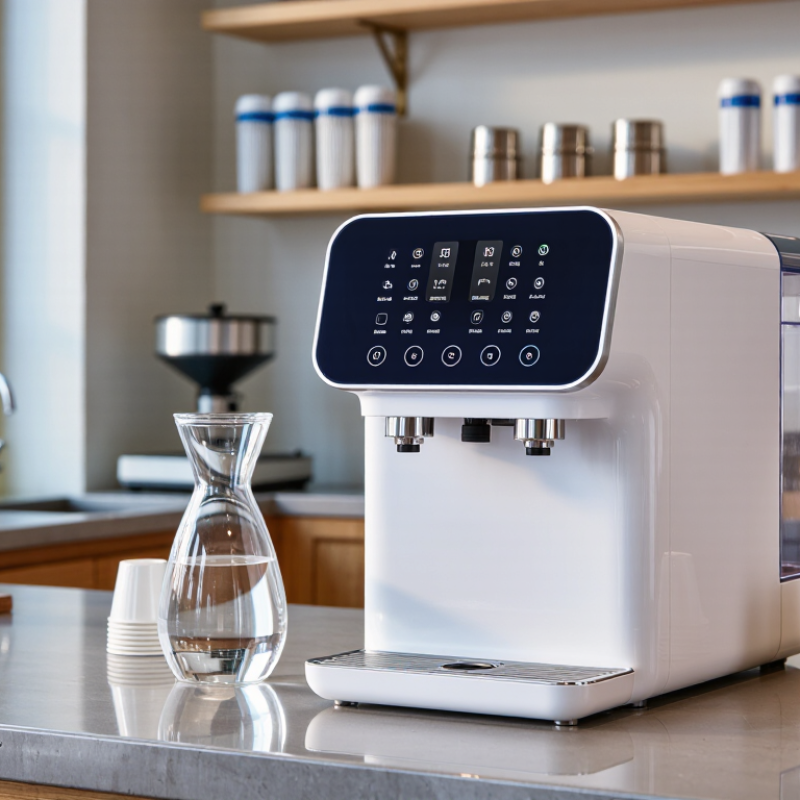
| Typical treatment method | Pressurized membrane filtration removes dissolved salts, many metals, and other impurities. | Water is evaporated and condensed; dissolved solids remain in the boiling chamber. | Finished water is purchased, transported, stored, and dispensed on site. | On-site production can reduce recurring delivery and packaging expenses. |
| Planning production volume | 1,000 L of purified water per operating day | 1,000 L of distilled water per operating day | 1,000 L equivalent per operating day | A common usage baseline for comparing business operating requirements. |
| Water recovery or waste | Approximately 50%–75% recovery is common, depending on membrane design and feed-water quality. Planning value: 60%. | Water is consumed through evaporation, cooling, blowdown, and cleaning. Planning allowance: approximately 10%–25% additional feed water. | No on-site process-water discharge, but packaging and transport create upstream resource use. | RO waste can be reduced with recovery controls, correct pressure, and reuse for non-potable purposes where permitted. |
| Estimated water required per 1,000 L produced | About 1,667 L feed water at 60% recovery; approximately 667 L reject water. | About 1,100–1,250 L, depending on equipment design and cleaning practice. | 1,000 L purchased as finished product; supplier-side process losses are outside the site calculation. | For RO installations, wastewater handling should be included in the site design and operating budget. |
| Typical electricity intensity | Approximately 0.05–0.20 kWh per liter, depending on pump pressure, pretreatment, storage, and distribution. | Approximately 0.60–1.00 kWh per liter because water must be heated and condensed. | Low direct electricity use at the site, excluding refrigeration, dispensing, delivery, and production energy. | RO generally requires substantially less on-site energy than thermal distillation. |
| Planning electricity use per year | 26,000 kWh at 0.10 kWh/L and 260 operating days | 195,000 kWh at 0.75 kWh/L and 260 operating days | Not calculated for on-site electricity because production occurs off site. | Actual consumption should be verified with a power meter during normal production. |
| Filter and consumable life | Sediment filter: commonly 3–6 months; carbon filter: commonly 6–12 months; RO membrane: commonly 2–5 years; polishing filter: commonly 6–12 months. | Usually no RO membrane; scale-removal chemicals and cleaning are required. Some systems use prefilters or post-treatment cartridges. | No on-site treatment-filter replacement, but bottles, caps, dispensers, and delivery services remain recurring inputs. | Scheduled replacement is more predictable than emergency replacement caused by neglected maintenance. |
| Maintenance workload | Routine filter changes, membrane performance checks, sanitization, leak inspection, and reject-flow monitoring. | Boiling-chamber descaling, cleaning, temperature checks, and condenser maintenance. | Bottle handling, storage-space management, dispenser cleaning, inventory control, and delivery scheduling. | The lowest-cost option depends on labor rates, water quality, production volume, and service discipline. |
| Illustrative annual water cost | Approximately $1,734 at 433,420 L annual feed water and $0.004/L. | Approximately $1,165–$1,300 at 286,000–325,000 L annual feed water and $0.004/L. | Not included because delivered-water prices vary significantly by location, contract, container size, and delivery frequency. | Use the local commercial water and wastewater tariff instead of a generic estimate. |
| Illustrative annual electricity cost | Approximately $3,900 at 26,000 kWh and $0.15/kWh. | Approximately $29,250 at 195,000 kWh and $0.15/kWh. | Direct site electricity is generally limited to storage or dispensing equipment. | Electricity pricing and the equipment’s measured kWh/L should be used for a final comparison. |
| Best fit for business operations | Continuous or high-volume use where water quality, production consistency, and cost visibility are important. | Applications requiring distilled water and accepting higher thermal-energy consumption. | Low or irregular demand, limited installation space, or locations where equipment ownership is not practical. | A pure water machine becomes more attractive as daily demand and delivery costs increase. |