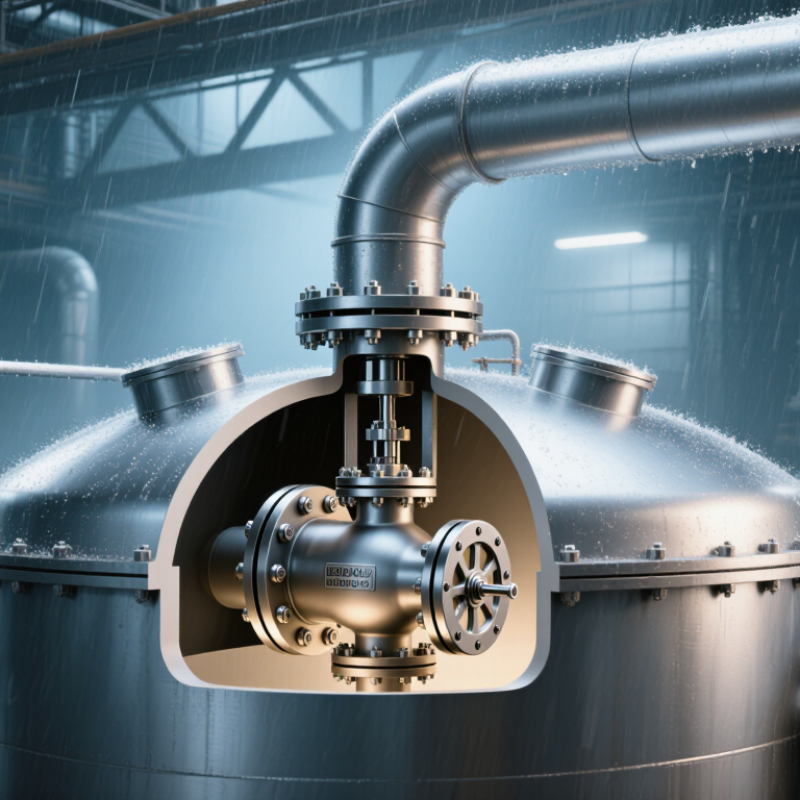
| Primary function | Pressure and vacuum protection for tanks, vessels, piping sections, and process equipment | The vent opens when internal pressure or vacuum reaches its configured set point, helping reduce the risk of tank deformation or overpressure. |
| Operating principle | Spring-loaded, weighted, or diaphragm-operated closure with a removable plug or protective cap | Under normal conditions, the sealing element remains closed. Pressure imbalance lifts or moves the closure to permit controlled airflow. |
| Common connection sizes | Approximately DN15 to DN300 (NPS ½ to NPS 12), depending on the equipment and required venting capacity | The connection size must be selected from the required mass-flow rate, allowable pressure drop, piping layout, and tank nozzle size. |
| Pressure set point | Application-specific; commonly specified in Pa, kPa, mbar, or inches of water column for low-pressure storage tanks | The pressure setting should remain below the vessel’s allowable working pressure and must account for filling, emptying, thermal expansion, and emergency conditions. |
| Vacuum set point | Application-specific; normally selected as a small negative pressure relative to atmospheric pressure | The vacuum function admits air or inert gas during liquid withdrawal, cooling, condensation, or other conditions that reduce internal pressure. |
| Atmospheric reference | Standard atmospheric pressure at sea level: 101.325 kPa absolute, approximately 1.013 bar absolute | Actual atmospheric pressure changes with elevation and weather, so set points and calibration should use the correct local reference. |
| Typical body materials | Carbon steel, stainless steel, aluminum, ductile iron, or engineering plastics | Material selection depends on the stored medium, corrosion risk, pressure class, outdoor exposure, and required mechanical strength. |
| Typical sealing materials | EPDM, NBR, FKM, PTFE, or other chemically compatible elastomers and polymers | The seal must be compatible with the process fluid, temperature, cleaning chemicals, and expected service life. |
| Temperature range | Often approximately −40°C to +200°C, but the actual range is determined by the body, seat, gasket, and process medium | Temperature changes can affect seal flexibility, set-point accuracy, corrosion rate, and the vent’s ability to open and reseat. |
| Flow capacity | Determined by orifice area, pressure differential, gas or vapor properties, and the manufacturer’s certified capacity data | A larger nominal connection does not automatically provide sufficient capacity; sizing should cover normal breathing and credible emergency scenarios. |
| Connection options | Threaded, flanged, sanitary clamp, socket-weld, or butt-weld connections | The connection should match the vessel nozzle, piping standard, maintenance requirements, and required leak-tightness. |
| Protection against contamination | Protective plug, screen, weather hood, flame-arresting element, or filtration element where required | These features help limit the entry of rain, dust, insects, debris, or flame, but they must not become blocked and restrict required airflow. |
| Applicable design references | Common references include API 2000, ISO 28300, EN 14015, ASME pressure-vessel requirements, and applicable local regulations | The correct standard depends on the tank or vessel type, operating pressure, fluid hazard, installation location, and jurisdiction. |
| Maintenance interval | Inspection frequency is service-dependent; periodic inspection is recommended, with more frequent checks in dusty, corrosive, or high-cycle applications | Inspection should verify cleanliness, free movement, seal condition, corrosion, fastener security, and correct set-point performance. |
| Main industrial benefits | Compact design, passive operation, low energy demand, straightforward servicing, and reduced risk of pressure-related equipment damage | Plug vents provide automatic pressure equalization without requiring continuous electrical power or a complex control system. |
| Typical applications | Chemical storage, water and wastewater treatment, petroleum products, food processing, pharmaceutical utilities, bulk solids, and general process tanks | The vent type, materials, seal design, and certification must be matched to the specific process and hazardous-area requirements. |
| Selection note | Use verified operating data rather than nominal size alone | Final selection should consider vessel design pressure, vacuum rating, required flow, fluid properties, temperature, corrosion, emissions control, and applicable regulations. |