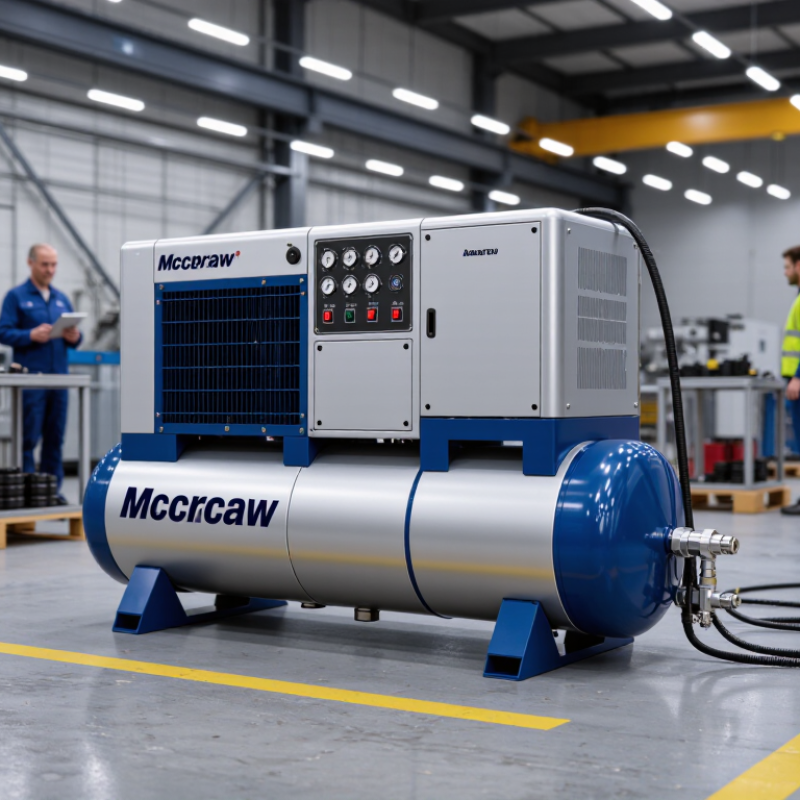
| Product Portfolio | Reciprocating, rotary screw, rotary vane, scroll, centrifugal, and oil-free compressor systems are common product categories. | Different industries require different pressure, airflow, cleanliness, and duty-cycle characteristics. | Match the compressor type to operating hours, air quality requirements, peak demand, and installation conditions. |
| Pressure Range | Industrial compressed-air systems commonly operate around 7–13 bar(g), while specialized equipment may require substantially higher pressure. | The correct pressure rating supports safe operation and prevents energy losses caused by excessive pressure. | Confirm required working pressure, maximum pressure, pressure fluctuation, and receiver-tank rating. |
| Air Delivery | Air output is normally specified as FAD or free air delivery, commonly expressed in m³/min, m³/h, or CFM. | Accurate airflow data helps buyers size equipment for production demand and avoid insufficient capacity. | Compare airflow at the stated pressure and test conditions rather than comparing motor power alone. |
| Lubrication Design | Oil-injected compressors are widely used for general industrial air; oil-free designs are used where air contamination must be minimized. | Food, pharmaceutical, electronics, and medical applications may require stricter air-quality control. | Define the required ISO 8573-1 air-quality class and specify suitable filtration and drying equipment. |
| Drive Configuration | Fixed-speed and variable-speed drive systems are common. Variable-speed drives adjust motor speed to better follow changing air demand. | Demand matching can reduce unloading and idling losses in systems with variable consumption. | Evaluate the demand profile, motor efficiency, control range, starting method, and local electrical regulations. |
| Power Supply Compatibility | Industrial units are commonly configured for three-phase supplies such as 380–415 V at 50 Hz or 440–480 V at 60 Hz, depending on the market. | Correct voltage and frequency are essential for reliable operation and motor protection. | Verify voltage, frequency, phase count, starting current, enclosure requirements, and regional certification needs. |
| Air Treatment Scope | Common auxiliary equipment includes air receivers, refrigerated dryers, desiccant dryers, particulate filters, coalescing filters, and condensate drains. | Air treatment protects downstream tools, improves product quality, and reduces corrosion in distribution piping. | Select equipment according to pressure dew point, ambient temperature, airflow, oil carryover, and moisture load. |
| Noise and Installation | Enclosed industrial compressors often use acoustic panels, cooling fans, vibration isolators, and service access doors. | Noise level, ventilation, floor loading, and maintenance clearance affect installation cost and workplace suitability. | Check sound-pressure data, ambient temperature limits, ventilation requirements, dimensions, and lifting points. |
| Standards and Documentation | Relevant documentation may include technical datasheets, operation manuals, wiring diagrams, pressure-vessel information, and conformity declarations. | Complete documentation supports customs clearance, installation, operator training, and local compliance review. | Request documentation aligned with applicable ISO, IEC, CE, UL, ASME, or local regulatory requirements. |
| Maintenance Requirements | Routine service may include oil and filter replacement, separator inspection, belt or coupling checks, cooler cleaning, and condensate management. | Accessible service points and readily available replacement parts help reduce downtime. | Review service intervals, spare-part availability, remote support, warranty terms, and technician training. |
| Typical Applications | Applications include manufacturing, automotive workshops, construction, mining, packaging, textiles, food processing, medical facilities, and electronics production. | A broad application range allows buyers to select equipment according to air quality, pressure, duty cycle, and environmental conditions. | Prepare an application profile covering daily operating hours, peak demand, required air quality, altitude, temperature, and expansion plans. |