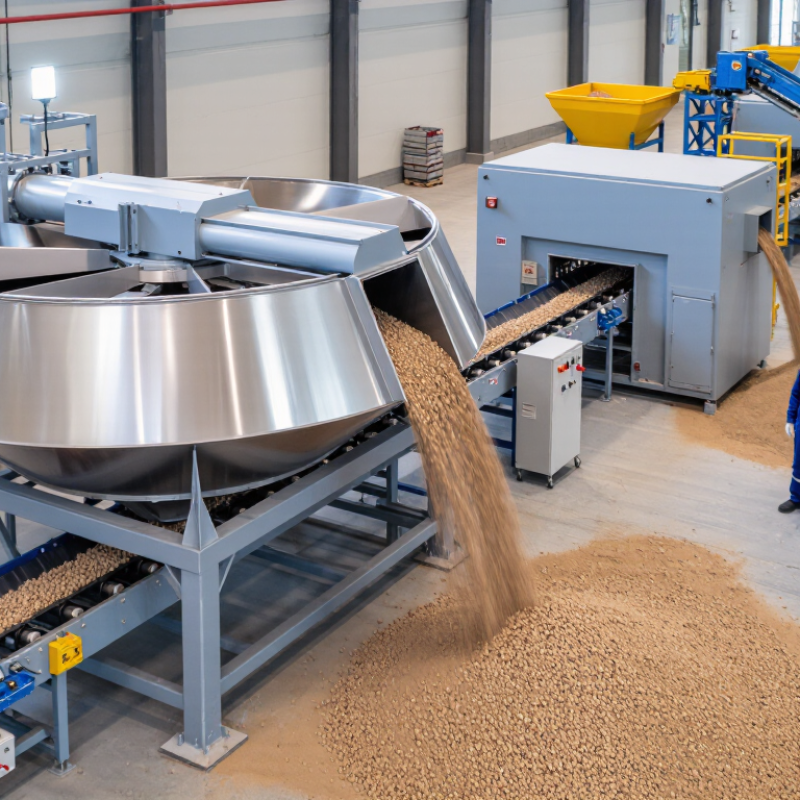
| Granule size | Many granular fertilizers intended for broadcast application use particles in roughly the 2–4 mm range. The suitable range depends on the product and applicator. | Consistent granule size helps fertilizer travel and spread more evenly. Size differences can cause particles to travel different distances from a spreader. | Check the product’s stated size range and confirm it suits the spreader’s recommended settings. |
| Size distribution | A product with a narrower size distribution has fewer unusually small or large particles than one with a broad distribution. | A broad distribution can contribute to uneven spreading because smaller and larger granules may follow different trajectories or separate during handling. | Review a sieve analysis or particle-size distribution specification where available. |
| Fine particles and dust | Particles substantially below the product’s target size, including dust, are generally undesirable in broadcast blends. | Fines can become airborne, increase dust during loading and spreading, and contribute to inconsistent placement. | Look for excessive dust or fines in the bag, hopper, or product specification; minimize rough handling. |
| Oversized granules | Granules larger than the intended product range may not spread like the main portion of the product. | Oversized particles can be distributed farther or unevenly, depending on the spreader, settings, and operating conditions. | Check for oversize material and calibrate the spreader using the actual fertilizer being applied. |
| Granule strength | Strength is commonly assessed by measuring the force needed to crush an individual granule. Results depend on the test method and granule size. | Granules with adequate strength are less likely to break into fines during transport, storage, and application. Excessively weak granules can increase dust and alter the size distribution. | Use the supplier’s crush-strength data only alongside its stated test method; handle and store fertilizer to limit breakage. |
| Moisture and storage condition | Moisture exposure can make some fertilizers cake or form lumps; susceptibility varies by fertilizer type and formulation. | Caking and lumps interfere with consistent flow through application equipment and may cause uneven distribution. | Store fertilizer dry, keep packaging closed when practical, and break up or screen lumps only as appropriate for the product and equipment. |
| Blended fertilizer compatibility | Components in a physical blend should have compatible particle sizes and handling characteristics. | Differences in size, density, or shape can encourage segregation during transport and handling, so the applied nutrient ratio may vary across the field. | Check blend compatibility and avoid unnecessary handling; use a well-calibrated spreader and follow product guidance. |
| Note: The size range shown is a general reference, not a universal specification. Spreading performance also depends on fertilizer properties, spreader design, working width, settings, and operating conditions. Follow the product label and applicator instructions. |